Comparing 30-footers: Ted’s “Brewernalysis”
Issue 53 : Mar/Apr 2007
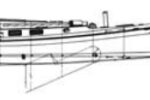
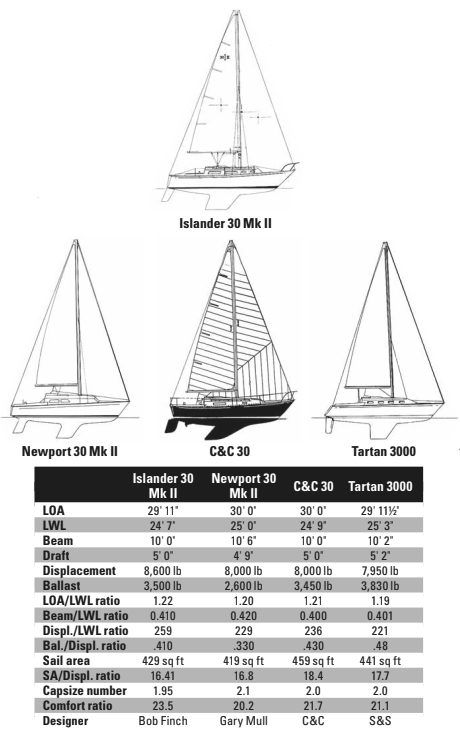
Initially, I was thoroughly confused about the Islander 30 Mk II and the Islander Bahama 30, but I finally determined that the Mk II is a slightly earlier version of the Bahama. The boats are virtually identical above the waterline but the Bahama appears to have slight modifications to the fin and rudder, although that may just be an error in the very small-scale drawings of the boats that I was able to find. The Bahama does have a very different layout and 20 square feet more sail area than the Mk II, along with 250 pounds less displacement and 180 pounds less ballast. This could give her a small edge in performance, although I expect it would be noticeable only in ghosting weather.
Both of these 30-footers are close in their characteristics to the other three yachts in this comparison. I would not want to be the man who had to handicap them for a race. A glance at the chart will show that all these boats are within inches of each other in waterline length and beam and very close in displacement and the other major factors.
It’s amazing that all of the four designers decided that a 30-foot sloop should have about a 25-foot waterline, 10-foot beam, 5-foot draft, and 8,000-pound displacement. The single anomaly is the Newport 30 with its much lower ballast ratio, which may have been done in order to obtain a lower racing rating. Whether her extra 6 inches of beam would add enough form stability to make up for the 33 percent ballast is doubtful and this could be to her disadvantage in heavier breezes.
The Tartan 3000, with her high ballast ratio and slightly deeper draft, could have an edge in average conditions but any of the five (if we include the Bahama 30) could be a contender in club racing. In any case, I am not going to go out on a limb and predict which yacht would perform best in light, medium, and heavy air as they are all as alike as peas in a pod. It could well come down to the hull and fin design as to which boat is the best performer and that information is not readily available.
Not Cape Horners
I would say that these yachts are not offshore voyagers though, definitely not Cape Horners. Still, I’m confident that many of them have made long and successful voyages, as have many less able vessels, but I doubt that is what the designers intended for their creations. In my opinion, the capsize screening factors are on the high side and the comfort ratios are on the low side for extended bluewater passages. It would take a strong, hearty, and experienced crew to take them through a really severe storm at sea and come up smiling. The true strength of these five 30-footers is daysailing, coastal cruising with family and friends, and club racing just for the joy of it.
However, these are all good old boats, with an accent on “old” and, for that reason, many of them are very competitively priced today, even bargain-priced in some cases. All were built to good standards originally. Indeed, Tartan has a long and excellent record for quality. Thus the buyer can be reasonably assured that these boats will be worth restoring if the purchase price is right or, if in pristine condition, be worth a serious look even if the price is slightly on the high side. If you can find one of these boats in good or restorable condition at a fair price, you will have the makings of a fine coastal cruiser and club racer. Be very sure to have a competent marine surveyor thoroughly check the boat over. Then try to hide that big smile as you sail her away.
Thank you to Sailrite Enterprises, Inc., for providing free access to back issues of Good Old Boat through intellectual property rights. Sailrite.com