Chrysler caterpillar turns into 22-foot butterfly
Issue 52: Jan/Feb 2007
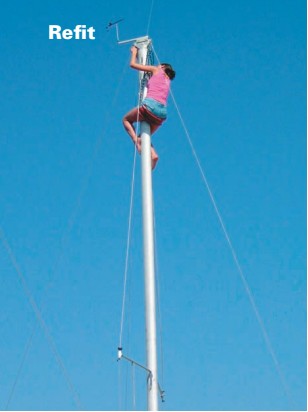
SARA WAS DANGLING FROM A BOSUN’S CHAIR HIGH ATOP THE MAST. Last night, Sara had gone to the prom. This morning, still wearing her fancy fingernail polish, she was trying to free the jib halyard and attach the wind-direction indicator. Sara is the best friend of my daughter, Katie, and was carefully selected for the task because she is so tiny, knows no fear, and is game for anything.
It started two years earlier with an email message from my friend, Steve, who runs an RV storage lot. He wondered if I would be interested in a free boat. My immediate response was, “What kind of boat?”
“A 1978 Chrysler 22 sailboat,” was his reply. “It’s been in my lot for four and a half years without moving,”
It was in awful shape. It had been parked under a stand of firs. The fiber-glass hull was dull and gray. Green algae stains were everywhere. The deck was covered by pine cones and needles; the trailer was covered in rust.
It was worse on deck. The wooden handrails and dropboards were dirty-gray. The hatch had been left open, and the boat was filled with 18 inches of green, slimy water. The interior woodwork was gray and weathered. The boom and other parts had been tossed randomly below. Everything was just plain dirty. She was a mess.
I thumped on the hull in several places; it seemed sound. “OK,” I thought, “I can clean and fix this boat up. After all, the price is right.”
Make an offer
Steve gave me the owner’s phone number. The owner went through the features and said he’d tried to give it to the Sea Scouts, but they took one look at the boat and decided it needed too much work.
“Make me an offer,” he said.
“I thought you were trying to give the boat away,” I said, somewhat surprised.
“Well, I was going to at least get a tax deduction from the Sea Scouts. Go ahead, low-ball me. Make me an offer.”
“How about $500?”
“Sold.”
It looked like I had a project on my hands.
I returned to the living room and sheepishly confessed to my wife, Connie. “I think I just bought a boat.” I expected an explosion.
“Good, you need something like that,” she said. “You spend so much of your time taking care of us, it’s about time you did something for yourself.”
That weekend my 13-year-old daughter, Libby, and I drove over to the seller’s house to give him a check and take care of the paperwork. We learned a bit about the history of the boat.
The seller had owned the boat for 21 years. He bought it when his daughter was 13. They had sailed it all over Puget Sound. Unfortunately, his marriage had dissolved. About 10 years ago he had remarried and his new wife hated sailing. The boat had become a bitter point of contention between them.
Monthly bill
In a fit of exasperation, he hooked his pickup to the boat trailer and towed it to Steve’s lot. There it sat for four and a half years. Every month they got a bill for the storage. Every month the wife seethed at having to spend $50.
“I am so tired of paying every month to keep that boat,” his wife had told Steve. “I would love to just give it away. Do you know anybody who wants a boat?”
The next day Libby and I piled into our Dodge minivan and drove over to Steve’s lot to bring the boat home. I backed the van up to the boat trailer and lowered the trailer hitch onto the van’s ball. I cranked down the trailer tongue. When I had cranked as far as I could, the front wheel on the boat trailer was still on the ground.
“Dad, look!” cried Libby.
The front wheels of the minivan were about 6 inches off the ground. This was obviously not going to work.
We unhooked the trailer and headed home. I needed to find someone with a big pickup. Peter, our neighbor across the street, volunteered the use of his truck. That worked just fi ne, and when we pulled up in front of my house with the boat in tow, I expertly backed (sometimes, you just get lucky) what seemed to us like a very big boat into the driveway. It filled the drive; it stood nearly as tall as our house. It is amazing how big a sailboat looks when it’s out of the water.
As I got out of the truck, Peter’s wife came to the door of their house. “Oh-my-god!” she exclaimed. “Does Connie know about this? When Peter said he was going to help you go get a boat, I thought it was, like, a little Boston Whaler.”
A gawking crowd
By this time, many of our neighbors had gathered in the front yard. There must have been a crowd of 20 people gawking at the Queen Mary blocking half of our driveway. I would not be able to park my car in the garage for a long time. Fortunately, Connie would still be able to get to her side of the garage. All this occurred while she was at work. I wanted to have the boat already stationed when she arrived. That way she couldn’t tell me not to park it next to her flower bed.
The real work began the following weekend. I started by scrubbing the boat. After years of neglect, just getting her clean enough to work on took an entire weekend. The following weekend I began removing what seemed like hundreds of gallons of water. At least I knew that her hull was watertight. I scooped bucket after bucket of slimy green water out and dumped it in the cockpit, which drained overboard. Then the real work began. Everything from the cabin sole up 18 inches was coated in slimy green algae. (Note: It’s far wiser to bail the boat before towing it. –Ed.)
I scrubbed and scrubbed. I borrowed all of Connie’s household cleaning agents in search of something that would remove the algae. Windex worked well. Algae removal took a full day.
Next was the job of cleaning the cabin enough to move around in it without getting dirty. Years of dust and dirt had accumulated. The cushions were a total loss, so I tossed them. The Porta Potti had been put away five years ago without cleaning. I cleaned it out only to discover that it leaked. It had to go too. I was the only one on the block with a Porta Potti on his Christmas list.
Caught the bug
When the boat was clean enough to crawl around in, Libby climbed up to see what I was doing. Incredibly, she caught the boating bug. She became an integral part of the restoration. She scrubbed and cleaned. She did all the brightwork. I was amazed at her level of interest. This was her boat.
The woodwork, what there was of it, was gray and dirty with age and exposure. I removed what I could and bleached it with Te-Ka to restore it to its natural color. I’ve tried several other products but found that the Te-Ka works best.
Te-Ka comes in two parts. Formula A opens the pores of the wood and draws out the dirt and grit. It’s amazing to see the grime come to the surface. Formula B neutralizes Formula A and restores the teak to its natural golden color. This took several applications. When we were done, the wood looked like new.
Once we had the teak restored, Libby took over and oiled all the woodwork with several coats of Deks Olje. The first part of the treatment restores the wood and preserves it; the second gives it a gloss finish that rivals varnish. The major benefit is that when it starts to show wear, you don’t have to remove the old coat. You just add a new coat over the old one. I discovered Deks Olje when I owned a teak-drenched Cheoy Lee and swore I would never use varnish again.
Now came the hard part. The fiberglass was dull and gray. I spent several weekends buffing it out and waxing it, using 3M Marine Fiberglass Restorer and Wax. I used the 09012 version, which is the heavy-duty oxidation remover. Rather than use a buffer, I rubbed it out by hand. I didn’t know what kind of condition the gelcoat was in and didn’t want to wear through it. That would have entailed an expensive refinishing project. The final result was that it looked like new. We were beginning to have a boat we could be proud of.
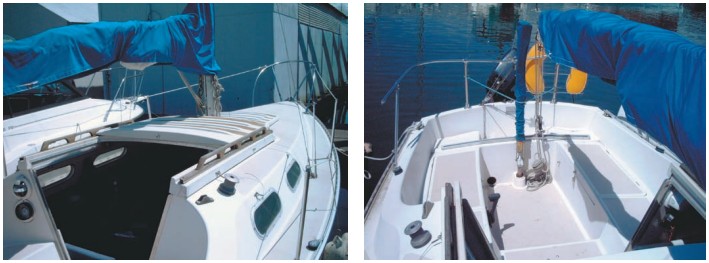
Presentable again
I’m sorry we didn’t think to take any “before” photos, because she arrived as a wreck. When we dragged her home, no one could imagine that she would look so good again. After three months of hard work, she was presentable. She wasn’t ready for sea yet, but the winter weather was setting in and I didn’t intend to work out in the cold and rain. Connie didn’t want the boat in the driveway all winter. She had been very patient with me so I relented and took her (the boat, not Connie) back over to Steve’s storage lot for the winter.
I wasn’t going to let the elements destroy our hard work. I bought a huge blue tarp and we covered her for the winter.
We had a boat-Christmas that year. On my list were a boathook, mooring lines, an air horn, a flare gun, and all sorts of other nautical paraphernalia. Santa was good to me. Everyone in the family got a life jacket too.
Late that winter, Libby and I went over to the RV lot to check on the boat. We were surprised to find the tarp full of water. The mast spanned the length of the boat and served as a center pole over which I had draped the tarp. As rain fell during the winter, it had accumulated in low spots on the tarp so I had two huge pockets of water on each side of the mast at the cockpit.
My first thought was to climb up the ladder and lift one edge of the tarp to let the water flow off. But there must have been a hundred gallons on each side of the mast. There was no way I could lift the edge. I needed a new strategy.
Untied the tarp
The next idea was to untie the tarp so it could move freely. Then maybe the water would shift and find a spot where it could flow off. As I walked around the boat untying the tarp, Libby climbed the ladder to check out the problem. As I untied the ropes holding the tarp down at the bow, the water shifted aft, the front of the trailer rose in the air, and the boat stood on her transom.
Libby was still standing on the ladder when this happened. A shift of 4,500 pounds of boat and trailer and several hundred pounds of water caused a violent alteration in the boat’s position. Libby jumped to save her life. She hit her hand on the way down but luckily suffered no permanent harm.
The final solution to the problem was to cut holes in the tarp where the water had accumulated. The water drained into the cockpit and overboard. This caused another violent reaction. As the water drained out, the stern lost all that weight. Finally, the trailer — boat and all — came crashing down. By some miracle, neither people nor boat suffered permanent damage.
When we got home and related the adventure to Connie, she told Libby, “If you are going to sail with your father, you are going to have to expect to get hurt.” That was the voice of experience speaking.
In the spring I had a chance to secure a slip in the Everett (Washington) Marina, so I grabbed it. The boat was a long way from being ready to launch, but I didn’t want to lose the chance to obtain dock space.
New cushions
We brought her back home in April. More hard work and expense was ahead of us. I had new cushions made for the cabin at a cost of $1,750. I checked out the mast, rigging, and sails. With the exception of a broken spreader, they all appeared to be in good condition. I was able to order a replacement spreader.
We still needed an outboard. I found an ad in the newspaper for a 20-year-old Mercury 10-hp motor for $500.
Libby and I painted and cleaned and scrubbed and prepped our boat all spring. In late May we were ready to launch her.
Our neighbor towed her down to the marina for me. Connie and Libby met us there. The yard hands picked her up with the lift and let us touch up the bottom where we had not been able to paint under the trailer’s rollers. Then it was time to commit her to the sea.
I climbed aboard. As they lowered us down to the water, I was nervous. Would she float? Sure enough, she did. No leaks.
My next problem was to get the outboard motor started so I could move the boat out of the way to clear the launch area for the next boat. I pulled and pulled on the cord to no effect. Finally, they used the little harbor tug to tow me to the guest dock where a crane was waiting to step the mast.
We rigged a sling on the mast and the crane hauled away. While one of the yardhands held it in place, I scrambled around attaching stays and shrouds. But some of the turnbuckles that attached the shrouds to the chainplates didn’t have clevis pins in them. I asked Connie to run up to the marine hardware store and buy enough pins to secure the mast. The guy working at the marine store was not very helpful, and Connie couldn’t find the pins.
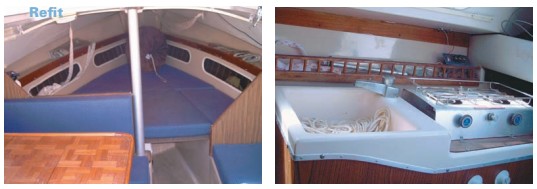
Got it secured
Before it was over, I had to leave the yardhand holding the mast in place while I ran to the store. We finally got the mast secured and the yardman and crane left.
Now we were alone on our boat with a motor that wouldn’t start. I went to work on the motor and finally got it going. We cast off our lines and headed toward our new slip. Then the engine died. We drifted in the marina while I tried to get it going again. I could get it to run for a minute or two at a time before it died again. We managed to get around the end float and start down our own row when the engine emitted a belch and a cloud of blue smoke, coughed a couple of times, then quit, never to run again.
Fortunately, there was a light breeze blowing us toward our slip, and we had steerageway. Connie took the bow line; Libby had the stern line. I managed to maneuver into the slip. Anyone watching would have thought we did this every day. Connie was an old pro from her sailing days early in our marriage, but Libby had never been on a sailboat before. It was all new to her. Just getting the boat safely moored was triumph enough for one day. I decided to tackle the engine problem later.
The next weekend was later. The engine was shot. It had virtually no compression in it. The repair shop said that they wouldn’t even work on it. “I’m not going to take your money when I can’t help you,” the owner said.
Needing a new engine, I looked around and found a 9.9-hp Evinrude for $1,000. The Evinrude would take cockpit controls. Since the boat had cockpit controls, I was happy that I wouldn’t be leaning over the sternrail working with the engine all the time.
Unfortunately, the cables from the cockpit controls had been cut. Of course, the outboard motor shop didn’t stock those parts, so I had to order them and wait weeks for delivery.
It took me all summer to get the parts, figure out how to install them, and, finally, to get the controls working. When I first hooked them up, if you pushed the throttle forward, the engine would go into reverse; if you pushed it backward, the engine would go forward. It worked well but was counter-intuitive. I got some help from Jeff at Olympic Marine and learned how to hook it up correctly. But now the motor wouldn’t go into reverse. Finally, I had to buy a new control box designed to work with the Evinrude. Eventually, I got the whole thing working.
Final obstacle
We were almost ready to sail. The last obstacle was the jib halyard. After we had the mast up and the boom truck was gone, I discovered that the jib halyard was all the way at the top of the mast. Somebody was going to have to go up there and get it. That’s where Sara came in.
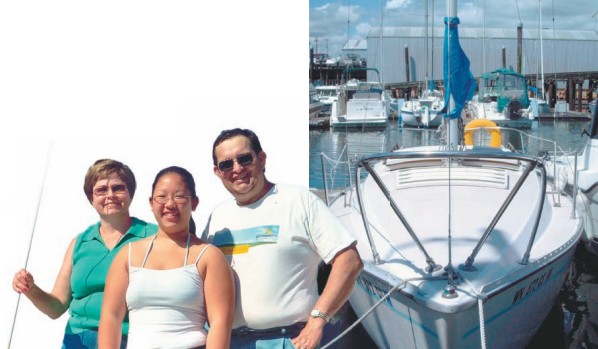
When we were finally able to go sailing, we had a family meeting to choose a name for our boat. The previous owner had never named her. That left us free to name her without incurring any of the bad luck associated with changing a boat’s name. She would be the Bonita.
In Spanish, bonita means pretty, and that she is. A bonita is also the smallest member of the tuna family. She was a small boat to us, particularly after having a 32-foot sloop as our previous boat.
Chryslers are not common boats in the Pacific Northwest. They were built in Texas for lake sailing. Instead of a trunk cabin, her cabin slopes into the foredeck. The Bonita has a white hull and light blue trim.
She is quite pretty under sail. She has a swing keel that I can’t get used to. When we are beating to windward there is a constant clunk-clunk-clunk as the keel works against its pivot bolt. She is stiff and a good sailor but is slow in light air. I don’t have a genny for her, but I think she would behave better with a genny when there is little wind.
A little cranky
With the swing keel and spade rudder, she is a little cranky to sail. She won’t track on a straight course for very long. You need to pay constant attention to the helm. On the positive side, she is very responsive and will spin on her keel. We have never had any problems tacking. She has quite a bit of weather helm; it takes a strong hand to keep her on course in a stiff breeze.
The Chrysler 22 is roomy belowdecks for a 22-footer. Because she was designed as a family cruiser, she has a pop-top cabin. The roof lifts up about two feet to give standing headroom below. Side curtains seal the opening.
In the forepeak there is a V-berth with a Porta Potti beneath it. Coming aft, on the port side there is a dinette that makes into a berth. On the starboard side is a settee. An ingenious sliding galley with a sink and two-burner alcohol stove slides back under the cockpit when not in use and slides out over the settee for cooking. It diminishes the space in the starboard cockpit locker and we haven’t used it yet, but somebody thought it was a good idea.
I am $3,500 and hundreds of hours of labor into my “free” boat, but she looks like a new boat and I’m sailing again. I wouldn’t have considered buying a boat at this time in my life if Steve hadn’t mentioned it. I wanted to get back into sailing but couldn’t justify diverting the money from the family. With one daughter in college and the other going next, we need the money now more than ever. However, Connie has been wonderfully supportive. She knows what sailing means to me and has been very encouraging.
Thank you to Sailrite Enterprises, Inc., for providing free access to back issues of Good Old Boat through intellectual property rights. Sailrite.com