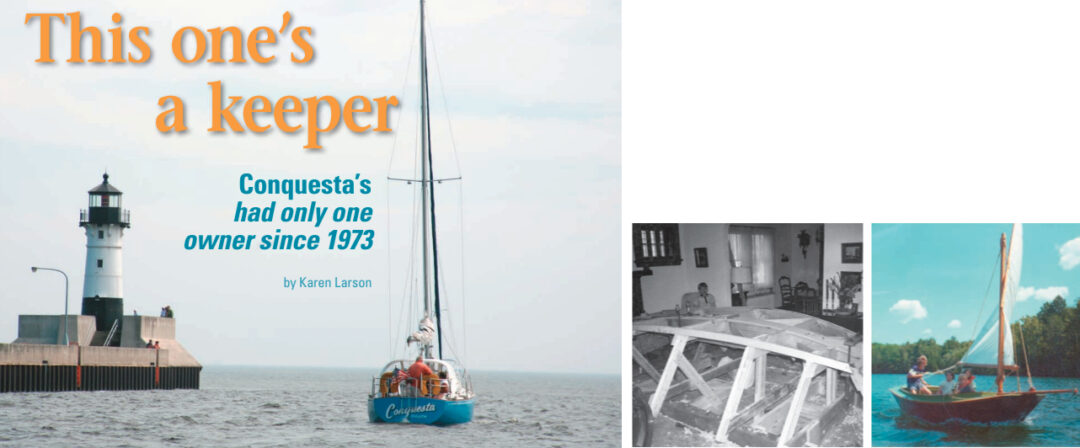
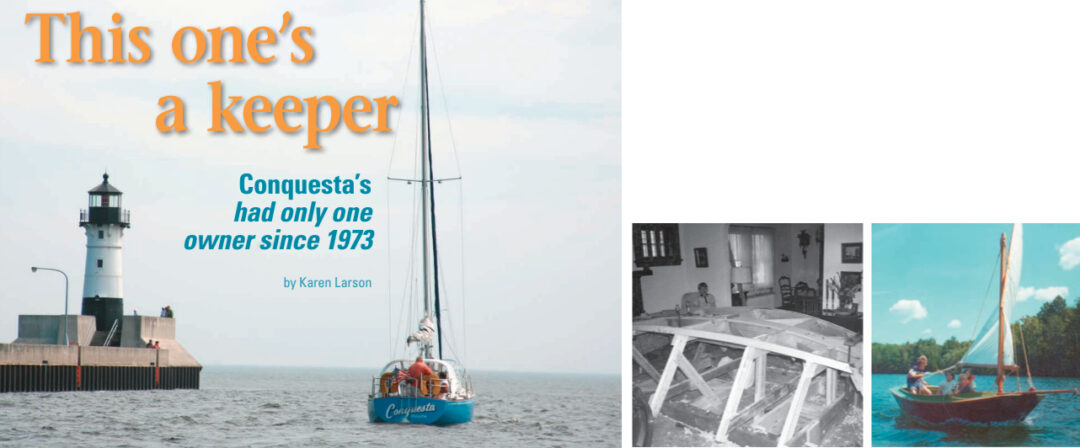
Conquesta’s had only one owner since 1973
Issue 53 : Mar/Apr 2007
Whether it’s salty or pure, water has an undeniable attraction. It enchants and draws children and adults alike to its shores. And then it beckons them farther . . . farther . . . to the shore beyond . . . to the distant horizon. Sailing dreams are made of this. Sailors are born when the water’s magical lure draws them in and captures a portion of their minds. For many, the enchantment lasts forever.
We were not surprised, therefore, when Derrill Adatte told us that because he had grown up a few blocks from Lake Superior’s shores as a kid, he was always working one scheme or another to get afloat. Anything that did float or might float was considered. It didn’t matter as long as it could be paddled, rowed, or sailed. There was a concrete manufacturing plant nearby. Derrill says he made one of his earliest vessels out of one of the company’s discarded mudboxes.
“It sank immediately,” he remembers with a laugh.
His interest in boats and the water did not sink with it. Upon returning from the Army in 1946, he bought a cabin on a lake and put his heart and soul into the many projects that improve a cabin and make it a home away from home, according to his wife, Mary. That — plus a career and a young son — kept him busy for a time. The career involved the purchase of a Duluth, Minnesota, plumbing and heating company, A. G. O’Brien, which is now run by Derrill’s son, Derrill John, and his wife, Liz. “These days we do sprinkling, in addition to plumbing and heating,” Derrill John tells us . . . fire sprinkler systems, that is.
Living-room boat
Finally, in 1967, Derrill built a San Francisco Pelican in his living room. (For more on the Pelican, see the May 2006 article in Good Old Boat.) As a woman who will give up her rights to the living room for an entire winter, Mary deserves extra credit. Upon meeting her, Jerry and I liked her immediately. Mary is the sort of person who knows no strangers, embracing all as friends. Over the years she has cheerfully gone on any number of family sailing missions.
The family Pelican has a story all its own. It went on many a sail on Lake Superior before it was retired to a smaller lake where the cottage is located. Eventually it was given to a friend and from there to another friend. Derrill never really lost track of it and was inspired last year, after reading about the Pelican in Good Old Boat, to retrieve it, restore it, and launch it once more at the cabin where it belongs. He was 85 at the time and the Pelican was 39.
There was also a Montgomery 12 and then later a Montgomery 17, both of which spent much of their time at the cabin, although the 17 spent one winter vacation in Florida. A company was hired to take the boat south. The Adatte family would follow a few days later. You can imagine their surprise when, as they were driving south, they were passed on the highway by their own boat!
There was a near miss with a Cal 20, offered for sale by a Duluth broker. Derrill had already made an offer and signed the paperwork when Mary suggested that a larger boat would have more accommodation space below. The broker was able to change the deal to an order for a new 1968 Cal 25. They sailed the Cal for several years before selling it and “sitting on the beach,” as Derrill puts it, for about a year while waiting for his brand-new Islander 30 to be delivered. “I ordered it in January,” he says. “It arrived in August.”
Robert Finch design
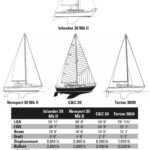
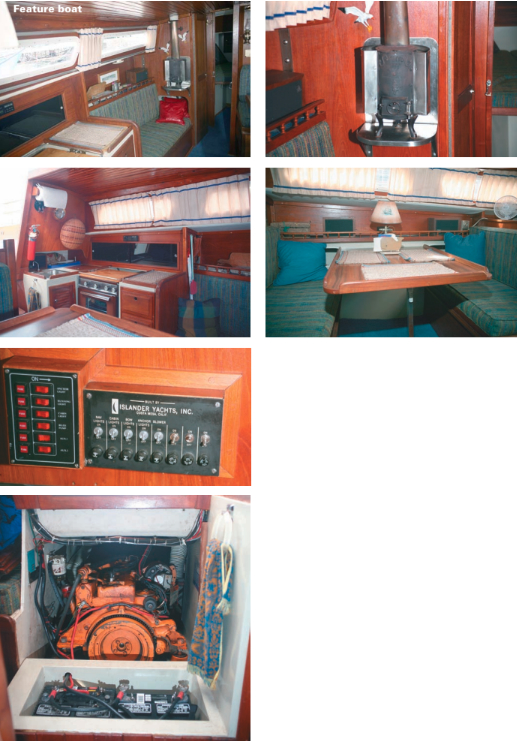
The Mark II version of the Islander 30 was built to the IOR rule at the Costa Mesa, California, Islander plant. (Islander later moved to Irvine, California.) It was designed by naval architect Robert Finch, who drew a number of Islander boats but seems to have slipped into relative obscurity since then. The sales brochure for this boat says, “In this boat, Robert Finch proved that a 30-footer designed to race under the new IOR rule could have a spacious interior that appealed to those who like more than their share of comfort when the anchor is dropped and the sails are furled.”
As it turns out, Robert Finch was drawing this boat just for Derrill Adatte. While Derrill had not hung on to any boat for long until this time, he bonded with his Islander 30 and has remained as her fi rst and only owner all these years. Wednesday night is race night in the waters near the twin cities of Duluth/Superior. And Wednesday nights became a traditional time for both Derrills and their friends to meet at the boat. Even if the weather caused the race to be cancelled, the gang had a lovely cabin below in which to pass some time together.
Now both Derrill and Mary ask why anyone is interested in the newer racing sleds. As they point out, they cost a lot of money. You can’t cruise in them. You can’t spend time with the race crew down below before or after a race. “They may be fast, but they’re just expensive daysailers,” Derrill concludes. These new sleds are certainly not the boats of his dreams.
Raceboat name
The boat of his dreams was to be named Conquesta. These days he can’t remember exactly why he selected the name. He figures it had to do with her intended use as a raceboat. It is a name incorporating a certain amount of racing bravado. But, in addition to racing, most summers he and the family cruised to the Apostle Islands, about a 12-hour sail away from Duluth. And while Derrill participated in four Trans-Superior International Yacht Races on other people’s boats, he did not enter Conquesta in one of these races between Sault Ste Marie, at the eastern end of Lake Superior, and Duluth, at the far southwestern corner, the longest freshwater sailing race in the world.
Boats were simpler in the 1970s, the Adattes remember, and as her first owner, Derrill has had no reason to curse a string of previous owners for modifi cations and “improvements” made over the years. In fact, since he has done very little to change her since her purchase, Conquesta might be thought of as a time capsule of sorts.
“In 1973 there were no interior electrical options,” Derrill says. ”There was no shorepower.”
These days the boat does have shorepower and a few more additions required by those who sail on a cold lake: an electric heater for use at the dock and a Tiny Tot wood-burning stove for use when cruising. Derrill added a wheel, but the tiller it replaced remains in sight in the V-berth for use at a moment’s notice as an emergency tiller. He had a load of cedar, intended for use as a dock for the cabin, which he instead installed in Conquesta’s overhead 20 years ago. And her blue hull has been repainted once.
Needless purchases
He bought her an autopilot but never installed it. “Who needs it?” he asks. Ditto for a cockpit barbecue. It’s still in its original packaging sitting on a shelf in the basement next to the autopilot he says.
The original engine is still in the boat too, of course. And it’s a bit of a rarity these days. It’s a Palmer Marine 4- cylinder flathead, a 16-hp gasoline-powered engine similar to the Atomic 4. Before our visit for a photo session, the crew had a moment of anxiety when the engine failed them, causing them to consider canceling our visit. Water had gotten in the fuel through a leaking deck-fill port. This was immediately repaired and our date was kept. “It occurred to us then,” Derrill John says, “that there aren’t very many hours on that engine, in spite of its age.”
Perhaps the big investments were made in sails. The family teases Derrill about the many sails Conquesta owns. She clearly has one for every occasion, in spite of the fact that he did succumb to the temptation of roller furling some time ago. The smaller jibs were only used under duress, apparently. As Mary recalls with a twinkle in her eye,
“We always flew the 170, didn’t we, dear?”
For those with roller furling, a quick note from your editors who are nearly the last sailors on earth with hanked-on sails: the deck-sweeping large-overlapping 170 (much larger than the mainsail) is meant to be a light-air sail. These sails are roundly dismissed by the sailing press these days as something no sailor should or would actually employ. They’re much too large, we’re told. Jerry and I dearly love our 170 and wouldn’t trade it for the world . . . but then we don’t consider everything written in sailing magazines (including our own) to be the final word.
Good reacher
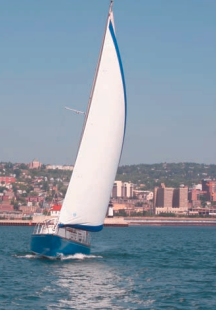
Over the years, Conquesta has been competitive. Although she is not usually first around the buoys, she gives those who get there first cause to look over their shoulders often. “She is a good reacher,” Derrill John says fondly. “We did well in the Wednesday-night family racing, and we loved it. We weren’t first, but we were consistently close.” Although they’re not racing as much these days, the gang still shows up at the boat on Wednesdays. It has become routine.
They remember a summer series for which they removed the settee cushions and other unessential boat parts in order to save weight. One crewmember’s wife wanted to come along on the race, but they refused on this occasion. They laugh as they recall the incident. After removing everything else, they simply couldn’t justify taking on the extra weight.
One member of the crew has been there practically as long as Derrill John can remember. Jim Yorston became a friend of the senior Derrill long ago as a supplier to the family plumbing and heating business. He is still a supplier, and he is still a member of the Conquesta crew. Exaggerating only a little, Derrill John says, “I was still pushing Tonkas around the driveway when Jim came around. And he stuck.”
Like so many others who are part of the extended family of crewmembers, he’s also available in the spring for the pre-launch work and in the fall when the season’s over. On the day of our photo shoot, Jim arrived to help trim sails. While waiting for the weather to clear following a morning rain shower, the rest of us spent time in the cabin, but Jim was never still. He wiped the deck and seats dry, treating Conquesta as if she were his own. Until recently he owned a 1976 Islander 30; perhaps this sort of work is therapeutic for one who is currently boatless.
That same loyalty exists in the hearts of both Derrills as well. It is rare that a boat from the 1970s has remained in one family, I point out. Rare indeed. I ask Derrill why he never traded her for another.
“Maybe I’m too easily pleased,” he says after pondering for a moment. But I don’t think that’s it.
Derrill John has two children. Perhaps the tradition will continue.
Thank you to Sailrite Enterprises, Inc., for providing free access to back issues of Good Old Boat through intellectual property rights. Sailrite.com