Forecast a boat’s performance by reading between the lines
Issue 22 : Jan/Feb 2002
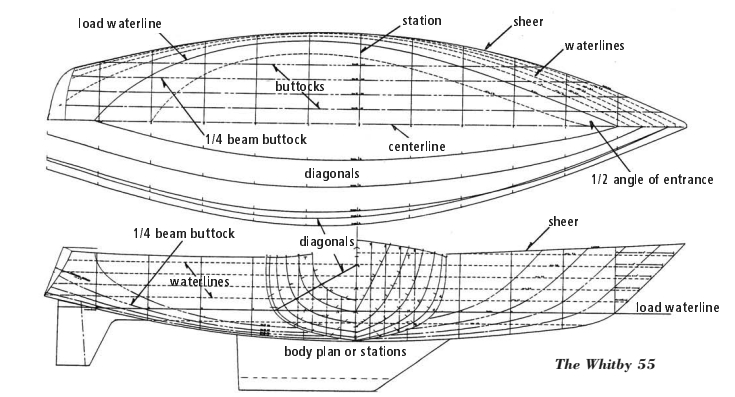
I trust that readers will appreciate the problem confronting the yacht designer. He has a two-dimensional sheet of paper in front of him, but upon it he has to draw a curvaceous three-dimensional object in such a manner that a boatbuilder can replicate it accurately. Adding to the dilemma is that the drawing will be only 1⁄12 to 1⁄32 the size of the actual vessel; a problem indeed.
The lines drawing of the Whitby 55-foot ketch is shown above. It was drawn about 18 years ago, to a scale of 3⁄4″ = 1’0″, or 1⁄16 actual size. Upon it, I’ve outlined the various lines that the designer uses.
The sheer is, of course, also the deck edge. The centerline is the longitudinal center of the yacht. Between these points, the hull is sliced up like a wedding cake to show the builder the actual shape and to permit the designer to complete his hydrostatic calculations.
The waterlines are like the layers of the cake; the buttocks and sections are like slices cut from it. The diagonals are as if some drunken wedding guest sliced the cake at rather strange angles. Each type of line has its story to tell the initiated. You’ll note that the drawing shows only one side of the yacht. In the Whitby 55 drawing, the waterlines show the port side, the diagonals reflect the shape of the starboard side, and the body sections show the forward half of the vessel on one side and the aft half on the other. Only one side is shown because the designer hopes and prays that with skill on the builder’s end, and perhaps a lot of luck, both halves of the yacht will turn out to be mirror images of each other. It doesn’t always happen, unfortunately, but mistakes are rare. Let’s consider the lines one at a time.
Waterlines
These are horizontal slices through the hull, usually evenly spaced, that show the shape of the vessel (looking down on the craft) from the sheer, or deck edge. The load waterline (LWL) is that waterline (WL) at which the designer hopes the boat will float if all his calculations are correct. On the 55, there is only one WL shown below the LWL as the hull is of rather light displacement. There may be several WLs below the LWL on heavier displacement craft or even on lighter yachts if the designer is not lazy and reduces the spacing of the waterlines below the LWL.
I was lazy, and besides, another WL would not have told me anything about the boat I didn’t already know.
Basically we have three forms of LWL shape (see diagram on Page 18). The “cod’s head and mackerel tail” dates from the 19th century and earlier and featured a fairly blunt bow shape and a fine stern. The Brits still favored it, with modifications, until the Sceptre fiasco in the 1958 America’s Cup Races. It didn’t work. ’Nuff said, but you’ll still see a few 1970s and older British designs with this hull shape, full forward and finer aft.
In the 1930s, the “balanced ends” or “symmetrical” model came into favor, particularly in England. These were craft with a finer bow and more fullness in the stern. While the form seemed to have produced an easy helm, one that did not pick up excess weather helm even when heeled, the boats were not particularly fast or weatherly. The term “weatherly,” incidentally, relates to windward ability, and has nothing to do with seaworthiness.
The “wedge shape” is the contemporary form of load waterline and has been used in North America since before the turn of the century. The bow entry is fine, the widest section is well aft, at about 55 percent of the LWL, and the stern is fairly full. Tank tests at the University of Southampton of models of the Rhodes-designed Weatherly and a symmetrical hull showed the former to pitch less in a seaway and to be definitely superior in weatherliness and steering.
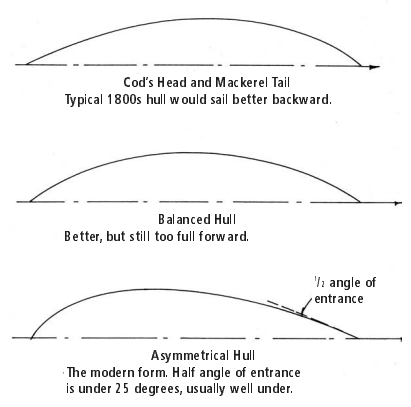
The half-angle of entrance (the angle that the LWL at the bow makes with the hull centerline) has fined up in recent years and, while angles of 24 to 25 degrees or more were common in the 1960s, the usual cruiser today will have a half-angle of entrance of 20 to 21 degrees (the Whitby 55’s half-angle is 21 degrees). High-performance yachts will show even less, perhaps as low as 15 to 16 degrees. The waterlines forward should be straight or slightly convex and excess hollow should be avoided where possible. Too much hollow forward means even greater angles further aft where the waterline swells out to maximum beam, and this increases resistance in the long run.
Craft with a plumb stem and deep forefoot, such as catboats and some clipper-bowed vessels, require hollow in the forward waterlines, but these are exceptions to the rule in order to avoid overly full diagonals. The entry of such yachts should be kept as fine as possible so the diagonals can be kept fair without the use of excess hollow in the waterlines.
The waterlines in cruising yachts will become increasingly full as they approach the sheer, of course. Many racing craft tend to have quite fine decklines due to stupid rating rules or an attempt to keep the ends super-light. However, cruisers do need some fullness in the ends to provide reserve buoyancy to keep the decks dry in a seaway and to lift the weight of the stores, gear, and ground tackle that such craft usually carry in the bows.
Buttocks
Buttocks are evenly spaced longitudinal slices through the hull. The centerline (CL) is actually a buttock at zero distance while the other buttocks will be spaced at equal intervals of from six inches to several feet out from the CL, depending on the size of the craft. The buttock lines that interest us most are the “quarter-beam buttocks,” those in the aft quarter approximately 25 percent of the beam out from the centerline.
Contemporary sailing yachts, even the older mid-1980s Whitby 55, show long and easy buttocks indeed when compared to yachts of the 1950s to early 1970s. Modern racing yachts with remarkably wide, flat transoms have even flatter buttocks and can achieve extremely high speeds when reaching. The owner of my 60-foot Wild Thing reported that she hit 22 knots at one time and that speeds of 20 knots were not uncommon!
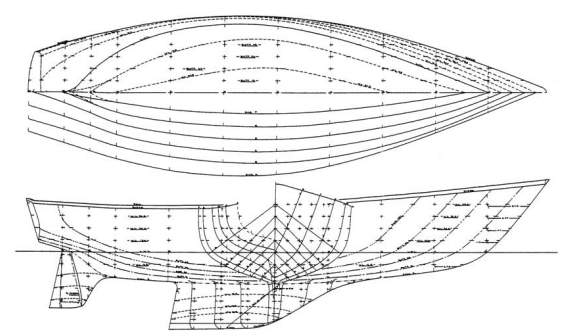
More moderate craft with heavier displacement will show greater rounding in the buttocks aft, but it is desirable to keep the angle to the horizontal as low as possible. In general, it’s considered that separation of the water flow begins when the buttock makes an angle of 15 degrees to the horizontal. At that point the water separates from the hull, creating turbulence and resistance. The further aft the buttocks can be carried before this 15-degree angle shows up, the less separation there will be and the less turbulence will develop, with lower resistance as a result. “Bustles” were developed in the late 1960s and early 1970s and will be seen on many yachts of that era. This flattened the buttocks and moved the point of separation as far aft as possible in order to reduce resistance. I still like to fit a small bustle to a heavier displacement design.
Very husky double-enders, such as the Tahiti ketch and old Colin Archer designs, had heavily rounded buttocks aft. This produced a slow boat due to the short and steeply angled buttocks. In addition, such end shapes tend to lack reserve buoyancy and may be prone to pooping in extreme sea conditions. I’ve been pooped once, on the way to Bermuda, and I didn’t like it!
Diagonals
Diagonals are primarily fairing lines that assist the designer and builder in assuring that the hull lines are lofted full-size with accuracy. The shape of the diagonals will vary with their angle and their location in the hull. The vital thing is that they should be fair, sweet curves without humps or hollows. Still, diagonals that are drawn in at a steep angle and close to the hull centerline will always reflect the shape of the craft’s ends. If the boat shows a hard-knuckled bow or a deep bustle aft, the diagonal will reflect this and can be disregarded as to its influence on the yacht’s performance.
Diagonals tend to show the flow of the water when the yacht is heeled under sail, and I always trusted the diagonals to show me that my hulls were sweet and fair. I probably depended on them more than many designers, and I think the Whitby 55’s lines show this. One of the greats, Knud Reimers, actually designed some of his yachts using only diagonals as fairing lines, no buttocks or waterlines except the LWL and centerline, of course.
A point to note is that many modern computer hull-fairing programs, like the AutoYacht program I use, do not show diagonals at all. I trust the program to properly fair the hull, within reason, but I would still prefer to see the diagonals when designing certain types of vessels. A plumb stem and deep forefoot, found on a catboat or a traditional clipper-bowed craft, can produce some oddly blunt shapes indeed in the forward end of the diagonals.
Sections or body plan
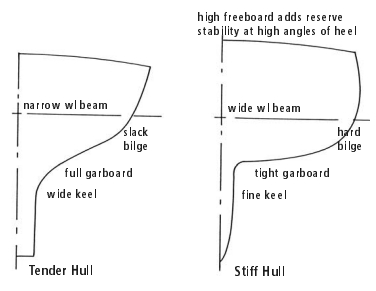
The form stability of a yacht increases with an increase in beam. However, hulls of similar beam can vary widely in form stability; one with great flare in the topsides and a narrow beam at the waterline will not have the stability of the yacht with relatively vertical topsides that carries its beam well down to the waterline. Of course, stability is a product of the displacement times the righting arm, so modern light displacement craft require greater beam and harder bilges in order to obtain the form stability, the righting arm, necessary to compensate for their lighter displacement.
Stability is also greatly affected by the underwater hull shape. Hard bilges and low deadrise angles add to form stability while soft bilges, deep deadrise, and a slack garboard indicate a more tender hull. But bear in mind that the hull shape is not the sole criterion for judging stability — the yacht’s displacement, the amount of ballast, and its location are also major factors and must be given equal consideration with beam.
Indeed, a narrower hull of husky displacement and proper ballast may have a righting moment at certain heel angles that is roughly equal to that of a beamier, lighter vessel. She will also have an easier motion in heavy seas and be kinder to tender tummies, as the narrow vessel will scend (an upward motion on waves) more slowly and will roll more slowly but, perhaps, to a greater degree. On the other hand, if the vessel is narrow and of very heavy displacement, she may be like a half-tide rock, scending so slowly that she is washed by every big sea that comes along. There is a happy medium!
The narrower hull does tend to “roll in” when she heels in a stiff breeze, and this keeps the rudder in the water where it should be. The beamy, hard-bilged hull “rolls out” as she heels, lifting her weather side well out of the water, and this may bring the top of the rudder close to the surface into turbulent, aerated water.
Then control is lost and a spectacular broach may result; the kind of action picture beloved by marine photographers. Nevertheless, the narrower hull, when running free under spinnaker, can develop an unnerving oscillating roll. The form stability of the beamy, hard-bilged hull tends to dampen out that type of roll.
The shape of the stern quarters is an important consideration also. Narrow hulls that sail at larger heel angles should have greater deadrise aft and slacker bilges in order to reduce turbulence and drag when heeled. Beamier hulls can employ flatter deadrise to increase stability as the yacht heels to the breeze. However, I do feel that many contemporary yachts have carried their beam to an excess aft in order to provide additional sleeping kennels, also laughingly called “state-rooms,” in the stern. The result is a yacht that may tend to nose-dive as she heels, dipping her bow and creating difficult steering when driven hard.
In effect, every design is a compromise of features, and no single design can be all things to all skippers. When you’re in the market for your next yacht, it will pay you to have learned all you can about hull design and hull shape so you can make the best possible choice. Even though you may not be able to get a copy of her lines drawing, you should be sure to see the vessel hauled out. Use your eyes to imagine the run of her waterlines, buttocks, diagonals, and the shape of her sections. Try to imagine how these will affect performance, stability, and comfort.
Ted is one of North America’s best-known yacht designers, having worked on America’s Cup boats and on boats that won the Olympics, the Gold Cup, and dozens of celebrated ocean races.
Thank you to Sailrite Enterprises, Inc., for providing free access to back issues of Good Old Boat through intellectual property rights. Sailrite.com