This pioneer brought many early fiberglass production boats from design board to dockside
Issue 22 : Jan/Feb 2002
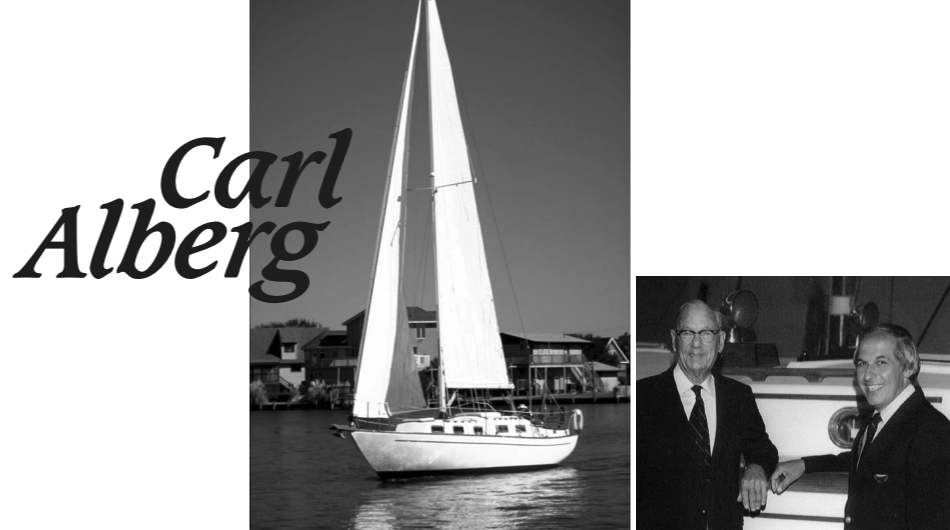
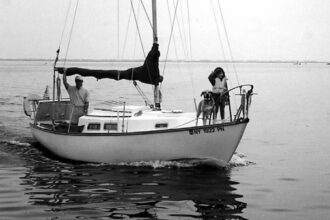
Many sailing enthusiasts can immediately spot an Alberg-designed boat. Characterized by a spoon bow, pleasing sheer, moderate overhangs, a distinctive wooden cockpit coaming, and pedestal- mounted winches, Alberg boats convey a traditional and
pleasing look. Carl Alberg brought many of the first
production fiberglass cruising sailboats from design board to dockside.
In fact, Carl Alberg influenced a whole new generation of sailors. During the 1930s and 1940s he established a solid reputation with his work at the John Alden company. Later with his own company, he designed many mid- to large-size wooden yachts for wealthy clients.
His work from the late 1950s through the time of his death in 1986 was for a whole new market — the middle-income sailor who may have been new to sailing or was perhaps upgrading from smaller daysailers or racers. Carl’s legacy for these sailors was a well-found, well-designed, quick cruising sailboat that could provide a safe and exciting family sail without the threat of easy capsize, a boat that would attract admiring looks wherever she went, a boat that any discerning owner would be most proud to own. Carl Arne Alberg may be no longer with us, but his designs live on.
Born April 11, 1901, in Gothenburg, Sweden, he was the son of Alma Larsson and Carl Alberg, a Gothenburg merchant. Carl and his brother often sailed in Gothenburg’s harbor with their father. Of his home he said, “The harbor was always filled with ships and boats of all kinds, and when we weren’t sailing there, the family usually vacationed on an island off the coast where my father, brother, and I used to race each other in small sailboats.”
Perfect bow
Yacht design was on Carl’s mind even as a youth. In 1913, four years prior to his admission to college, he wrote of the difficulties of choosing the perfect bow design: “The problem is the eternal one, to eliminate the faults of the two extremes (fineness and fullness) and combine as much as possible their two good points.” In 1917, Carl entered the Chalmers Institute of Technology, in Gothenburg, where he studied naval architecture and marine engineering until 1919.
By 1925, Carl had emigrated to the United States and moved to Lynn, Mass., where he found work as a rigger for General Dynamics in nearby Quincy. Andrew Vavolotis, founder of the Cape Dory Yacht Co., and now president of Robinhood Yachts, relates: “Carl worked with the master shipwright, Brorr Tamm, while he was working in Quincy.”
Later, Carl worked for the Lawless Boatyard in Neponsett, where he met John Alden, who hired him as a designer after seeing some of his drawings. Carl said: “I enjoyed working with Alden very much. He was a wonderful guy, pleasant, calm, never getting excited, and I learned quite a bit from working with him. His designs were conservative. He concentrated on seaworthiness, comfort, and boats that would sail on their bottoms, and that’s pretty much what I’ve tried to do with my boats.”
Carl was responsible for Alden design #583, a schooner built in 1934. In 1937, Malabar XI, yawl rigged, a slightly modified 583, was built for John Alden’s own use. This boat turned out to be a fast one, coming in second in Class B in the 1937 New London to Gibson Island Race. In 1938, Carl designed White Wings, a gorgeous 50-foot sloop built by J. J. Taylor and Sons, of Toronto, for Percy Grant of the Royal Canadian Yacht Club. This was the first Canadian boat to win the coveted Lake Ontario Cup.
A better ketch
Carl also designed John Alden’s ketch, Malabar XII, which was built in 1939. While many of Alden’s earlier Malabars were schooner rigged, at this time Alden felt that the “Twelve” was right for a ketch rig since “a ketch of this size can have less sail than a schooner of the same model, and yet be just as fast.” In 1941, when asked to recommend a design for long ocean passages, the “Twelve” was Alden’s choice.
Immediately after Word War II, Carleton Mitchell bought Malabar XII, renaming her Carib and cruising her extensively in the West Indies. Malabar XIII, design #756, also came from the drawing board of Carl Alberg. This boat represented a compromise by Alden between racing efficiency and ease of handling by a small crew. In 1948, under the ownership of Morgan Butler, Malabar XIII won her class in the Newport-Bermuda Race.
Another of Carl Alberg’s classic designs in wood for Alden was Tioga Too, a 53-foot yawl commissioned by well-known New England sailor Harry E. Noyes, who specifically asked Carl to design her lines and other plans. Built in 1939, Tioga Too was known for her graceful sheerline, low cabin trunk, and her long, well-balanced ends. The bow was particularly handsome with its clipper profile and decorated trailboards.
When World War II broke out, Carl temporarily left Alden to work for the U.S. Navy in their Charleston, Mass., naval shipyard. Following the war, he once again designed boats for Alden, including a Hinckley 21.
In 1946, Carl left the John Alden company and set up a design shop for himself at 131 State Street in Boston, Mass. For three years, Carl designed wooden boats, such as the Sea Lion and an Alberg 46-foot ketch, but business slowed down, and Carl returned to the Charleston Naval Shipyard for a six-month period during the Korean War.
There he was offered an opportunity to work for the U.S. Coast Guard, where he became chief marine engineer/architect for 10 years. During this period of his life, Carl focused much of his energy on his Coast Guard work. He was also devoted to his family: wife, Irma; daughter, Corrine; and later his grandson, Kaifser Burril . . . all avid sailors.
Fiberglass transition
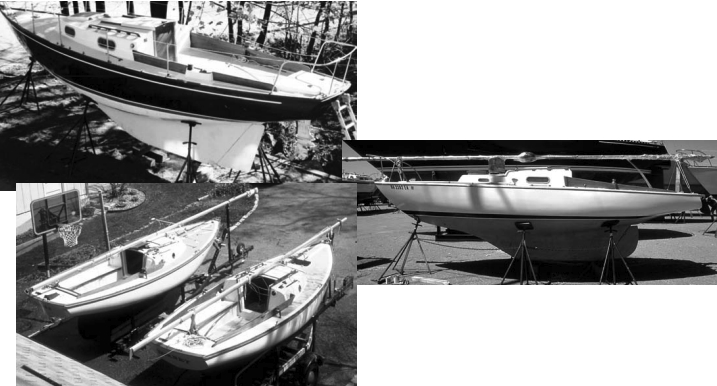
Carl made the transition from traditional wooden sailing yachts to fiberglass sailboats in 1958. Everett Pearson, co-founder of Pearson Yachts, remembers, “Tom Potter, who had been working at the American Boat Company, in East Greenwich, R.I., builders of the 23-foot Alberg-designed Sea Sprite, came to us and asked if we would be interested in building a 28-foot Alberg-designed cruising sailboat. This was in the spring of 1958, and we introduced this boat as the Triton at the New York Boat Show in January 1959. Tom Potter convinced us that Carl Alberg was a competent designer with a great deal of experience gained from working with John Alden. His designs were conservative cruising boats, so the conservative cruising sailor would accept them. The first plans we had of the Triton were for wood construction.”
Tom Potter was involved in the early days with the Pearson cousins. “Carl worked for John Alden toward the end of John’s life,” he recalls. “He did designs, many of them magnificent. We found him designing ammunition boxes for the Coast Guard. The Triton got us going . . . he built himself a well-deserved reputation from the boats he designed for us. We must have made thousands of Ensigns. His success with Pearson led to his success at Cape Dory. At Pearson we designed and built the Tritons first. We hoped to sell six, and we actually sold about 800! That really got us going. I put up the money for the tooling for the Triton . . . after the Triton came the Ariel and its daysailing version, the Commander, as well as the Electra and its daysailing version, the Ensign.”
Work with Pearson Yachts was seminal in Carl’s career; the popularity of the Triton brought him into the yachting limelight. The Pearson story has been told in an earlier article in Good Old Boat (November 1999). The Pearson cousins were planning to build dinghies and powerboats until Tom Potter approached them with the suggestion to have Carl Alberg design them an affordable medium-size fiberglass cruising sailboat. The Triton has been heralded as the first mass-produced fiberglass cruising sailboat. Clint Pearson remembers that in March of 1957 he had 12 men working in his garage boatworks. In June of 1957 Everett joined him, and production took off with the introduction of the Triton.
A bit stubborn
“Carl’s most significant characteristic was a sense of stubbornness in defending his designs and opinions,” Everett Pearson remembers. “We asked Carl to reduce his royalties as the volume of business grew, as the Grumman people (who by then owned Pearson Yachts) thought Carl’s fees were excessive. He was making three to four times what anyone else in the business was making, and other designers would work for far lower fees. That’s why we went to Bill Tripp for the Invicta, and Phil Rhodes for the Vanguard. We later hired Bill Shaw to create our own design team and eliminate paying royalties.”
Clint Pearson says of Carl, “He was very easy-going, kind of quiet, with strong ideas . . . he was a good guy to work with.” Clint believed his designs provided easily handled boats and rigs: “They won’t get you in trouble, plus his boats provided good speed and stability.”
Carl designed the 19-foot Bristol Corinthian (Good Old Boat, September 2001) as well as the Bristol 27 (March 2001). In addition to his work for Pearson Yachts and Bristol Yachts, Carl Alberg also designed two boats for Whitby Boat Works, an Ontario, Canada, yachtbuilder.
In 1961, a number of yachtsmen from Toronto, Ontario, approached Kurt Hansen of what was then Continental Yacht Sales (later Whitby) looking for a 30-foot fiberglass yacht for club racing. Kurt contacted Carl late in 1961. He developed a design that both thought would sell well in the United States and Canada.
Carl based this design on the heavily built Odyssey boats, and construction started on the first ones in 1962. Another group of 25 from the Chesapeake Bay also was looking for a 30-footer for club racing. When these sailors heard that a Canadian manufacturer of a popular well-built 24-footer was building a 30-footer, they sent members Bud Tomlin and Boyce Beville to Ontario to check it out. Two major groups of buyers, the Great Lakes Toronto-based members and the Chesapeake Bay group, became the first buyers of the new, superbly designed and built Alberg 30. Almost 40 years later, nearly every one of the original Alberg 30s is still enthusiastically raced and cruised. (More on the Alberg 30 in the November 2000 issue.) Whitby also built the Alberg 37, a boat designed for offshore cruising.
Carl Alberg’s last large and loyal client was Cape Dory Yachts. In 1987, one year after Carl Alberg’s death, the Cape Dory catalog offered these Alberg designs: Cape Dory Typhoon Senior, Cape Dory 26, Cape Dory 28, Cape Dory 32, Cape Dory 33, Cape Dory 36, and new for 1987, the Cape Dory Custom 40. (Several Cape Dory designs are featured in previous issues: 30 in June 1998, Typhoon in November 2000, and the 25D in May 2001.)
In 1986, after a long and fruitful life, Carl Alberg died in his adopted home, Marblehead, Mass. Bill McGrail, of Marblehead, remembers: “Although I was a member of the Boston Yacht Club with Carl Alberg, I met him only a few times. He was not a man about whom stories were told. He is perhaps best remembered by his work.”
Scott and wife, Nan, enjoy camping, canoeing, and sailing in Ontario. They are members of the Rocky Fork Sailing Club, in South Central Ohio where they sail a Bluenose sloop. Their last boat was a Pearson Electra; their first, a Catalina 22, Cat Dancing. For 15 years they have sailed on the Great Lakes and the sounds of the Outer Banks, North Carolina.
Thank you to Sailrite Enterprises, Inc., for providing free access to back issues of Good Old Boat through intellectual property rights. Sailrite.com