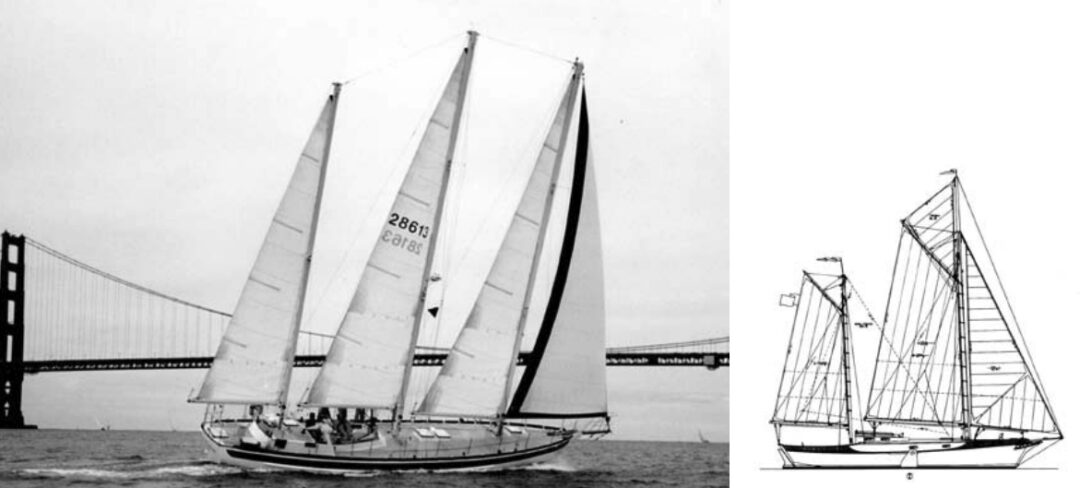
Solutions to the problem of sailing in thin water
Issue 19 : Jul/Aug 2001
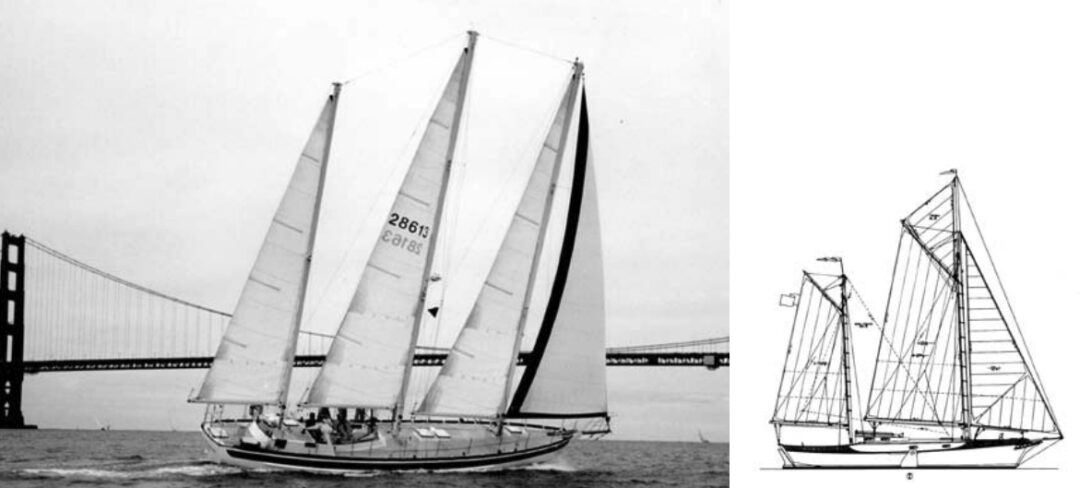
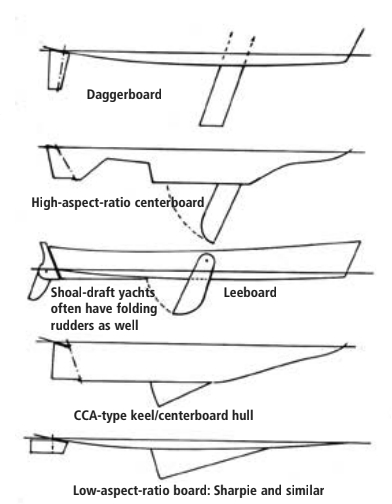
One answer to obtaining both shoal draft and good sailing performance is the centerboard, and boards have been fitted to every type of yacht, from dinghies to workboats to ocean racers. Like modern fins, the centerboard comes in all types: long shoal boards such as those fitted in sharpies; deep narrow boards; slab-sided boards; streamlined boards; daggerboards; ballasted boards; and twin centerboards. They’ve all been tried. Even the drop keel, seen on many trailersailers, is simply a heavy, shaped centerboard and, usually, a high-aspect-ratio type for better windward ability.
The efficiency of a board, like that of the fin, depends on its aspect ratio and shape. Streamlined, high-aspect-ratio boards provide the most lift and least resistance for their area and are the choice when maximum performance is required. Slab-sided boards, whether of wood or metal, are simpler and less costly but not as efficient for their area, although probably the majority of centerboards are of this type. Long, shallow boards lose efficiency due to their low-aspect ratio but, again, there are reasons for using them. They create less strain on the centerboard trunk and can usually be operated with simpler mechanisms than the high-aspect type.
The centerboard has always posed maintenance problems, particularly for larger craft that remain afloat and not on a trailer. It is difficult to paint the board, as the boat has to be raised with slings. Even then you cannot get at the part of the board that remains inside the trunk, where all the barnacles grow. The inside of the trunk is even harder to paint so on a steel boat there is the danger of rust, and on a wood boat there is the danger of worm damage or (in fresh water) rot. It can wind up being a continual source of weeping and minor leaks and may require major repairs eventually.
A few larger yachts have ballasted boards that add to stability when lowered, but they require mechanical or hydraulic means to get them up and down. High-aspect-ratio centerboards create another problem, particularly if they are streamlined and moderately thick. That is the drag of the big open slot when the board is lowered. Racers have tried to close this off with neoprene strips and other systems, but it still adds up to one more nuisance and expense.
Another obvious problem of the centerboard is that it can be jammed in place by rocks or clay if you go aground, and boards can be bent by a grounding so they won’t retract. They may even be broken off completely. This happened to one of my 42s in the western Pacific on an around-the-world cruise. The owner, a Mr. Brewer (no relation) simply completed his circumnavigation sans centerboard! The daggerboard is even more fragile, and in a hard grounding the case may be damaged so severely that the vessel is endangered.
The centerboard does have its drawbacks, but these can be partly overcome with intelligent design. Look for a positive stop, so the board cannot swing wildly at sea if the pendant breaks, along with generally sturdy construction of the board, the pin, the trunk and, indeed, every part of the assembly. A pendant that can be inspected and easily replaced (even when afloat) is desirable. The pivot pin should be a stout one and replaceable without major surgery; and a board that can be removed without having to lift the boat or dig a deep hole, can be an advantage. On larger yachts the board, or the trunk, should have rubber “bumpers” to keep the board from banging back and forth when running or in harbor. It’s difficult to get all these features in any one design, but the more the merrier.
Twin centerboards have been used on a few designs. This usually consists of a large board in the normal position or slightly forward of that and a smaller board aft. The combination can work well as the smaller board is used to balance various rig combinations or by itself when running free to provide good directional stability. Needless to say, the conflict between an aft centerboard trunk and a centerline propeller shaft can pose its own design problems, as I once found to my dismay.
A point to note if you are ever caught out in a squall in a small centerboarder: when you lower the board you increase the distance between the center of sail effort and the center of lateral resistance. This increases the heeling moment, yet an unballasted board adds little or no stability. So unless you absolutely have to beat to weather, reef down and raise the board to reduce the heeling moment as much as possible. You’ll make more leeway, but you’ll be safer.
Leeboards
A simple way to eliminate the headaches of the centerboard is to use leeboards. These have never been popular in North America but have long been used in Holland. L.-Francis Herreshoff’s Meadowlark is one of the few U.S. leeboard designs to achieve popularity, and Phil Bolger is the only American designer who has used leeboards to any great extent. I’ve only designed one leeboard yacht, the 34-foot sharpie, Centennial, but the original owners still have her after 20 years so there must be some merit to them. In any case, I do believe that leeboards warrant attention as they have their own advantages.
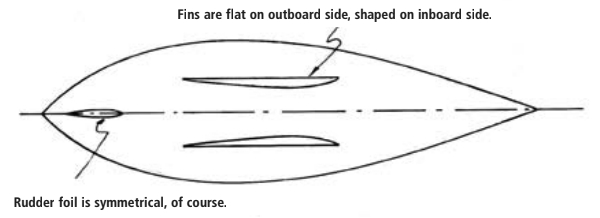
The initial cost is low compared to a centerboard and trunk; there is no trunk to leak or jam; maintenance is simple; the pendant can be inspected and replaced easily; and there is no trunk to break up the interior of the cabin. Performance does not suffer greatly either if the leeboards and their mountings are well designed, as the boat doesn’t care if its board is on the centerline or on the side. There may be a small loss in efficiency due to ventilation, but some boards are angled out 10 degrees or so from the vertical and thus may improve in efficiency as the boat heels. The well-designed leeboard is one that is asymmetrical with a flat side outboard and the streamlined shape on the inboard side, thus adding lift. They can be toed in a few degrees to increase the angle of attack; this also improves efficiency.
In shape, leeboards can be of fairly high-aspect ratio for efficiency or, like those shown on the Dutch Boeier yachts in the September 2000 issue of Good Old Boat, wide and fan-shaped for minimal draft, even with the board down.
So, why are so many shoal-draft North American yachts centerboarders instead of leeboarders? The answer is simple: aesthetics! The leeboard breaks up the clean lines of the yacht and, unlike the Dutch, we have not become accustomed to seeing them for the past 300 years. Too, the boards should be shifted when the boat tacks, although many are designed so they can be left down in a pinch when on short tacks with a small crew. Still, shifting a leeboard when tacking has to be a breeze compared to tacking a 140- or 150-percent genoa, and many sailors do that routinely and think nothing of it.
Bilgeboards
Bilgeboards are simply leeboards fitted in two board trunks, one on each side of the centerline, usually forming the face of the settee berths. They are high-aspect-ratio boards, generally asymmetrically shaped and fitted so that, when down, they are angled outboard at about a 15-degree angle. Because of their shape and angle, they can be very efficient indeed. However they have all the disadvantages of the centerboard when it comes to maintenance — double that because there are two of them.
Furthermore, bilge boards double the initial installation cost and, with that and their added maintenance, the advantages are not sufficient enough that they have ever become popular.
Bilge fins
Bilge-fin sailing yachts represent another answer to the quest for shoal draft — one which has never caught on in North America and is not all that popular on the other side of the Atlantic either, particularly in the larger boats. Bluebird of Thorne, a 50-foot bilge-fin ketch, was designed by Arthur Robb in the 1950s, I believe. She was quite successful, made several Atlantic passages, was written up in all the yachting magazines of the time, and was reviewed in The Proper Yacht, a book by Arthur Beiser. Still, bilge fins failed to attract much interest from sailors. Except for a few small sailing craft, such as the 17- to 21-foot chine-hulled sloops imported from the UK in the late 1950s and, in later years, the larger Westerly yachts, bilge-fin craft have been rather rare in North America. Even rarer have been the bilge-fin craft built here.
My work with bilge fins started in the mid 1980s with a husky 38-foot sloop. This design, almost a motorsailer, had to be seaworthy enough for bluewater passages yet with shoal draft for cruising the European canals. The owner preferred bilge fins to the complexity of a centerboard and also wanted the benefit of remaining upright when drying out at low tide. But when I began to research bilge fins for the project, I found that information was sadly lacking except for the little in Beiser’s sketchy writeup on Bluebird. I had no choice but to start from scratch.
The 38 had a shoal, ballasted, central keel as well as the bilge fins and, for some reason, it occurred to me that the fins should be asymmetrical, absolutely flat on the outside and shaped on the inside, like an airplane’s wing, quite unlike any other fins I had seen. The results both surprised and pleased me. The yacht sailed better than I had dared hope: pointing nicely, tacking positively, making reasonable leeway and having surprisingly good speed even in light air. Armed with this happy result, I began to take a more serious look at bilge fins and their several advantages.
Then a client came to me for a shoal-draft 60 footer, and I talked him into bilge fins using, basically, the following arguments:
1. The bilge-fin yacht can have the same shoal draft as a centerboarder but avoids the problems inherent in centerboards. The difficult job of painting the board and inside the board trunk is eliminated. There are no more broken pendants and no sleepless nights with the board banging back and forth inside the trunk.
2. The boat can dry out on her bilge fins and take the ground in a level position. In tidal waters this allows the skipper to clean and even paint the bottom and is a big advantage in some areas of Europe where it is common for moored boats to dry out at low tide. The fins eliminate the need for an expensive cradle for haulout and can also simplify shipping.
3. There is no loss of stability as the center of gravity of a bilge-fin yacht is about the same as that of a keel-centerboarder or single-fin hull of equal draft. In a serious knockdown the stability actually increases the moment the weather fin clears the water as the heeled center of buoyancy will then shift slightly to leeward.
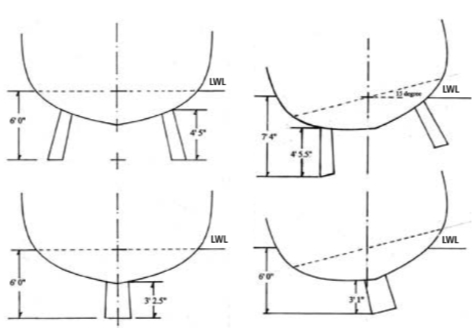
4. On a normal moderate-displacement yacht, the bilge fin can be more efficient than a shoal-draft single fin. The drawings on this page show both bilge- and single-fin hulls of 6-foot draft. Note in the drawing below that the depth of the single fin below the hull is only 3 feet 1-inch while the bilge fin extends 4 feet 5 1⁄2 inches. Obviously the latter is of higher aspect ratio for a given area and thus more efficient.
5. The draft increases with heel angle so, if you grounded under sail, you could reduce draft and get her off simply by letting go the sheets. The draft of a 6-foot bilge-fin yacht can increase to 7 feet 4 inches as she heels to 15 degrees. Of course, going aground under power is a no-no as you cannot reduce draft by heeling her. If you absolutely must go aground with a bilge-fin yacht, do it under sail!
6. Since bilge fins are angled outboard at about 15 degrees, the fin becomes more vertical when under sail and, obviously, more efficient in resisting leeway. Also, as pointed out earlier, the draft increases on the bilge-fin hull while the draft remains the same, or even decreases, on a single-fin hull. Modern wing keels on single-fin yachts can also increase the draft as the vessel heels but are far more fragile in a grounding. We could put wings on bilge fins, too, but I prefer a simple “foot plate” that extends outboard of the fin a few inches to reduce cross flow and vortices, with their resultant drag.
7. While the leeward fin is providing lift to reduce leeway, the weather fin is providing lift to increase stability and reduce heel angle. I’m certain this conflict increases resistance slightly, but I feel that the reduced heel angle increases the efficiency of the sails and may offset any added drag to a large degree.
8. Bilge-fin yachts appear to have excellent directional stability and are very steady on the helm. Surprisingly, they seem to steer better in reverse than a full-keel yacht.
The downside
All is not gravy, of course, and the twin fins have their disadvantages. The primary one is added wetted surface over a single-fin yacht of similar draft, about 15 percent more on one design I did. This is of major concern in a racing yacht, obviously, but not to a cruising skipper who is likely to start the engine when the breeze falters or raise a whopper of a light sail that would be “illegal” under the racing rules.
Construction can pose a problem also. The typical yacht has a central keel or reinforced centerline structure where it is in an ideal position to support a fin. With bilge fins it is necessary to fit hefty structural reinforcing outboard of the centerline, and this adds weight and cost.
In sum, the bilge-fin (or twin-fin) yacht has considerable merit and deserves full consideration by the serious cruising sailor. It may not be the perfect answer to the search for shoal draft, but it can provide good performance and, at the same time, eliminate the problems associated with centerboards. That’s reason enough to think about a bilge-fin cruiser if you sail in areas where the water is thin.
Ted is one of North America’s best-known yacht designers, having worked on the America’s Cup boats American Eagle and Weatherly, as well as boats that won the Olympics, the Gold Cup, and dozens of celebrated ocean races. He also is the man who designed scores of good old boats . . . the ones still sailing after all these years.
Thank you to Sailrite Enterprises, Inc., for providing free access to back issues of Good Old Boat through intellectual property rights. Sailrite.com