Advanced concepts in styling and design
Issue 82 : Jan/Feb 2012
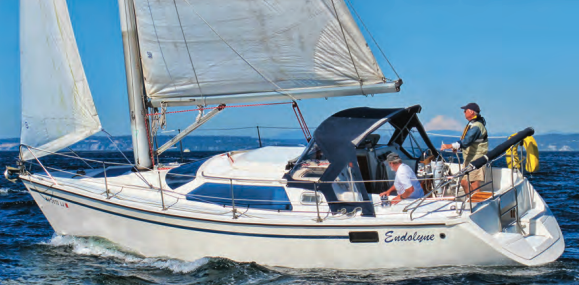
Walking down the dock on review day, I couldn’t help but notice the sharp contrast between Jeff Carey’s 1989 Hunter Vision 32, Endolyne, and her older and more traditional neighbor, a vintage Pearson 30. The Hunter’s designers were looking at a very different market, and in creating the Vision, took advantage of the opportunities for design and styling that modern materials and construction methods have to offer.
History
Hunter Marine, a subsidiary of the Luhrs Marine Group, is the product of a long tradition of shipbuilding that has its origins in the 1800s when Henry Luhrs and his grandson, another Henry, outfitted trading ships, later owned a chandlery, and eventually owned their own ship. Grandson Henry, together with his sons, John and Warren, shared a love for the sea. In time they took the work to New Jersey and built more than a thousand boats a year.
In 1965, the company was sold to Bangor Punta, a large timber conglomerate. Eventually, John and Warren (the latter a passionate sailor with a keen business sense) went off on their own. They sought to bring production line efficiencies to the sailing industry and in 1973 commissioned John Cherubini, a much-admired naval architect in the 1970s, to design a 25-foot sloop. That boat became the first Hunter. It launched the company that now turns out around 2,000 boats per year in Alachua, Florida, and ranks with Catalina and Beneteau as one of the largest producers of mid-priced sailing yachts in the world. (Hunter Marine should not be confused with the similarly named British boatbuilder. The American firm uses the brand name “Legend” for its boats sold in the United Kingdom.)
Design
Hunter prides itself in responding to market forces in both aesthetic and functional details and consequently changes its designs, specifications, and model designations frequently. It has been very successful at producing boats that appeal to buyers looking for good value for money, that are easy to sail shorthanded, and that provide comfortable living quarters with plenty of headroom and elbow room.
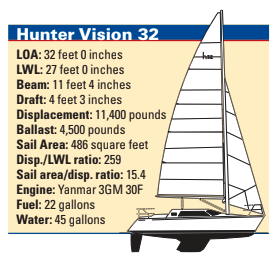
Hunters present a departure from traditional design, so they don’t have the lively sheers, well-balanced ends, or low houses of their CCA forebears. The Vision 32, in production between 1988 and 1994, has features similar to those found in European boats, such as Beneteaus and Jeanneaus, and much larger yachts. Its superstructure, with its wraparound tinted windows, resembles a pilothouse. The exaggerated volume of the hull form allows an interior arranged more like a modern living room, with curvy sectional sofas and large windows, than the snug accommodations common to more traditional yachts of this size. Freeboard is high, and the displacement/LWL ratio of 279 indicates moderately heavy displacement.
Deck and rig
The Vision 32 is fitted with an enormous tapered unstayed mast that has a 38-inch circumference at deck level. Two folding mast steps attached near the base, a lower one to starboard and a higher one to port, get the foredeck crew up off the deck to assist in raising the sail and fitting the mainsail cover. A solid boom vang supports the boom when the sail is being lowered. A block and tackle is incorporated in the vang to control leech tension with downward force. The mainsail is sheeted mid-boom with a 6:1 tackle that’s attached to a traveler mounted on the cabintop just aft of the sea hood.
All sail-control lines are led aft to the cockpit. The main halyard, boom vang, and first jiffy-reefing lines run along the starboard side while the mainsheet, jib halyard, and second-reef lines are led to port. Lines on either side of the companionway are handled by Barient 21 two-speed self-tailing winches. It’s all done neatly, with the lines partly concealed in deck recesses and under the sea hood, but the attendant routing through gangs of turning blocks produces a lot of friction, especially with the main halyard. The 350-square-foot mainsail is equipped with full-length battens, furling lines, and lazy-jacks. Consequently, the highly touted simplicity of the unstayed rig can quickly become a handful. On later Vision 32 models, the mainsail halyard was led to a power winch.
The 100 percent working jib is on a Hood SeaFurl roller furler and trimmed by Barient 22 two-speed self-tailing sheet winches. Some owners going to a 130 or 135 percent jib report much-improved performance. The small headsail is intended to help the Vision’s relatively weak pointing ability and it may well do this. However, several factors contribute to a general lack of weatherliness with an unstayed rig. The large-diameter mast creates a considerable amount of turbulence and, in the absence of a backstay, the headstay sags in a gust, making it difficult to flatten the jib for that windward-hugging slot. The weight of the large mast also contributes to raising the boat’s center of gravity, and that can adversely affect stability.
Without shrouds to hold onto, crew must take extra care when working on deck. They must keep their bodies low at all times when moving forward and aft and make good use of handrails and toerails.
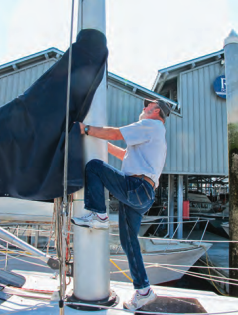
That said, an unstayed rig has its advantages. With no backstay to interfere with it, the mainsail can have greater roach. In a gust, the mast bends to leeward, spilling wind out of the top of the sail. This lowers the center of effort and reduces heeling. Plus, there are no chainplates to leak and no complicated rigging to tune. And the small jib is a joy to tack and jibe.
The advantages can extend to the accommodations. In the Vision 32, for instance, the keel-stepped mast is carried well forward and is fully contained in the forward cabin where it’s entirely outside the saloon.
The cockpit
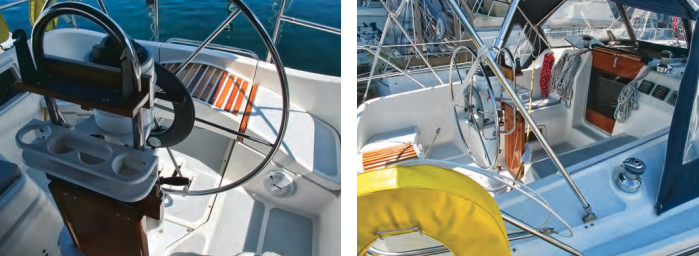
The large T-shaped cockpit has a curved helmsman’s seat, a walkthrough transom, and a swim platform with seats on either side — an advantage when debarking to a dinghy from a high-sided boat. The manual bilge pump is fitted in the lazarette to starboard of the walk-through, and the port-side locker houses the batteries, two for the house and one dedicated to starting. Two 5-pound propane bottles and miscellaneous items are stowed in compartments in the transom on either side of the swim step. The starboard cockpit seat and back open “gull wing fashion” to a very large locker. Endolyne is equipped with a Raytheon autopilot. The cockpit drains very effectively through the sugar-scoop transom.
Construction
Endolyne’s 22-year-old hull shows little sign of wear. No evidence of crazing is visible in the gelcoat and no blisters have appeared on her bottom. The hull is solid fiberglass. The deck is laminated with fiberglass skins on either side of a core material consistent with good practice in the 1980s. The two moldings are set in 3M 5200 and bolted together through an external flange.
The interior is virtually free of bulkheads. The hull derives its strength from its laminate and the hull-to-deck joint. A modular system of interior moldings strengthens the hull further and establishes a base for cabinets, berths, nav table, and other components.
The steel fin keel with bulb and wings was grit-blasted and coated with an epoxy system shortly after Jeff bought the boat.
Belowdecks
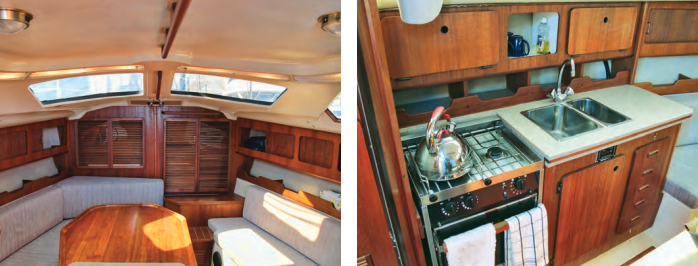
The forward berth is well ventilated and lighted by a tinted translucent deck hatch. A 45-gallon water tank is underneath. The berths are accessed by stepping over the seatback of the wraparound settee; Jeff modified this area on Endolyne with custom-built stowage lockers. For privacy, Jeff also installed twin louvered doors in the bulkhead cutouts.
The general appearance of the saloon is striking. The designers emphasied the look, comfort, and convenience common in up-market houses rather than the requirements of a fast boat working to windward in a chop. The cabin is highlighted by a wraparound tinted windshield and large matching side windows. Jeff says they have never leaked. Some owners report otherwise and that replacing them is expensive.
The settees are very comfortable for sitting but not for sleeping, except for the smallest of crewmembers. There is copious stowage beneath them. A nav table is tucked into the after end of the starboard settee. The bilge contains two separate compartments served by a single electric pump. A third panel in the teak-and-holly sole gives access to the transducer. A Volvo Ardic diesel furnace heats the cabin.
In the galley, on the port side of the boat, a two-burner propane stove and oven is next to a double sink set in a Corian countertop and served by hot and cold water through a pressure system. A 6-gallon hot-water tank is located under the forward settee. Storage space in the galley is akin to that found in a small but well-appointed kitchen. An icebox is fitted with hinged Corian tops that lift on gas struts similar to those that raise the trunk lid on the family car. The box is located amidships between the galley at and the nav station. Jeff rebuilt the icebox mounting after the original proved weak.
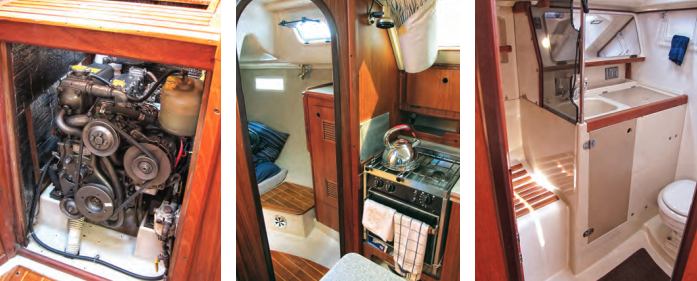
Aft of the galley, a door opens to a cabin with a commodious athwartships double berth under the cockpit and a hanging locker. The large head with sink and shower, and many built-ins and splash guards, is to starboard of the companionway. (There is also a hot- and cold-water shower in the cockpit.) Both of these compartments are lighted and ventilated by hatches on deck, and the sleeping compartment also has a fixed portlight at pillow level and an opening portlight.
The accommodations are well thought out. There are no visible hoses in the head with improvised twists and turns or hose clamps to nick your fingers and it was a pleasure to use the Vision’s dedicated companionway ladder without worrying about stepping in the salad (a hazard on many more traditional boats). However, the open plan and style of furniture makes it difficult to find places to drill holes to add special features or to personalize the space.
A marina neighbor of Jeff’s who also owns a Vision 32 (1990) told me he’d had a blockage in the 10-gallon holding tank. To solve the problem, the handsome, curved, teak-slatted top of the shower seat had to be cut out so the aluminum tank could be removed bit by bit. He had the enclosure rebuilt and a more appropriate polyethylene holding tank installed to the tune of about $14,000. Insurance covered the cost as the reason for the work was deemed a “manufacturer’s defect.”
Jeff thinks that many of the problems with Endolyne have to do with awkward or difficult maintenance that could be attributed to innovations in design and construction — specifically those that conceal the boat’s systems.
The engine
The front and top of the Yanmar 3GM30F diesel are accessible when the companionway ladder and a panel at bridge-deck level (above the oil filler) are removed. Removable panels in the head give access to the dipstick and stuffing box and another removable panel under the aft sleeping compartment gives access to the gearbox, sea strainer, engine, raw-water seacock for the toilet, and the secondary fuel filter. The engine enclosure is rigorously soundproofed and the fuel tank holds 22 gallons.
Under way
We backed out of the slip precisely — the three-blade, 16-inch Max-Prop feathering propeller gets a good grip on the water. With Jeff cranking on the main halyard winch, fellow crewmember John Wolfe mounted the folding steps at the mast base to urge the big luff along its way while I steered and tried to keep the leech from entangling with the lazyjacks. It kept the three of us busy even in the light 10-knot wind. In spite of the manufacturer’s claims about the ease of sailing the boat singlehanded, Jeff said he’d never willingly attempt it.
Once the small jib was unfurled, the Vision demonstrated some of her better qualities. Close-hauled, we could tack easily without having to worry about a large overlapping headsail. We jibed frequently in the light air to maintain momentum. The boat seemed well balanced and light to the touch, tracking very well with just a slight weather helm. In heavier wind conditions, Jeff says, the Vision is dry and stable. He’s never found it necessary to reef in winds up to about 20 knots. We found some slightly stronger breezes farther out and, with sheets eased, Endolyne settled into a groove and gave us a nice ride back to the marina.
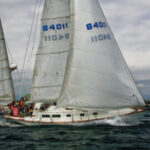
While taking photos of the Vision under way, I was able to see how she made light of blustery 20-knot winds. She sailed relatively upright, even in the considerable gusts. She jibed over smartly and seemed to make little disturbance in the water. Our chase boat, running at full revs and making about 6 knots, was barely able to keep up with Endolyne as she sailed happily off on a beam reach, her favorite point of sail.
Conclusion
The appearance and accommodations of the Hunter Vision 32 contrast markedly with those of more traditional cruising sailboats and are more akin to modern European and emerging American design concepts. Some buyers will certainly be attracted to the stylish interior lit by the wraparound window and fluorescent accent strips. The Vision is a family boat with plenty of room for kids to romp about and friends to gather in the spacious cockpit and lavish saloon.
The pros and cons of an unstayed mast should be looked at carefully, particularly with regard to handling and safety, and the aluminum tanks can be costly to replace. Hidden wiring and plumbing can be troublesome.
An Internet check shows a large number of used Hunter Vision 32s available. Prices range from $26,000 to $69,000 with the majority around $30,000.
Your reviewer gratefully acknowledges the continuing good work of Marty Bower and Jerry Riggs of the Edmonds Corinthian Yacht club who cheerfully provided good photography platforms.
Richard Smith, a contributing editor with Good Old Boat, is an architect. He specializes in designing and building very small houses and has built, restored, and maintained a wide variety of boats. These days, he and his wife, Beth, sail their Ericson Cruising 31, Kuma, on the reaches of Puget Sound.
Thank you to Sailrite Enterprises, Inc., for providing free access to back issues of Good Old Boat through intellectual property rights. Sailrite.com