A system that simplifies storage and use
Issue 80 : Sept/Oct 2011
Everyone knows the importance of keeping paper charts aboard as backups for our electronics. But these things can be huge, so how do you store them? Rolling them might make sense if you had a full-sized chart table, but few sailors have that much space aboard. The other solution is to fold them.
Most folks fold their charts in half and then half again until the size is manageable. This works for storage but usually requires that you completely unfold the chart to find the part you need, then make new folds to reduce the size once more to what you can fit on your nav table.
There is a better way to fold charts that makes them handy to store while allowing you to access any part of the chart quickly without opening the entire sheet. I learned this method from an orienteering book years ago as a way to fold topographical maps for use in the field.
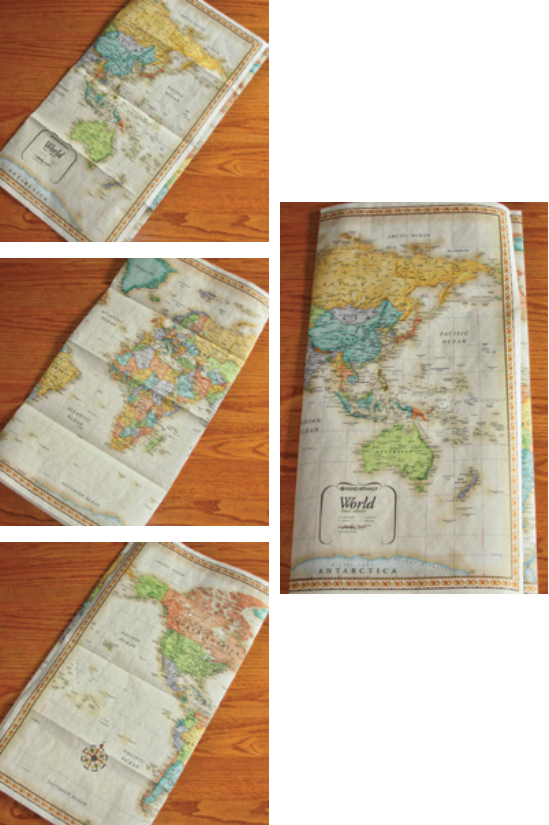
Thirds, then fourths
First, divide the long axis of the chart into unequal thirds. Then fold the bottom third and the top third panels under the middle section. (Note: This concept is similar to folding a letter to fit in a business envelope. We used a world map to show how the technique makes every part of the map accessible. –Eds.) Make the center portion slightly bigger to allow both the top and bottom portions to fit behind the center section.
Next, make an accordion fold of the short axis of the chart by first folding it in half, then folding each leg back on itself outward. The result is a folded chart that is one-twelfth the original size with the printed chart number (if your chart is arranged this way) showing on the upper right corner.
Try this with a sheet of paper and you will quickly see the benefit of this approach. If the part of the chart you need is on the top third, you can open one fold in the middle. If you need more width, unfold one or the other side flap. If the part you need is in the middle third of the chart, flip it over as you unfold at the middle. And if the part you need is on the bottom third, open the accordion fold all the way, open the chart, and refold it with the top portion inside and the bottom portion showing. All this occurs without completely unfolding the chart or adding any new creases in the paper.
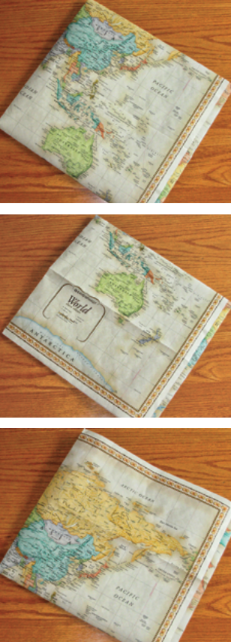
Fold for normal use
A couple of variations can be useful to keep in mind before you start to fold a chart. If, for example, your sailing area is near the main folds, or if you are mostly following an up-down route, you could find yourself frequently turning the chart over to see different thirds. A solution for this is to instead fold the chart into thirds across the short axis fi rst and then add the accordion fold.
The other variation is that if you are primarily going to be using the middle third of the chart, it can be advantageous to install the accordion fold with the middle third, rather than the top third, facing up.
But don’t worry too much about these subtleties. Whatever way you choose to do it will still be much easier on you and your charts than folding them into eighths the way most sailors do!
Steve Christensen , a research chemist, sailed his Ericson 38, Rag Doll, for many years on Lake Huron and spent each August cruising the North Channel. He is between boats just now, but looks forward to owning another good old boat in retirement.
Thank you to Sailrite Enterprises, Inc., for providing free access to back issues of Good Old Boat through intellectual property rights. Sailrite.com