They roam the world’s oceans
Issue 26 : Sept/Oct 2002
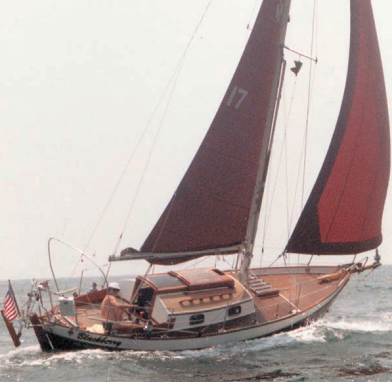
The British manufacturers of Frances 26 sloops managed to characterize them perfectly in remarkably few words: “They routinely roam the world’s oceans.” Enough said, old chap.
In fact, the Frances 26 has an Anglo-American heritage, for she was designed by one of America’s best-known smallboat architects, Chuck Paine.
Morris Yachts, of Maine, originally built the Frances as the Morris 26 — about 35 to 40 of them came off the production line there. In total, about 200 were constructed professionally, and about 40 more have been built by amateurs from sets of plans — still available, incidentally, from Chuck Paine’s design office in Camden, Maine.
Until recently, the boat was offered by Victoria Yachts, in Hampshire, England, but at the current time there is no manufacturer building the boat from the molds which are reportedly resting unused in a field in Holland. If you want one of these gems your choices are to buy a used one, build one, or have one built as a one-off from the plans.
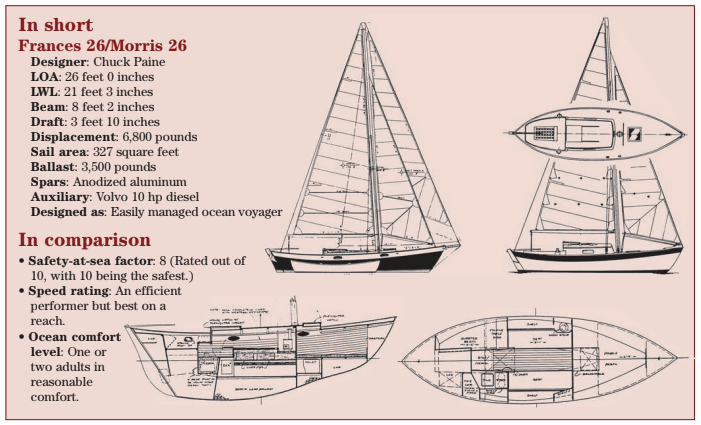
Significantly, the Frances 26 was designed by Chuck Paine for his own use. She was, in fact, his first design as an independent naval architect, and she had to be capable of cruises from Maine to the West Indies and back crossing the unpredictable Gulf Stream. She also had to be capable of being sailed by only one or two persons.
For his own comfort and safety, Chuck chose a traditional, long-keeled hull with moderately heavy displacement, an outboard rudder, and short ends. It’s interesting that so many designers who plan to cross oceans in their own boats choose that time-tested formula, no matter how many fancy fin and skeg boats they draw for others.
This boat is almost a starved Colin Archer, except that her sternpost is straight, not curved, and the forward end of her keel is cut away slightly for better maneuverability, less drag, and better directional stability downwind. Chuck Paine says the cutaway also stops her from developing weather helm.
Although many of these small voyagers are now routinely roaming the world’s oceans, you won’t find many used ones for sale on the open market. At the time of this writing, Morris Yachts was advertising four for sale from $38,000 upward. But this is the kind of boat owners tend to hang on to for life, so when they do come up for sale they’re quickly snapped up by savvy sailors who’ve been waiting in the wings for their chance to pounce. Better get in line.
Basic design
One unusual aspect of this boat’s design is the amount of weight she carries on her keel. The ratio of ballast to displacement is 51 percent. In other words, more than half the total weight of the boat resides in her ballast keel. Such a high ratio is rarely seen in a cruising boat, but it argues well for her ultimate stability. Should she ever be rolled over by a rogue wave (and that possibility should never be dismissed no matter the size of the yacht) she will undoubtedly regain her feet very swiftly, probably before too much water has found its way down below.
Her hull is solid, hand-laid fiberglass, made to Lloyd’s specification. The gelcoat was colored according to the owner’s choice. The fiberglass deck has a core of balsa wood, except in those places where fittings are bolted through — there the core is a more substantial material known (appropriately enough) as coremat.
Each end of the hull is pointed and joined by a full-length keel of traditional proportions, modified slightly (as if the designer were making a nodding concession to modernity) by removing a thin crescent from its forward edge.
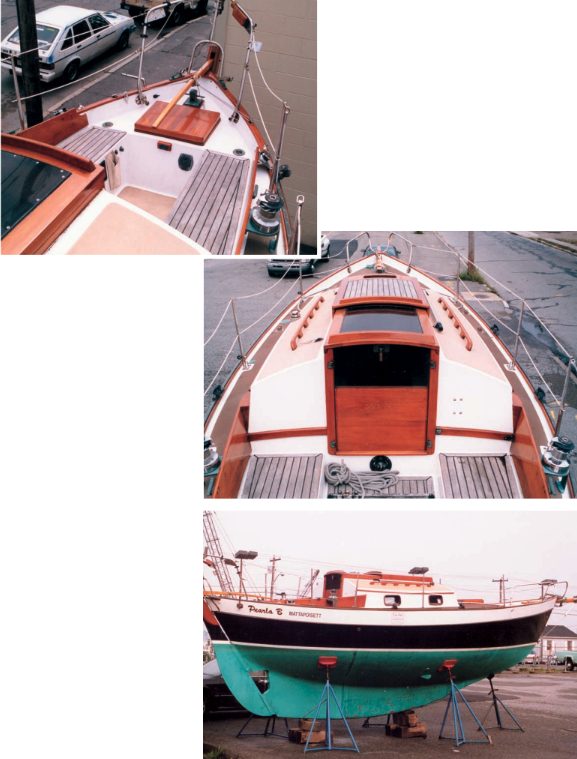
The freeboard is generous but cunningly lessened visually by what is called a “gunwale styling line.” And yes, she has proper gunwales, capped by a solid teak toerail.
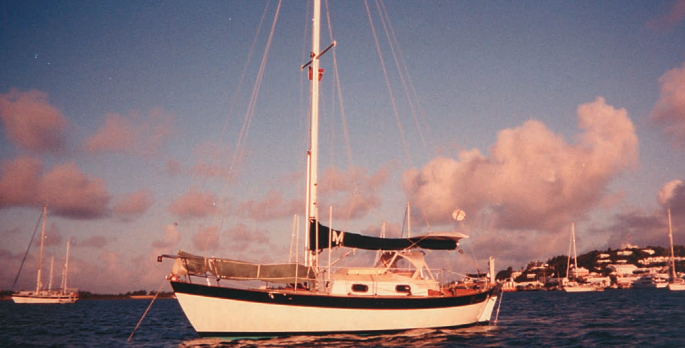
Her coachroof is high, angular, and truncated. It stops short of the mast, and by rights ought to look unflatteringly boxy. For some reason though (perhaps because of its deep crown or the shape of its ports), it earns the epithet “purposeful” rather than the disparagement “ugly.” In any case, it provides full standing headroom in the main cabin below, which is no mean trick on a 26-footer.
This is one of the last remaining boats provided with the cruiser’s friend, a proper samson post on the foredeck. Nothing is more convenient for mooring lines, anchor lines, and towing lines, yet fewer and fewer modern sailors ever get the chance to test its virtues against the inadequately sized and awkwardly placed deck cleat that has become the mediocre standard.
The sliding hatch over the companionway is made of 3⁄8-inch thick acrylic plastic material. It slides on brass runners inside a fiberglass turtle, or sea hood, that prevents heavy water from finding its way under the hatch into the accommodations.
Teak coamings surround the modestly sized, self-bailing cockpit, which has a vented locker for propane gas and a large lazarette aft. The tiller sweeps the aft end of the cockpit but without getting in the way too much. A more inconvenient obstacle is the mainsheet, which attaches to a deadeye on the bridgedeck. Even at the cost of some efficiency, the mainsheet might better be sheeted to a horse spanning the pulpit, as it was on the original Frances.
You’ll find all kinds of power plants in the Frances, ranging from 5 to 25 hp, but the standard engine was a diesel, the freshwater-cooled Volvo Twin 2010, which develops 10 hp. That’s slightly more power than the 3-hp per ton often recommended for modern cruisers, but it certainly won’t be too much in heavy weather.
Victoria Yachts commendably went to some trouble to reduce noise by lining the engine compartment with an insulating foam that incorporates a lead barrier.
Accommodations
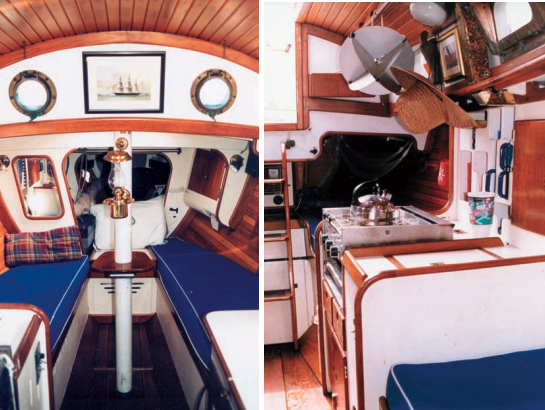
Since most of these boats have been built to the requirements of individual owners, who knows what you might find down below? Their coachroofs, or lack of them, reflect the status quo in the eternal battle between the hedonists, who insist on comfort below, and the Spartans, who are happy to suffer for good looks.
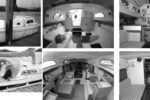
A handful of Franceses were built with a raised deck amidships. They are very sleek, very pretty, but they offer no standing headroom below. They make Spartans very happy indeed. The majority (and those pictured here –Ed.) have a raised coachroof to open up the accommodations, and while some of them have a jaunty, truncated cabintop (an uneasy truce, but acceptable to both armies) others have a coachroof that extends forward of the mast in total surrender to the hedonists.
In a refit there’s wonderful scope for redesigning the interior. If you very sensibly decide that four berths are two too many for this boat, you can get rid of those rarely-used V-berths and put something more useful in their place. And if you simply can’t live without a double berth, it’s easy to make an extension berth from one of the settees in the saloon.
The galley, the head, and the chart table, like movable feasts, are to be found all over the place on various boats. You can, in fact, squeeze four full-sized berths into this hull and still have room for all the rest, but if you’re planning to sail single- or doublehanded, as the majority of long-term cruisers do — you will probably prefer to have fewer bunks and more specialized accommodations for cruising with two.
The rig
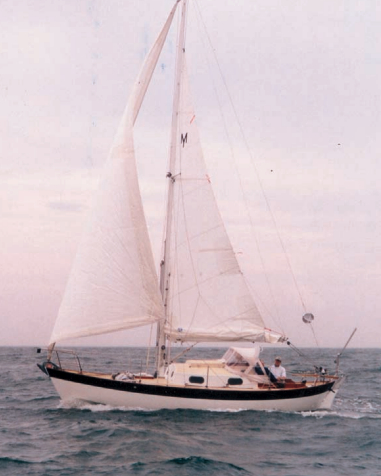
The rig is another area in which variations abound. You can find masthead sloops, 7⁄8ths-rigged sloops, and cutters with a bowsprit. Victoria Yachts supplied a thoroughly modern, silver-anodized mast, stepped on deck with airfoil spreaders and an internal conduit to keep electrical wires from slapping around inside the mast and driving you crazy.
The boom, also silver-anodized, has a built-in groove for the mainsail foot boltrope and an internal reefing system for two slab reefs. There’s a special winch to aid jiffy reefing and a fancy casting near the gooseneck with four built-in jammers for the reef lines and the clew downhaul.
The sail area, incidentally, is exactly 30 square meters, or 327 square feet, with a slight majority of it in the mainsail so the headsails can more easily be managed by short-handed crews. If you’re familiar with the old International 30-Square Meter class, you will be fascinated by the fact that the same sail area that drives those glamorous, but malnourished, 40-foot racers so quickly and efficiently is needed to push the sturdy Frances 26 along in rather more prosaic fashion.
Performance
This is a seakindly boat, as comfortable in broken water as any 26-footer can be expected to be and more seaworthy than most. Her pointed stern will win the approval of many traditionalists who believe that it parts following seas as does the stern of a lifeboat and thus makes the hull more seaworthy. Even those who scoff at such a theory on the grounds that if a big wave is going to come over the stern, a pointed end won’t stop it, must agree that is it pretty to look at.
Her performance to windward will depend to some extent on the rig: a masthead sloop with a hanked-on foresail will probably do best because the size of the headsail is important. It’s more efficient than the mainsail, area for area, because it is not affected by the power-wasting vortices spawned by the mast.
She’s a little shallow-drafted for premium performance on the wind, so she’ll need to be sailed a bit freer and a bit more upright in heavy sea conditions, but in light or moderate weather she might surprise a few competitors. Like most full-keel boats, she comes into her own as you ease her off the wind, and there’s no reason why she shouldn’t notch up some pretty respectable daily runs on an ocean passage.
Known weaknesses
- Expense. Custom built new, or used, this is not a cheap boat. If she’s well maintained, though, she could make a safe, solid investment because there always seem to be more people looking for used boats of this type than there are examples available.
- Lack of availability. If you want a used one, you’ll probably find there are fewer than half-a-dozen for sale in the U.S. at any time. You may have to find one yourself and haunt the owner until he or she sells her to you.
Owner’s opinion
In this case, the owner’s opinion is the designer’s, too. Chuck Paine’s original Frances, named for a friend in London, had a 7⁄8th sloop rig for no better reason than the fact that it looked pretty. For the same reason, she also had a flush deck instead of a raised cabintop.
Chuck calls her a mid-Atlantic boat. “I wanted to combine the qualities of the best of British and American design,” he says, and she has, in fact, appealed to people on both sides of the Atlantic.”
He designed her as a deepsea voyager with ruggedness, character, and good looks. She had to be small enough to suit a modest budget but large enough to survive at sea. But it was his concern with seaworthiness that was paramount. That’s one of the reasons he gave her a whopping 51-percent ballast ratio.
“She has very positive capsize numbers,” he says, “She can heel a very long way over before she reaches her limit of positive stability.”
To the uninitiated it may seem paradoxical, but despite all this weight hanging from her keel, Frances is a little tender initially. Many of the most seaworthy yachts share this tendency to heel quite easily to 10 or 15 degrees, and then suddenly stiffen up, refusing to heel further until the wind really starts to blow seriously. The reward for this lack of initial stability is increased ultimate stability, a feature that should be borne in mind by every prospective ocean sailor. If she’s ever hurled upside down by a giant wave, Frances will bob upright again promptly. A very stiff boat, one that gains her initial stability from wide beam, will take much longer to recover, and may even sink before she does.
You don’t have to worry about the cockpit being too big on this boat, either. “It’s small,” says Chuck, “it’s safe for ocean cruising.”
If you’re sailing a sloop-rigged Frances under all plain sail when the wind starts to rise, you should first reef the mainsail, he advises. If you’re sailing the cutter, however, with a roller furling headsail on the bowsprit, you should roll up the Yankee completely and hang on to the staysail.
The idea is to lessen her angle of heel as much as to keep her helm balanced. In fact, Frances does not seem to suffer from weather helm. “She’s the most beautifully balanced boat of her type that I have ever sailed,” Chuck says, throwing modesty to the winds.
“She’s not as bad to windward as you might suspect, either, especially in moderate weather, but her best point
of sail is a reach, anything from a close reach to a broad reach. Dead downwind, like any small boat of this type, she rolls.”
Conclusion
Like many a jewel, she was costly for her size, but she brings a great deal of pleasure for a very long time. Even if money is an object, there are very good reasons for buying this sweet but tough little boat. There are no new boats available at the moment, except by having them custom built, which is expensive. This boat has a very high displacement-to-length ratio, which is exactly what her design type calls for. Compare her to other boats of similar displacement, not similar length on deck.
Thank you to Sailrite Enterprises, Inc., for providing free access to back issues of Good Old Boat through intellectual property rights. Sailrite.com