Cruising Baja Part 2: Hot tips for cool cruising in the Sea of Cortez
Issue 26 : Sept/Oct 2002
The second of two parts dealing with preparing yourself and your boat for tropical cruising south of the border in Mexico’s Baja California. Learn how to beat the heat, anchor correctly, ready your boat for the return trip . . . and much more.
Imagine a peaceful night at anchor in the Sea of Cortez. An afternoon of snorkeling and an evening beach party with other cruisers have left you tired. It was absolutely still when you dinghied back to the boat, so you decided to leave up the awnings that had protected you from today’s intense sun. Climbing into the V-berth felt especially good.
But it’s midnight now and something has awakened you. In the few minutes you’ve been awake, the wind has increased from 10 to 30 knots. Lightning flashes over the hatch and you hear the rumble of thunder — Chubasco!
You wake your mate as you climb out of bed and fumble for the switch that turns on the spreader lights. Soon two sleepy people are doing a midnight dance out on the deck under the spreader lights ripping down the awnings before the wind can destroy them.
Within minutes, the wind is blowing more than 45 knots. While sudden Chubasco winds are not a nightly occurrence, anyone who spends much time in the Sea of Cortez will experience them. One challenge of designing an awning system for Baja California is a quick-removal feature.
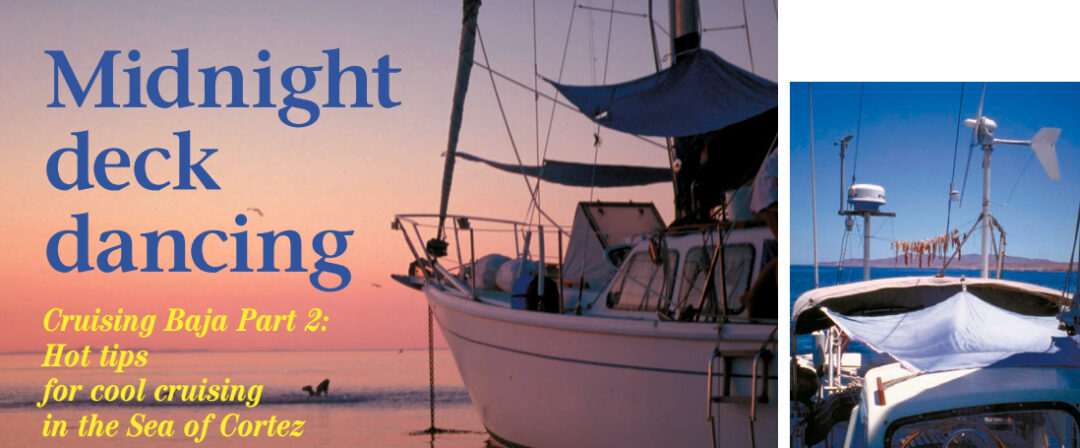
Mexican palapas with palm-frond roofs are common for a reason: the Baja sun can be intense. The inside temperature of our boat was reduced by 10 to 150 F when we put up awnings to shade the entire boat. Baja cruisers put a lot of thought into their various sunshades, and it took us a few tries to get our own system completed. We added Textilene snap-on covers to the windows on the hard dodger so we could still see out through the screen-like material. We liked shade when we sailed, so we ended up with a well-braced Bimini made of 1-inch stainless-steel tubing that stayed up all the time. The Sunbrella cover could be removed, but it seldom was. It withstood winds of 50 knots more than once. The outboard-motor hoist, rail-mounted barbecue, and sail controls were fully functional with the Bimini in place. The aft-cockpit seat/storage boxes I added gave us a comfortable place to sit in the cooling shade of the Bimini.
No chafing problem
Our largest awning connected to the front of the Bimini with zippers, and extended forward to the mast. The Sunbrella was supported by 10-foot tubes of 1 1⁄2-inch PVC that rested on the mainsail cover over the boom. Chafing the sail cover was not the problem one canvas book warns about with this design. But an awning located at a higher level will allow for more air circulation. Using the boom resulted in a lower system that gave us less windage and was stronger.
I drilled holes in the ends of the tubes to connect bungee cords that ran to the deck and railing. The cover was held to the tubes by Velcro pockets and by clips at the ends of the PVC tubes. It was worth the time to use lightweight cord in a slack position to double-up on the bungee cords. This limited the bungee stretch and kept the wind from getting under the edge of the cover and lifting it like a sail. I had a lot of time and money in the final awning so I tried to protect it from damage.
In sudden wind conditions we could unclip, unzip, and un-Velcro the cover from the PVC frame and stuff it into the cockpit in less than two minutes. Under way, the PVC tubing was tied to the stanchions out of the way on the sides of the foredeck. It might take 15 to 20 minutes to get the whole awning re-assembled at a new anchorage, but it could be removed in a hurry if needed. As time went on, we added lightweight side covers that could be hung from the main awning to shade the cockpit from low angle sun in the morning or afternoon.
An additional part of the system was a triangular, lightweight, 3⁄4-ounce nylon cover that I sewed from part of an old spinnaker purchased for a few dollars at a swap meet. This cover shaded the foredeck area in front of the mast and was tied around the furled genoa forward and to the PVC tubing behind the mast. We took this lightweight awning down at sunset.
Cockpit shade
The final part of the system was an additional cover made from the 3⁄4-ounce material that we used when underway on hot days. It shaded the cockpit by connecting to the back of the dodger and the front of the Bimini.
A gentle breeze can make living conditions ideal at anchor, but sometimes it gets hot, humid, and still. Over the years, I’ve tried 12-volt automobile fans and inexpensive computer fans to circulate air in the boat. It was worth the money also to get a few of the efficient and quiet Hella-brand two-speed fans. Because the natural airflow of a boat at anchor will be from the bow, it makes sense to use fans to help air move in the same direction. We each had a fan over the V-berth sleeping area, and there was a nav-station fan, a galley fan, and a main saloon fan.
Many cruisers overlook the importance of getting fresh air into and hot air out of the diesel engine compartment. I installed a small fan to help air in and a larger unit that exhausted warm air through a cowl vent on the transom coaming. The engine ran well, and we never overheated an alternator with this system. The life of in-line bilge blower fans is limited to a couple of hundred hours. They are not designed for continuous use, but they are inexpensive at $20 and easy to replace (carry a spare). Another solution would be to spend the money for a more expensive squirrel-cage unit.
Water cooling
Diving off the boat to stay cool is a must in Baja. During the middle of summer, we spent as many as six hours a day snorkeling and exploring, hunting fish for dinner, and just staying cool in the water around the boat. We ended up with a high-quality stainless-steel swim ladder that extended 3 feet underwater to make boarding easy. It had mounts on the starboard deck, and we also installed mounts to store it in a folded position in front of the dodger while underway.
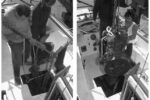
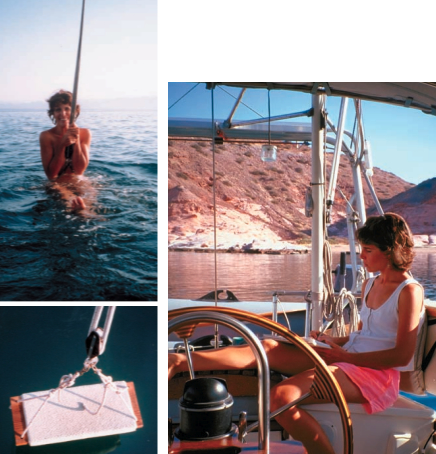
On the port side, opposite the swim ladder, we hung a simple boarding step (photos on next page) that allowed us to unload supplies or passengers from the dinghy. It also served as a good place to stand and fish while at anchor and could be unclipped and used as a swing-style seat that we lowered into the water from the dinghy davits on hot days. It was something I fabricated in a few minutes using a section of old 2 x 8 plank with a carpet sample stapled on for traction and to protect the boat.
Refrigeration
Life without cold beer on a boat is possible, but what’s the point? In reality, we often ran out of beer and survived, but the refrigerator was invaluable for keeping fish fresh for a few days and for keeping produce from perishing quickly in the heat.
There are several ways to power a refrigerator. I know of people who have spent more than $10,000 on elaborate refrigerator/freezer systems. We met several cruisers with powerful engine-driven compressor systems who eventually tired of running their engines for an hour or two each day at anchor. Furthermore, the complicated systems do break down.
I heard a story about a group of cruisers who began to follow a large yacht with a huge freezer packed with meat and ice cream. The yacht’s expensive refrigeration system would fail on a regular basis. When the fridge broke down, its sumptuous contents were destined to spoil, so they would be distributed to other cruisers in the anchorage. The rumor that we were part of this parasitic group is not true, but the rumor that a person with a good background in refrigeration will always find work is true.
We were at the other end of the refrigeration expense spectrum and got along well with an investment of about $600. In fairness, this does not take into account the battery and charging system needed to supply the power. In modifying our refrigeration system we kept the original built-in, top-loading box from the factory but replaced the old out-of-production refrigeration unit. I feel that a 12-volt refrigeration system is the way to go, even though it was our largest single source of battery drain. Adding a water-cooling system does increase efficiency — until the salt water destroys it. I believe in keeping it simple without the water-cooling option. A less complicated air-exchange system that is installed with good ventilation for the compressor and exchanger can last 10 years with virtually no care.
Without spending much money, we added Styrofoam insulation to the inside of the box, which also reduced the area to cool. We insulated the lid and replaced the seal. Many cruisers have had good experience with the Adler/Barbour units. Ours was a Norcold with an L-shaped evaporator in our small top-loading box. We learned to change our habits so we did not open the box too many times in a day.
Ground tackle
All the fun stops when a boat drags onto the beach . . . or worse. There are enough other factors to keep you from sleeping at night without worrying about your anchoring system. Why not move up one size from what is usually recommended? A strong manual or electric windlass is a must on a cruising boat our size. Most cruisers use a single anchor (Bruce, CQR, Delta, and so on), and my preference for anchoring in the prevalent sand in Baja is a claw anchor such as a Bruce or a Simpson Lawrence.
We also carried a Danforth for stern anchoring. This type of anchor has amazing holding power in sand and does not depend on weight to do the job. But the Danforth is not the best choice for the bow anchor that will have to reset itself when the wind or tide changes and the boat pulls from the opposite direction.
We carried 300 feet of all-chain rode for strength and weight, but since chain can’t absorb shock a snubber or shock line is also needed. After the anchor is set, the snubber line (30 feet of 1⁄2-inch three-strand dockline, in our case) can be secured to the chain with a simple rolling hitch. Additional chain is let out while dropping the rolling hitch into the water until the line is stretched tight with the chain sagging beneath it. This shock line is attached to a bridle on the bow cleats or a designated anchor cleat. We dropped the spliced eye of the dockline over the bollards on the windlass itself. The line must be chafe-protected (covered with hose sewn into place) near the cleats or where it goes over a bow roller next to the chain.
If the boat has a long bow platform, it’s best to use a bridle to take stress off the platform. We also added a strong chain stopper that would keep forces from being transferred directly to the windlass if the snubber broke or came loose. We tied off the end of the chain with a section of line that can be pulled out on deck and cut in an emergency. When you can imagine your boat staying put with the wind blowing 45 knots as the bow bucks up and down in huge swells like a scared horse, you’ve probably done all you can do.
Swinging space
Most anchoring in the Sea of Cortez is done over a sand bottom in 15 to 30 feet of water. Tide changes can exceed 15 feet in the northern part of the sea. Winds can come from any direction at any time, and the interval between dead calm and 40 knots of wind can truly be only a few minutes. Make sure your boat is safe from obstructions in all directions of swing, and remember to add the length of your boat to your swinging radius. In close quarters take time to back down on your anchor toward the rocks in question even if you are backing into the present wind. Many of the charts for the Sea of Cortez are lacking in detail, and they are often incorrect. Some charts of this area have not been updated in more than 100 years.
It’s usually best to enter a strange anchorage at low tide, if possible, with someone on the bow to watch for rocks visible just below the surface. Entering at high tide can yield surprises when rocks appear later. Consider anchoring temporarily in a deeper spot and exploring for a more protected location in the dinghy, looking into the water with a dive mask.
You may be anchored here for a while, and if you are too tired to check things out and do it right now, think of what it will be like when 40-knot winds are putting you on the rocks at 1 a.m. I made a practice of diving into the water and checking out the bottom and the anchor. Occasionally I found rocks in the area that could tangle our chain, so I searched for a better area in the dinghy and took the time to re-anchor.
There were many times in Baja when I set a stern anchor up by the beach to keep Maho Blues pointed into the swells. This allowed us to enjoy anchoring in beautiful places that other boaters avoided because of the swells. After the primary bow anchor was set and the boat was safe to swing a full 360 degrees, I got in the dinghy and set our Danforth with 25 feet of chain and 100 feet of line in shallower water near shore. The stern anchor was set for comfort, not safety, and if it was cast off or even cut loose, our bow anchor was still there to hold us.
I was amazed on a few occasions when the wind blew 40 knots from our stern and the 1⁄2-inch line and the little Danforth held us. Pulling up a Danforth that has worked itself deep into the sand may require a steady pull for several minutes before it releases. I did have to cast the stern anchor off a few times in strong winds from shore. I was always able to retrieve it when things settled down.
Passagemaking
It gets rough out there. It’s no fun dodging your gear and supplies as they fly around the boat. It’s also important that you don’t go flying around the boat. Take time to install locks on all doors and drawers, to install hooks for bungee cords, and to strap down anything that can move. Install grabrails so you can move around the cockpit and down below with one hand continually holding on to the boat. Pack soft things between hard things. Pack yourself between pillows so you can get some rest when you’re off watch.
I added a removable inner forestay to our boat and used only the staysail when the wind got up to 30 knots. We also had a third reef point in our mainsail, and the lines for reefing were always in place. We learned to keep our meals simple and small during passages, and we traded the watch at three-hour intervals.
Even in coastal cruising we sometimes made four- and five-day passages to take advantage of good weather. My favorite piece of equipment on a passage? A reliable autopilot. Our Navico Wheelpilot 5000 was excellent.
The Baja bash
The trip from San Diego to Cabo San Lucas on the tip of Baja is 800 miles of sailing off the wind with ocean swells helping to push you south. It is a relatively easy passage, even though there are only two major protected bays along the way that offer the chance to take on fuel, water, and supplies. Many boats that are not particularly well prepared survive this trip and spend time in the Sea of Cortez. But at some point most people want to return to the United States and Canada.
Some cruisers with boats that sail well head out to sea for hundreds of miles and then tack back into San Diego, and it is usually a rough trip. Most people choose to motorsail a shorter coastal route that offers a few places to rest and take on fuel. This infamous 800-mile passage against the wind is known as the Baja bash, and the trip takes its toll.
Engine and transmission failures are common, thanks to eight or more days of continuous motoring into the wind and seas. Many boats have decks covered with extra jugs of reserve diesel fuel. Sensible spares to carry for this trip include belts, a spare raw-water pump or impeller, and fuel filters.
A raw-water strainer should be installed so it is easy to service when the boat is underway in rough weather. Before heading down to Baja, it’s certainly worth making sure that your boat is in a thoroughly seaworthy condition and that you can carry enough fuel to get back up the coast.
The boat
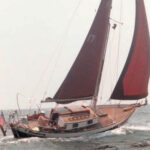
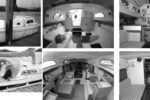
I loved the strength and size of our 1974 Cal Cruising 35 the first time I saw her. The boat was designed for cruising with a powerful diesel, large fuel and water tanks carried low in the hull, a huge galley, a good-sized head with shower, two large hanging lockers, and huge amounts of storage everywhere. Down below didn’t seem so much like “down below” with the plentiful light and excellent visibility provided by the large windows. The boat immediately seemed like a comfortable home with the potential to be a sound cruiser. She had an incredibly strong, nearly full keel with a cutaway forefoot.
The rigging and the spars were larger than I’d seen on other boats this size. I knew this was not the fastest boat that Bill Lapworth ever designed, but all his boats sail well. With the ability to carry 160 gallons of diesel fuel and 110 gallons of water as it came from the Jensen Marine yard, the Cruising Cal 35 was definitely designed as a long-range cruiser.
Problems? The portlights were too large for safe offshore passages, and the cockpit seemed too big and open. There were few grabrails inside. The overall lines were excellent to my eye with one exception — it looked as though Bill Lapworth was tired by the time he reached the transom. He drew a nearly vertical line and said, “There. I’m done.”
Modifications
I doubt that anyone ever made more cruising modifications to one of these boats than we did to ours. The nearly vertical transom that I joke about turned out to be exactly what allowed the dinghy davits to function so well. This boat can handle being loaded: we weighed 22,000 pounds with the tanks full and all our cruising gear and provisions onboard. The boat handled well, and the cockpit stayed dry.
Windows were replaced with 3⁄8-inch acrylic that was through-bolted to inch-thick hardwood frames. I was unable to break the plastic with a hammer when I tested it, and they never leaked a drop of water in six years. We removed the aft and largest window on each side of the cabin and glassed it in but covered an acrylic blank to maintain the three-window look on each side of the cabin.
We glassed in an additional bulkhead to support the new Harken traveler on the cabintop. We added grabrails everywhere. I cutter-rigged the boat. We added six stanchions to the cockpit along with cockpit storage boxes and a teak helm seat. I replaced the original fixed three-blade prop with a feathering Max-Prop. Dual fuel filters and a changeover valve were installed. Ventilation portlights were added for the V-berth, a stronger gooseneck was fabricated, and we ended up with plenty of rope clutches and a total of eight winches. The list goes on.
The key to a good boat is that everything works well together. The old Cal Cruising 35 had the strength to get us where we wanted to go and the ability to carry the supplies needed to extend our stay. The windows provided excellent visibility during passages and made it possible to enjoy the scenery at anchor. The spacious cockpit was a wonderful, comfortable place in which to enjoy life in Baja.
Closing thoughts
People who love boats seem to also love sharing ideas and information. Each boat has its unique features and there are always other ways to do things. We are grateful to all the people who have shared so many boating and cruising ideas with us over the years. Living aboard Maho Blues and cruising taught us the joys of the simpler life and changed us forever. We learned to live with limited space, limited shopping facilities, and even a limited income. These things were traded for more time to enjoy each other, to enjoy what we had (great boat included), and to explore new cruising grounds.
Thank you to Sailrite Enterprises, Inc., for providing free access to back issues of Good Old Boat through intellectual property rights. Sailrite.com