Searching for the ideal sailing tender, we test four of the best
Issue 17 : Mar/Apr 2001
As our friend John Fox says, “It’s a dinghy’s life.” They spend most of their lives upside down on a beach somewhere or else tied to a dock jostling their cousins. When finally called to service, they’re all but set adrift tied by the nose by a light piece of line and left to fend off wind and wave as they are dragged from location to location. There they are filled to the brim with too many people or too much stuff and rowed or motored someplace else, only to be dragged over the sand and rocks to await the next travail.
They don’t ask for much. A little fresh water cleaning. A little bottom paint to keep from becoming marine habitat. Maybe, occasionally, a little wax or a coat of paint. Utilitarian to the core, all they ask is for a little respect and, as to those in life who most deserve it, it is seldom given and then only sparingly.
But, as in the core of every Volkswagen lives the heart, soul, and engineering of a Porsche, in every dinghy lurks the desire to break free of the mundane, to run with the wind, to skim across the sea. In short, in the heart of every tender is the desire to sail.
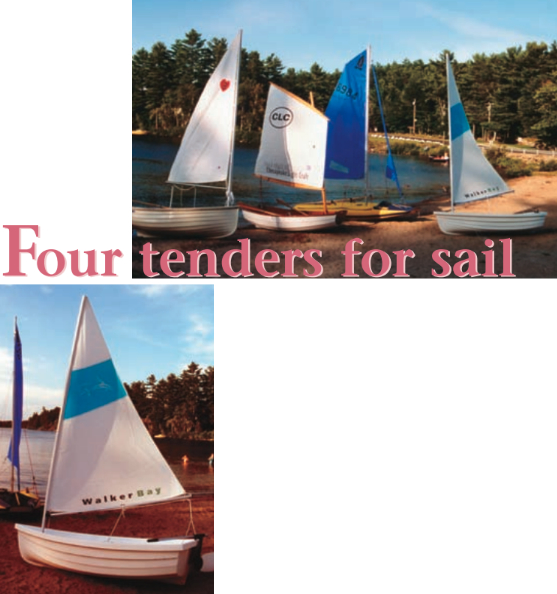
We gathered four sailing tenders, each representative of a different concept regarding how to best set free that desire. Each was developed to satisfy the designer’s best methods of addressing the compromises embodied in a small sailing craft. Each is capable of utility, transporting people and cargo in the best dinghy tradition. But each one has also been designed to take that extra step . . . to let that latent desire take wing . . . to break free and run with the wind.
Plastic and fantastic
You’ve undoubtedly seen the Walker Bay 8. In a world where a good tender has become the forgotten boat accessory (forgotten by boat dealers, that is), these boats have become commonplace, showing up in showrooms around the country, their cheerful blue and white hulls gleaming. A casual glance tells you right away that, though this may look like nothing more than a big toy, there’s more here than meets the eye.
It’s the details that set this boat apart. For instance, there’s a wheel molded into the aft end of the vestigial keel to help save the plastic hull from the rocky shores of the real world and to make it less awkward for one person to move the boat. That keel is hollow to the interior of the boat, so any water that does find its way aboard will settle lower than cargo and not wet the bags and butts that end up sitting on the bottom. The seats are foam-filled for strength as well as for flotation, and the fasteners holding them in place don’t penetrate the centers, so the flotation won’t get saturated. The lapstrake hull is not only pretty, it also gives longitudinal stiffness without the weight penalty and intrusion into the living space of internal stringers.
The test boat arrived unassembled, like a big model kit, and I came to appreciate the quality of the manufacture while I put it together. I admit surprise — the parts fit, without forcing. Holes lined up where they were supposed to. Only one tool (they provide it for you) is necessary to tighten all the nuts; the heads of the bolts are captured by the plastic moldings, and the ends of the bolts are positioned so they are unlikely to tear clothing or skin. The bolts meant to be permanently fastened already have Loctite applied, so they are unlikely to loosen with time. The assembly instructions are simple, and easy to follow — the whole thing from bags to boat takes only 40 minutes or so.
Like the hull, the sailing rig is elegant in its simplicity. The sail slipped easily over the two-piece aluminum spar, and one piece of line served to hold the rig to the hull and as a Cunningham for sail tension. There is a boom vang and an adjustable outhaul on the boom. The rudder assembly was the best of all the boats tested with a simple, positive lock and a push-button release. With practice, the Walker Bay could be rigged and ready to sail in about five minutes and was stable enough to be rigged while afloat — essential for quick evening jaunts from the mother ship. The spars, foils, and sails all come with storage bags. Both the spars and the oars can be stowed in the hull of the boat (though not wedged under the seats — they should be tied in if kept there while under way). The sail could also be left wrapped around the mast for short-term storage.
The light weight of the hull and the fine lines of the bow make it very easily driven, either under oars or sail (we tested none of the boats under power, though all can carry a small outboard). Like the Fatty Knees, and for that matter, all round-nosed dinghies, the Walker Bay is a little tender when you step into it from above but, like a canoe, that initial tenderness firms up as the side of the hull comes more in contact with the water (so-called form stability). The Walker Bay has a fairly firm chine aft, which anchors that stability and also helps prevent the hull from squatting under power or a load. That said, the Walker Bay is mostly a one-adult/two-kid boat. With only the midships rowing station, the normal balancing act of placing a rower forward and the second adult aft, can’t happen without adding extra holes for the oarlocks; and the hull has such a fine bow that the weight forward would impede the otherwise fine rowing abilities.
Under sail, the Walker Bay moves briskly. It comes about smartly and balances the tiller well on all points of sail. The rudder has authority, as evidenced by the boat’s ability to sail backward under control (useful for getting out of irons), and the long keel keeps the hull tracking well. The sail luffs cleanly along the mast, and the unsupported tip bends to spill excess wind in a puff.
Sailing is best accomplished sitting in the bottom, as keeping most of the passenger weight below the waterline helps ballast the boat, as in a kayak. As the boat heels, the chine and the lands of the lapstrake work with the daggerboard to keep the boat on its feet.
When the inevitable does occur, the boat is easily righted, though the mast will fill with water if left upside down for long and may counterbalance the weight of a kid trying to right it. However, this would not be the boat for a kid (or adults unsure of themselves in the water) to sail unsupervised without adding buoyancy bags like those found in an Optimist. The boat will fill with water to the brim, and that may make it difficult to bail or pump enough water to make it possible to re-enter it. My weight along with that of the sail rig meant that the swamped Walker Bay 8 floated in a stable manner about four inches under the surface when I sat in it, and just above the surface when I hung alongside in settled conditions. While this is OK close to shore and in warm water, it could be an issue in any but the best conditions.
Despite that caveat, the Walker Bay 8 is a pleasant surprise. Experience it, and it’ll prove that your first impressions were correct. It is much better than the toy you might take it to be. While its abilities as a working tender might suffer some from its small size, that size and its light-though-rugged construction might be just the thing as a people-mover for folks who don’t need a lot of room to haul anything more. Its low cost, both for the boat and the sailing rig, mean it is really affordable, and perhaps an argument could be made to justify it as a second dinghy, conceivably kept just for the pure joy of having a small boat to sail. A 10-foot version has also been introduced.
Nice touch: The sliding tiller, for different-sized skippers.
Could be better: Could use more flotation.
A traditional favorite
The Fatty Knees dinghy is to the Walker Bay 8 as a Mercedes 300SL is to an MG Midget. Where the Walker Bay is light, quick, and relatively inexpensive, the Fatty Knees is solid, substantial, and built with the best materials. It carries with it the weight of tradition and the blessing of Lin and Larry Pardey who have owned one for years.
The Fatty Knees 8 is a Lyle Hess design and, like his Bristol Channel Cutter and Seraffyn and Taleisin, the Pardeys’ cruising boats, it shares the full buttocks and bluff bow of the eminently seaworthy British pilot boats of the last century. As built by Edey & Duff, it shows the same commitment to quality and attention to detail as their Stone Horse sloop. The bronze fittings, the riveted teak rails, and solid teak foils show that this is a boat to be treasured, to be used well and handed down from sailor to sailor for a long time. And now that the company has produced more than 2,000 of them, one at a time, it has truly become a classic.
From a few feet away the Fatty Knees and the Walker Bay could be confused with one another. Both are lapstrake, and it’s not until you see them side by side that you can pinpoint the differences. The Fatty Knees seems bigger, with its higher topsides, but it’s actually 3 inches shorter and has 1 inch less beam. The bow is not so fine, but the stern is more so: the Fatty Knees has more of a wineglass shape when seen from the transom. Its buttock lines are softer; it’s left without the hard chine. This makes its immersed surface area less than the Walker Bay 8’s and gives it livelier performance despite its greater carrying capacity and one-third higher displacement. The high topsides make this a boat you sit in, not on, and the T-shaped front seat means the interior space is more usable. The boat can swallow all the gear and groceries for a week’s sailing adventure and still give you room to row.
In anything this small, it’s details that count: the optional teak floorboard (oh so nice for keeping feet and cargo out of any water in the bottom) has an opening to get a bilge pump down to the very lowest point when it’s sitting on its lines. The inside fiberglass has been coated with a buff-colored gel to help keep the inside clean. The motor mount, a teak pad, has been offset to port, to make it easier to reach the steering handle of the outboard. The teak cap for the daggerboard opening has a rubber gasket to keep water from coming up the trunk while motoring or rowing (and conveniently makes it much more comfortable to sit on). A bag inside the inspection port in the front seat keeps cameras and lunch safe and dry during dinghy adventures. There is even a notch in the transom so the forgotten skill of sculling can be practiced.
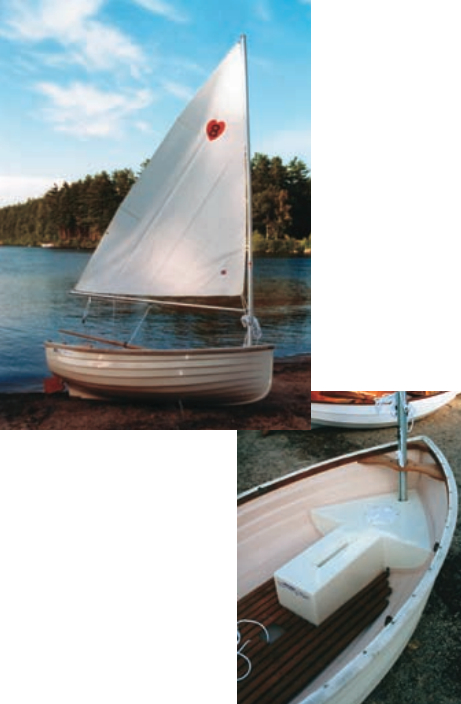
The increased cost of the sailing kit, compared to the Walker Bay 8, is evident in the size and quality of the bits and pieces. The Fatty Knees uses real Harken blocks where necessary, and the bigger-cross-sectioned mast seems also to be Harken roller furling extrusions. The slip-together joint in the mast was yet another of Edey & Duff’s details: the two halves of the male insert are of different lengths, the easier to align them as they slide together. The spars can be stowed aboard the dinghy, as can the 7-foot leather-covered oars. The foils are solid teak, and the rudder assembly is a traditional mix of stainless gudgeons and pintles with a simple but effective cord-based lifting arrangement. Initially, we had some trouble fitting the gudgeons to the pintles, but when we realized the trick was to angle the tiller slightly off the centerline, things lined up much more easily. Because she’s more robust, she’s more likely to get used in higher winds than the Walker Bay, which makes the reef points in the sail more than just a good idea.
In the water the Fatty Knees feels lighter and more responsive than it does on land. She accelerates quickly and is very responsive to inputs from the varnished ash tiller. Upwind she glides smoothly, tacking within about 85 degrees. On a run the bow lifts over the waves and the water slips easily astern, leaving a small wake. The openness afforded by the T-shaped front seat was most apparent when under sail, and the cockpit was the most comfortable of all the boats reviewed because of that room. With two aboard, the crew gets relegated to the front seat and, while the higher weight didn’t seem to affect the heeling moment, fore-and-aft trim could be affected by just where on the seat that weight is placed.
In my experience most dinghies tow best when the towline is fastened to the top of the bow and the full waterline length of the tender can be used. This also helps keep the dinghy from squatting on the back side of the wave, slowing progress for the dinghy and the yacht. On the Fatty Knees, however, the tow eye was perfectly placed (low, just above the waterline), and the dinghy stayed back where it belonged, perfectly behaved.
All in all, the first impression is that this is a well-crafted boat with good performance. It will do a great job in nearly any task, from shuffling gear and people to playing in a crowded anchorage. Further examination continues that impression. A possible heirloom, it might be almost too nice to leave tied to a crowded dinghy dock, there to bump and grind against its less well-bred cousins.
Nice touch: The replaceable sacrificial teak shoe at the end of the keel, designed to take the wear of dragging the dinghy up those rock-strewn beaches.
Could be better: Expensive to buy.
A sailing inflatable?
“Who ever heard of such a thing?” That was the way my friend Jack put it when I first mentioned the Tinker Traveler to him. Well, the Brits, that’s who. The Traveler and its little brother the Tramp are exports from England and are as common there as Avons and Zodiacs are here.
The Tinker Traveler is an interesting hybrid, sort of a cross between a common inflatable and an Olympic-class sailing dinghy. Of the four boats tested, it is perhaps surprising that this is the most purely performance sailing machine of the bunch. The literature says it’s at its best performance in winds between 8 and 15 knots, and that statement is backed up by Michelle D’Aoust of Neris Marine, the East Coast distributor. She tells of blasting around the Chesapeake with a partner and having to use the painter as a makeshift hiking strap when trying to keep this lightweight flyer upright in winds of 20 knots and more. When you see the boat and realize how light the whole package is and that the two hulls and the flat floor are not much more than catamaran hulls connected by a planing surface, you can imagine the turn of speed this demon must have.
Unfortunately, the wind our scheduled sailing day was blowing less than 10 knots, but even in the zephyrs it was obvious that the Tinker was the fastest of the boats. Broad reaching and running, we were able to go just less than the speed of the wind, demonstrating the Tinker’s catamaran-like abilities. She crawled upwind smoothly, tacking between 85 and 90 degrees with the roller-furling genoa pulling well. I was even able to hike the hull upwind, getting the rig high into clear air and effectively sailing on only one hull, a great way to decrease drag and increase speed. As you might imagine, the boat is quite stable with the catamaran hulls and the deep, wide daggerboard giving the Traveler nearly all its surface area below the waterline. The biggest boat of the bunch, it was very comfortable to move around and spend time in, even for two.
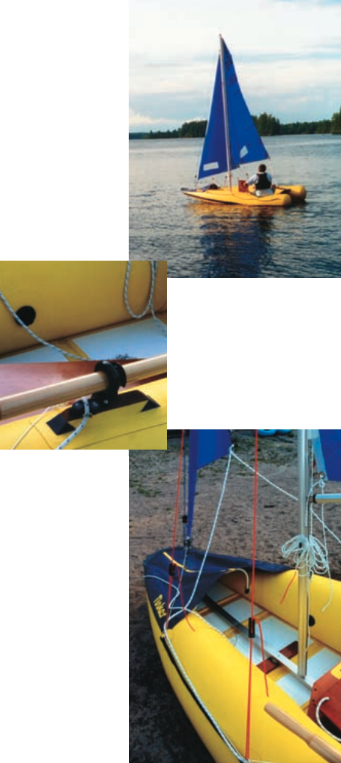
The hull is surprisingly stiff for an inflatable, though it does flex some. The two inflatable tubes that make up the side of a Tinker run one inside the other, and each is enough to keep the shape of the boat, should one be punctured. The base of the mast sits on an aluminum brace that runs from the thwart/daggerboard trunk forward. This also helps keep the bow in place, against the upward pull from the rigging.
Unlike most of the inflatables we’re familiar with in this country, the Tinker has a pram bow, a flat piece of wood that joins the port and starboard tubes together, rather than having the main tube circle back. The tubes, 18 inches in diameter at the stern, taper carrot-like as they go forward, and from the permanently attached spray skirt forward they also slope toward the water. This odd design, reminiscent of the wave-piercing hulls seen in modern multis, is part of a second feature that sets Tinkers apart: available as an option is a kit to turn the dinghy into a highly regarded (and legal for racers) emergency life raft. The bow is shaped low because it becomes the boarding platform for the life raft.
While a low bow makes a great loading platform, under sail downwind it can make a good shovel, and the Tinker newsletter mentions what can happen if you inadvertently stuff the bow into the back side of a wave while planing downwind. (Apparently, there is quite a one-design class in England, and the Brits race these things intensely.) Inadvertent pitchpoling or temporarily “taco-ing” of the boat adds to the excitement, I guess, but it does explain the need for the two big drain plugs in the transom. I expect that it takes an awful lot of wind to get that to happen, and chances are the average user won’t be sailing the boat under those conditions. With the weight of a motor aft, it’s not so much of a problem under power. While rowing, the boat is so buoyant it floats above everything.
Due to time constraints, we didn’t practice the capsize drill with the Tinker, but Michelle asserts that the boat rolls up dry, and I believe her. The boat is so buoyant and floats so high, the round tubes wouldn’t scoop much water on the way back up.
The Traveler had the largest sail area of the four boats with up to 63 square feet set from its three-section mast (52 square feet if you set the working jib, rather than the genny). It was also the most complicated rig of the bunch. It was the only one with stays, nylon cords attached and adjusted with cam cleats. With experience, you could set the rig and be sailing in about 20 minutes, though it would be better to do it ashore.
Rowing the Tinker is a little cumbersome, with the locked-in oars, and the seat atop the thwart is of necessity at the same height as the row locks, making for an inefficient stroke angle. Michelle says they’re coming out with a set of breakdown oars for next year that’ll be easier to store, and with luck the grips will be smaller, too. It rows well, though tracking is a bit of an issue without any kind of a keel, and the light weight makes it hard to have any authority over wind and chop. The best place for a passenger is forward of the thwart, feet under the skirt, facing forward. Sitting back-to-back with a passenger would give the rower some more support. There is room for cargo between your feet and farther under the skirt, but the tall rowing position would limit the amount you could carry. Like most inflatables, it’s better to motor if you have to go any distance.
There is a towing eye well anchored on the pram bow, but like most inflatables, the Traveler is going to tow best with the bow tied against the stern rail, nose in the air. Even then it’s susceptible to wind gusts and wear on the Hypalon. Since it folds up into a space less than 4 feet by 2 feet by 1 foot, why bother? Let the air out, stick it in a locker, and refill it when you get there. It only took us about 10 minutes with the supplied double-acting pump. Isn’t that the beauty of an inflatable?
Testing the Traveler was an interesting diversion into just what a sailing tender might be. It embodies all the useful attributes of an inflatable: light, stable, and taking a minimum amount of storage space, with the added excitement of sailing and the ability to become a true emergency life raft. Its ability to sail will appeal to those who expect more from their sailing than a pleasant dodder around the cove. That it is a quality boat becomes apparent when it’s known that no less than respected technical maven Nigel Calder owns one.
Nice touch: The tensioners on the stays.
Could be better: Complicated rig.
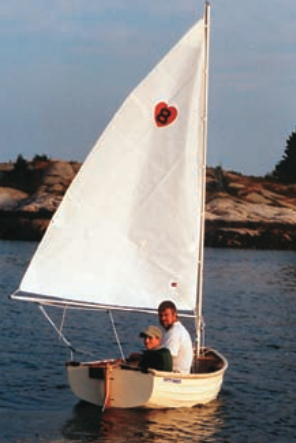
A pretty pram
The Chesapeake Light Craft’s new sailing tender nearly didn’t make this test, and wouldn’t have without the lucky intervention of an anonymous truck driver. The logistics of getting the boat finished on time and delivered to our test site seemed insurmountable as the deadline loomed, until a delivery driver allowed as to how he just happened to be heading from Maryland to New Hampshire and that he would be glad to drop it off.
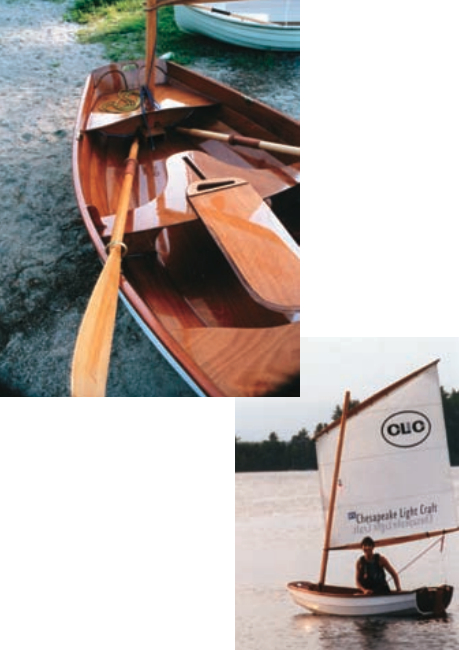
There was no doubt about which boat was the favorite of the beachgoers when we pulled up to do our photo shoot. In the last rays of sunlight, the deep-red stained and varnished wood, offset by the contrasting white paint, seemed to glow from its own inner light source. One of the beachgoers referred to it as sculpture, and Barbara and I immediately gave it its name, “Art.”
Chesapeake Light Craft is an Annapolis-based company specializing in making plans and kits for do-it-yourselfers to complete. They started out with designs for sea kayaks and have a whole stable of those craft. Several years ago they started branching out into other designs: rowing gigs, sharpies, skiffs, and this one, the Eastport Pram. It’s such a new design it’s not even listed in their current catalog.
Most of the designs are built using the stitch-and-glue method of boatbuilding — flat precut panels of wood are held together using short twists of copper wire and tape. Once the epoxy has set, the wires are cut off, the joints are filleted, and the holes are filled using thickened epoxy. It’s a quick, relatively simple method of building small boats that are very strong and usually very light, as the panels create a monocoque structure without the need for the weight of internal bracing. It’s a technique that’s perfect for getting folks with the most basic of tools and skill levels afloat in vessels they’ve built themselves, boats they can be proud of.
With the exception of a few bits of hardware for the rudder, and so forth, there’s almost no metal in the whole boat — a couple of pairs of oarlock sockets, a couple of screws to hold the cleat and the towing eye in place, and that’s about it. It’s details like this that make the Eastport the lightest of the bunch, weighing in at just 55 pounds. It’s also the smallest of the four, measuring just 7 feet 9 inches, with a beam of 48 inches. It spreads the same 39 square feet of canvas as the Walker Bay and carries the same load as the Fatty Knees. It also looks like a lapstrake, and has some of those virtues, but because the individual panels are wider, it is more correctly a multi-chine hull.
The stiffness and lightness, coupled with the lowest wetted surface of the four, means that “Art” was the most easily driven of the boats, noticeably so in the light winds we encountered. Rowing from the center seat with the spoon-billed oars moves the boat with a minimum of effort, and it sails in just a ghost of a breeze. It punches through chop and boat wakes more easily than might be expected from such a light boat, particularly with that flat pram bow, a benefit of all that stiffness. The bottom panel is shaped and wider in the middle than it is at the bow, which helps with buoyancy and tracking. The Eastport is not the fastest of the bunch — it’s got too much rocker for that — but that rocker makes it very nimble. The rocker also makes it a little more conscious of fore-and-aft trim than the others. It really likes to have the weight in the boat centered. I found it happiest when I sailed it from atop the center seat, though Barbara was able to sit in the normal spot quite comfortably. It does come with two rowing stations and still leaves some room for cargo between the passengers’ knees.
The gaff rig was the best balanced of the boats without a jib, the peak of the sail forward of the mast helping to balance the helm. The boat reached and ran well, as is to be expected with a big square of canvas set high on the one-piece mast. During upwind work the boat sailed flat though we noticed that heeling it intentionally helped prevent leeway. We had problems with the daggerboard wanting to levitate out of the slot when sitting still in the water, though once water is moving past it, it’s not a problem. Tying it in place wouldn’t be a bad idea, especially in the event of capsize.
The rudder is big enough for control and helps with the lateral plane, but it’s here that it becomes obvious that this design is still a work in progress. Instead of using gudgeons and pintles, the builder’s lighten-at-every-cost mentality shows. They compromised the weight issue with four stainless steel eyescrews, set in the transom and the leading edge of the rudder stock. These are connected by, and pivot around, a length of stainless rod, that is drilled for split rings top and bottom.
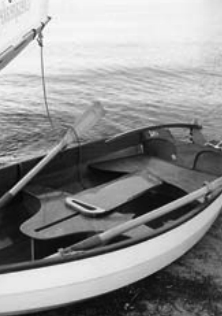
The idea is that with one hand you line up the four eye screws (two of which are mounted on a piece of wood: the rudder, which wants to float away) and then you put the rod down the centers of all four eyes. Then, without dropping the split ring, you open it up and put it through the hole in the bottom of the rod. Couple this with the fact that the tiller is in your face and that the rudder has no provision for kicking up — so you have to be in a bit of water to get it in place — and it means that parts of you are getting wet while you rig the boat. Did they save much weight? An ounce or two at best. This system is way too fussy. Two pintles, two gudgeons, and a thumb latch, and it’s all over with, weight be damned!
All in all, though, the Eastport proved itself a fun little boat that’s enjoyable to sail and has working capabilities that belie its small size. As a tender to a yacht, it will fit on the foredeck of all but the smallest of cruisers. As a sailboat in its own right, it’ll satisfy all but the most demanding. And as a piece of “Art” that you can make yourself, well how satisfying is that?
Nice touch: The two wear strips on either side of the skeg on the bottom. They keep the boat upright and stable on the beach, and help the boat track in the water. (Perhaps they could be faced with stainless-steel rubrail, to save them from wear, too?)
Could be better: The mast is too long for easy storage aboard the mother ship. Perhaps a two-piece take-apart stick, like the Fatty Knees/Walker Bay, or better yet, a two-piece sliding mast would be more appropriate.
Scott has returned three boatyard monsters to solid sailboat status with the primary addition of elbow grease. He and Barbara sail Penelope, their 1968 Camper-Nicholson 32, from Falmouth, Maine.
Thank you to Sailrite Enterprises, Inc., for providing free access to back issues of Good Old Boat through intellectual property rights. Sailrite.com