Friends forever . . . fiction with a touch of truth
Issue 18: May/June 2001
“JIMMY? IT CAN’T BE. YOU’RE DEAD!”
“I’m standing right here in front of you, Bob. I’m not dead.”
The shallow, wrinkled face of Bob Wainwright went from surprise to sadness. “Why aren’t you dead? You said you’d be dead. I mourned for you.”
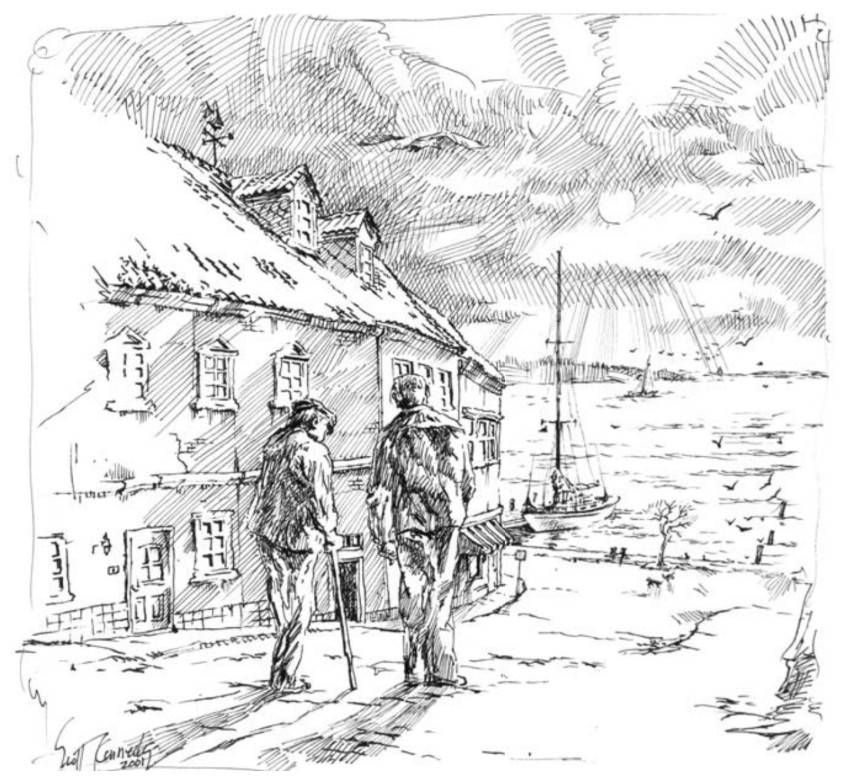
Jimmy Sangster looked down at his friend of 75 years and read the disappointment in his eyes. The park around them was quiet on a crisp, fall day with no one walking through the brilliant carpet of red and yellow leaves laid amid the sparse stand of lonely, naked trees. Bob sat on the bench the way he always had since moving into the seniors’ home across the street. His shoulders were stooped, his hands rested on the curved handle of his cane, and his knees, showing bony and thin through his trousers, were given to shaking as if he had to go to the bathroom all the time.
In contrast, Jimmy Sangster stood stiffly at attention to his full height of six-foot-three. He was still an imposing figure of a man at 84 years of age, with a shock of thick, white disheveled hair over a tanned, leathery face, broad shoulders, barrel chest, and only a slight paunch around his middle. In his youth, he’d been six-foot-five and proud of it. He decried the loss in stature and wondered where the two inches had gone. Perhaps the same gremlin that had snuck in one night and pasted thickets of springy gray hair over his eyes had also filed away at the soles of his feet. Such were the mysteries of aging.
He looked down at his stooped friend and pictured him once again on the day they’d met by the railway tracks, hitching rides. Bobby had been 10 then, with a wiry, thin body and a thick, black tangle of hair. Jimmy was only nine, but already stood almost a head taller. Still, he’d never mess with Bobby. Bobby had a toughness and determination that more than made up for any size disadvantage. In a fight or hopping trains, he was fearless and relentless. And now, all these years later, it took all that determination and guts just to get up in the morning and shuffle across the street to the park.
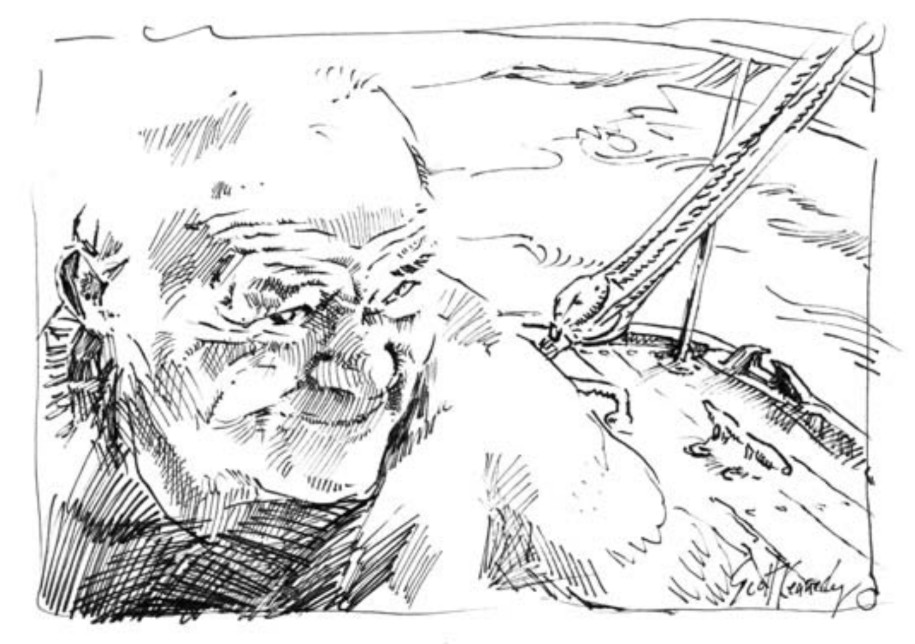
“What’d you do, chicken out?” asked Bobby, looking up, feeling his hands shake on the cane, and regretting the words as soon as they’d come out. Jimmy squared his shoulders and looked down at the pale white expanse of skin where a 10-year-old’s thick, black hair had been.
“Doesn’t matter,” apologized Bobby, quickly. “It’s just that for 75 years you were always the one person I could count on to do what you said you were going to do. You’re the last idol to fall, Jim, but at least you lasted longer than me.”
Jimmy sat down beside his friend and the bench squeaked its objection. “You been cashing my pension checks like we planned?”
“Sure.” Bobby smiled at the thought of the government and Sun Life finding out they’d been paying a dead man, but not until long after they were both gone.
“You got any of the money?”
“Got it all, more’n $1,800 right in my sock. Cash money, and no one at the home knows a thing about it.”
“Thought you’d buy a VCR or something.”
“What for? Can’t run one of the damn things anyway.”
Both men stared at the ground and said nothing for a long time, struggling in an awkward silence. Bobby felt the numbness in his fingers and toes from the diabetes; he would have to go back soon. Still, he wanted to know.
“I’d toast you every morning with my prune juice, you know. Every day for the last three months I’d raise that glass high in the air and say, “Here’s to my best friend, Jimmy Sangster. Lived like a man, died like a man.” Jimmy leaned back, visualizing the raised glass and toast to an uncaring room full of old folks, but said nothing. “So why didn’t you die?” demanded Bobby.
With a long sigh, Jimmy began. “I did what I said I was going to do, Bob. I went down to the boat and there she sat, just the way I’d left her. New owner hadn’t even changed the lock. According to the harbormaster, he’s only had her out a few times over the past six seasons.”
“You talked to the harbormaster? But I thought you were just going to jump aboard and take her.”
“When I saw her I knew she hadn’t been sailed in a long time. Harbormaster told me the owner was in Europe, so I just said he asked me to take her over to Long Beach for refurbishing. He could tell I knew the boat and that was that.”
“So you slipped her lines and out you went, just like you said you would.” Bobby’s shoulders straightened a bit and his eyes started to take on a twinkle that had once belonged to a 10-year-old crouched beside a railway track, ready to jump a slow freight train.
Jimmy turned to face his friend. “You know, that engine started on the third crank. That’s an amazing boat. It felt just like I knew it would. I guided her out past all the piers, waving to everyone just like we used to, and she just hummed along. I cleared harbor under power and then put up the main and the jib, pointed her west, and let her sail. It was a beautiful sunny day with a gentle wind, and the sails filled, and she leaned into it. God, it was a beautiful day to die, Bobby, a beautiful day to die.”
“And you didn’t take any food or water or anything with you?”
“Nope, not a thing, but after I put her on autopilot and went below, I found the tank was full of fresh water, and the galley was stocked with all kinds of canned goods and a bottle-and-a-half of Pinch.”
“But you said the guy was in Europe? Hadn’t been on the boat in months?”
“Right,” shrugged Jimmy, “but he paid one of the kids at the marina to keep her stocked in case he got a chance to come back and go for a sail. I found that out later, when I brought her back.”
Bobby had been sitting a long time. He wiggled his butt on the hard wooden bench. He felt an ice-cold deadweight from his knees down. It would be difficult to get up. “So why’d you bring her back? You said it when you left. You got arthritis in your hands and both knees. You got a heart condition. You got the prostate problem. Life wasn’t going to get any better, you said.”
“I said it, and I meant it.” Jimmy leaned into the conversation. “The first day I didn’t eat a thing, and I didn’t have the medication with me. I let her just sail out into open ocean. But somewhere around nine or ten, in the dark, the breeze stiffened, and she took a hell of a heel. I had to go forward and take down the jib on a plunging deck awash in seawater, then a reef to the main, then I hoisted the working jib, and then the angina hit. I went back to the cockpit and waited. Hurt like hell, but I thought it was a great way to go.”
“How’d you get the jib down? That was a two-man job 20 years ago.”
“Don’t know. Didn’t think I’d have the strength, but I got her done.”
“Jeez.”
“Anyway, my chest felt like Neptune was standing on it, so I went below and got the bottle of Pinch. Next thing I know, I wake up to a beautiful sunrise, and she’s sailing along flat as you please. My hands hurt like hell from the ropes and the dampness, and I thought my legs would break off when I first moved them because I’d fallen asleep in the cockpit, but as the sun warmed me, things got better. Made myself a coffee and put up more sail.”
Bobby sat enthralled at the story. He’d forgotten the numbness in his legs and hands. He remembered when he and Jimmy would sail up and down the coast for weeks on end, stopping at each yacht club, buying drinks and meeting people. Those were great days.
“It went like that for three days,” continued Jimmy. “Didn’t eat a damn thing. Drank coffee in the morning, water all day, and Scotch at night. Found the prostate got better and better so’s I could piss over the side without dribbling all over myself. I’d get a shot from the ticker every now and then, but I’d just stop working and rest until it was gone. Then on the fourth day, the storm hit, and I figured that was it.”
Bobby leaned forward, putting all his weight on the cane and pushed down hard to stand up. He shuffled his unfeeling feet to get some circulation back into them. Jimmy just stared up at him as he hobbled back and forth, supporting himself on the cane. “Well, go on,” Bobby said, almost angrily.
“Well, it was one hell of a blow. Wind speed indicator showed she was going at 60 to 70 knots. Got the jib to the deck and tied down. I was at the mast trying to get the main down when the mainsheet let go at the buckle, and the boom nailed me in the shoulder, sending me to the rail. The main was halfway down and filled like a pillowcase. She was plunging and bucking into the huge swells, and I thought she’d sail right under. I was lying on the deck, my shoulder hurting like hell when a wash of water picked me up and threw me against the rail. Would have gone right over, but I reached up with one hand and grabbed on.”
“Seventy knots with that main loose and not reefed. That’d rip the mast right off her,” Bobby said.
“That’s what I thought.”
Bobby’s pace quickened as he limped back and forth in front of the bench. His toes were still numb, and he waited for the next words, which came haltingly from the sitting figure staring down at the green wooden planks of the bench.
“Bobby, as I hung overside there, my feet in the water, the waves tugging and tearing at me, trying to pull me to the water, my hands numb, I said to myself, ‘This is what you wanted. Just let go, and it’ll all be over.’ But I couldn’t let go, Bob, I couldn’t let go.”
Bobby stopped his pacing a moment and looked down at his friend. There was moisture in Jimmy’s eyes along with a very clear sense of the mystery of that moment. Jimmy looked up, seeking an answer from his friend. “I was four days out, in the middle of the ocean, fighting for my life in the worst gale I’ve ever seen. It was perfect, and I couldn’t let go.”
“Course not,” said Bobby. “A challenge like that, you couldn’t just quit. Winning against all odds, that’s what life is all about!”
“I suppose. I don’t know how, but I hung on there for at least an hour until it let up a bit and I could pull myself into the cockpit. I cut the main halyard and went below. My chest hurt like hell, thought my shoulder’d been broke, and I fell asleep in the main cabin with the hull rockin’ like a roller coaster. Never thought I’d wake up, but there I was again the next morning, sipping coffee on deck in a pouring rain. The wind had died down, but it was cold and wet. I jury-rigged the main and turned her around, and here I am, Bobby, and I don’t know why. As soon as I tied her up, I knew I’d made a mistake. I should have stayed out there. I should have died. There’s nothing here but dried-up old memories and young people pushing you out of the way. I don’t know why I came back.”
Bobby leaned heavily on the cane and sighed. “I know why you came back, Jimmy.”
Jimmy looked up in surprise. “Why?”
“You came back for me.”
Like a hand drawing a line on his face, Jimmy’s mouth slowly arched into a broad smile. “You! You! You wouldn’t last five minutes out there. Take you off those blood thinners, and your arteries will clog up like grease in a drain pipe.”
“Ya, well, we’ll see. Maybe I’ll be the one pushing your carcass over the side.”
“Jeez, you won’t even make it to the boat. Look at the way you’re limping.”
“Ya, well, you’d limp, too, with a wad of bills in your sock. Now let’s get going before they come looking for me.”
Bobby turned and straightened his back and shoulders as best he could. He moved off down the gravel path away from the barren trees, away from the park bench and the old-age home. Jimmy sat there a long moment and then rose and followed him.
“It’s October, Bobby, there ain’t going to be many sunny days.”
“Maybe, but there will be Pinch, and sardines, you know the small ones we used to have aboard. Got to get some of those.” Jimmy fell into step beside Bobby’s limping gait.
“So now we’re going to the grocery store. And I’m going to stand there while you take off your shoes and socks in the middle of the check-out line to pay for this stuff.”
“I’ll get the money out of my sock in the bread section. And fruit. We’ll die of scurvy before anything else. You’d never think of fruit.”
Jimmy put his hand on Bobby’s cane and brought him to a halt. The two men turned to face each other, wrinkled old warriors planning their final battle. “What about your stuff at the home?”
“Nothing there I need, Jim.”
Jimmy pulled himself up to his full height, feeling Bobby’s hand shake on the cane beneath his, “Whichever one is left aboard raises a glass every night he’s able, to us.”
Bobby put his hand over Jimmy’s and felt a warmth come back to his numb fingers. “To us.”
The afternoon sun hung low above store rooftops lining the main street of the small town. The two silhouettes stood facing each other on the sidewalk. Behind them, the paved street stretched down to a pier far in the distance. The cold wind of a disappearing fall day swirled around them. They turned toward the harbor and leaned into it.
Don, a freelance writer, sails a 1974 Grampian 30. He lives in Toronto, Ontario, and sails Lake Ontario with the North Channel and Georgian Bay as favorite destinations.
Thank you to Sailrite Enterprises, Inc., for providing free access to back issues of Good Old Boat through intellectual property rights. Sailrite.com