Expanding storage and improving their function
Issue 82 : Jan/Feb 2012
One of the rewards of owning good old boats is overcoming the challenges they inevitably present. It helps to prioritize and pick your battles though, to avoid being overwhelmed. One project I took on recently was to deal with a number of dysfunctional drawers, making the most of their organizational and storage potential.
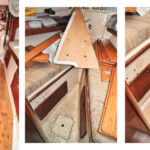
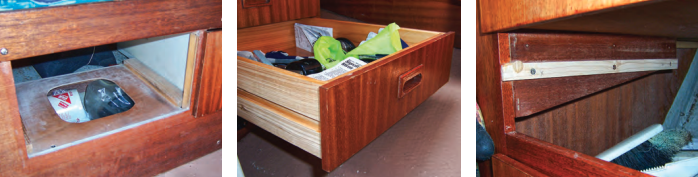
Our 1973 Albin Ballad was originally built with plastic drawer boxes faced with mahogany plywood drawer fronts. They are of two sizes: shallow and deep. The deep drawers are very successful, really more like bins than drawers. Sturdy and capacious, they slide in and out under the settee berths, supported by a flat plywood panel beneath them. Below the plywood, however, was a fair amount of dead space I wanted to access for extra storage, inspection, and ventilation without compromising the function of the drawers or the outward appearance of the boat’s joinery.
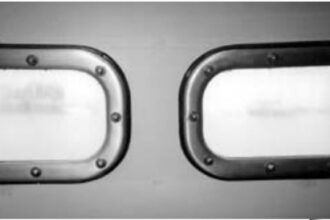
I accomplished this quickly and easily by making a simple plywood pattern of the drawer-compartment bottom and cutting a square hole with rounded corners in the center. The perimeter margin is about 2 1⁄2 inches wide, which still gives plenty of support for the drawer. Using this pattern and a small router fitted with a pattern-cutting bit, I made short work of opening up the four plywood bottom panels since they’re all the same size. It was kind of like using a cookie cutter. Working with drawers can often be a series of repetitive processes that, if well organized, can be very productive and satisfying.
Because the drawers have to be removed completely to get at them, we use the hidden spaces for storing things we don’t need very often. On one side, we store extra bottles of wine, rolls of paper towels, and bags of pasta. On the other side are spare fuel filters, pump-rebuild kits, and engine parts that I hope to never need but would regret not having if I do.
Old faces, new boxes
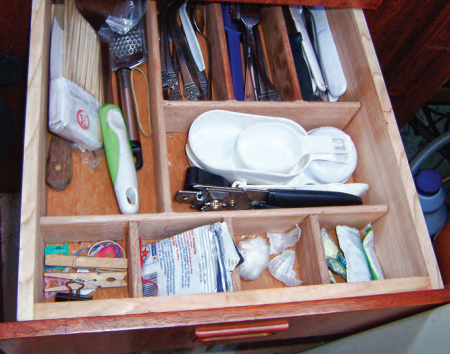
The shallow drawers were another story. Some of the bottoms were cracked from the weight of winch handles and snatch blocks being thrown into them over the years and the slide mechanisms were flimsy plastic channels stapled to the inside of the carcass. It frequently took some jimmying and selective language to get these drawers back into place. There are four of these drawers, three in a stack under the nav station and a utensil drawer in the galley.
I decided to replace all four with nice new wooden drawer boxes running on wooden slides dadoed into their sides. I reused the original drawer faces to preserve the character of the Albin Ballad’s Danish modern interior. I milled to a 1⁄2-inch thickness some nice scraps of clear-cedar fence boards I’d been saving. Once more the production-line efficiency of making multiple similar boxes came into play. The drawer slides are simply 1⁄4-inch x 3⁄4-inch sticks of mahogany the same length as the drawer cavity. The dadoed drawer slide is a nice reliable mechanism that minimizes the material and structure needed to support the drawer and maximizes the size of the drawer. It provides a distinctive touch but is hardly ever used in production work because some care is required to position the slides properly.
A crafty stop
The three drawers under the nav station are oriented fore and aft, so they don’t need the stop/lock mechanisms typically used on boat drawers to keep them from flying open when the boat heels. The galley drawer, on the other hand, opens athwartships and needs a stop to keep it closed when we’re sailing on starboard tack.
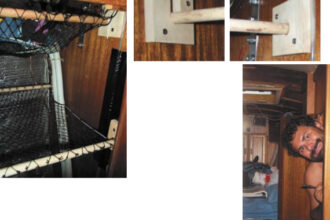
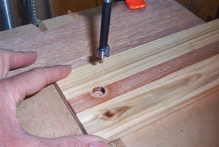
I devised an effective drawer stop by insetting a thin cross section of a 1⁄2 -inch dowel into the drawer slide in such a way that it engages the drawer side when the drawer is closed. The beauty of it is that it’s very easy to build by simultaneously drilling a shallow hole in the side and the slide to accept the dowel. This ensures perfect t and registration between the two pieces. The best drill bit for this is called a Forstner bit. It makes very clean at-bottomed holes with precision and should be used in a drill press. The bottom edge of the dado on this drawer needs to be widened by a bit more than the distance that the dowel protrudes from the slide so the drawer box can lift up and ride on top of the dowel as it opens.
A place for everything
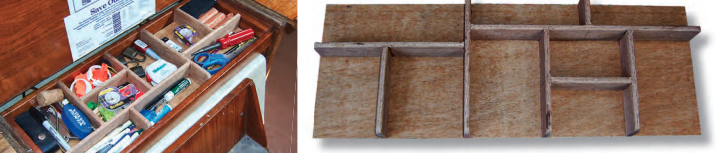
The plastic organizing trays we’d been using in the drawers up to this point had to go because they looked tacky and didn’t efficiently use all the available space. That is the danger of raising the bar in one area. High standards tend to insinuate themselves into other areas or you become a snob, depending on your point of view.
For the galley drawer and the ip-top compartment under the companionway steps, I made custom sets of dividers to make the most of every available inch. I mocked these up using all the actual items to be housed therein. I made the compartments by fitting a 1⁄8-inch-plywood door skin closely to the bottom of the drawer box and attaching 5⁄16-inch mahogany partitions to it with glue and brads. The drawer box itself forms the perimeter and the compartmentalized board can be lifted out for cleaning.
Our eight drawers and related spaces are ring on all cylinders now and pulling their weight in our quest to make the most of our 30-foot sloop. At a time when many production boatbuilders are eliminating as many drawers as possible (and almost everything else made out of real wood) to cut costs, good old boats, well maintained and thoughtfully appointed, may begin to look luxurious by comparison.
Tony Allport is a SAMS marine surveyor. He lives on Anderson Island, in southern Puget Sound, and sails extensively with his wife, Ann, and children, Alden and Claire, on their Swedish classic 30-foot Albin Ballad sloop, Pleiades. He is also known on the island as a skilled cabinetmaker and for his excellent pies. See .
Thank you to Sailrite Enterprises, Inc., for providing free access to back issues of Good Old Boat through intellectual property rights. Sailrite.com