A cut above the competition
Issue 67: July/Aug 2009
Just after high school, Jerry Riggs began a life with boats racing 75-mph Class B hydroplanes. A fascination with engines and aerodynamics led to a part-time job in college testing outboard engines for Mercury Marine that eventually led to an engineering degree and a career in torpedo-propulsion testing. Along the way he married and built a house just outside Kingston, Washington. He and his wife, Jean, raised a family and cruised in a succession of powerboats while changing diapers, water skiing behind skittish 17-foot runabouts, and eventually cruising into retirement.
For veteran and committed powerboat people like the Riggses, this would seem time for a trawler yacht — something less strenuous, something suitable for retirees in their 60s. But just before hip replacement surgery, Jean revealed a long-held, but secret, love affair with sailboats. Initially dubious, but sensing a challenge, Jerry said, “OK, let’s do it.”
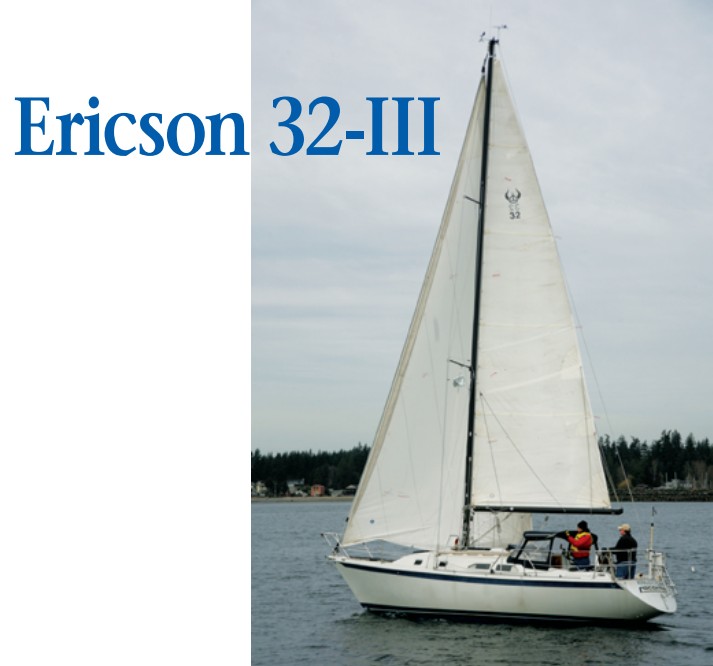
A search began that led to Raconteur, a 1986 Ericson 32-III, and it was love at first sight.
Design
The first Ericson 32-footer was actually called the Scorpion 32, and was a development of the Sabre 5.5 meter built by Columbia Yachts. Next was the Ericson 32-II, a racer/cruiser designed by Bruce King and built between 1969 and 1978. The 32-III, modernized from its forerunner in several significant ways, was built beginning in 1985. A fourth model, the Ericson 32-200, was essentially a deluxe version of the Ericson 32-III. In 1990, some Ericson molds were acquired by Pacific Seacraft, which built the last 32-foot hulls, calling them the Ericson 333. The run finally ended in 1998.
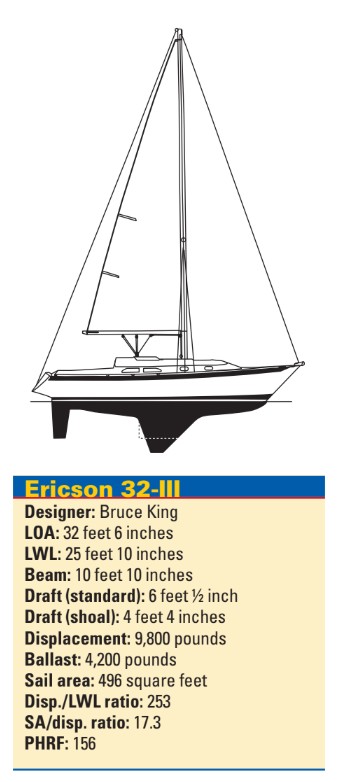
Compared to its predecessor, the 32-III is 11 inches longer, nearly 2 feet beamier, and 1,000 pounds heavier. It was available with several keel configurations, the standard fin being 1 foot 3 inches deeper than the 32-II’s. It’s no surprise, then, that the 32-III carries more sail area on a rig that has a significantly higher aspect ratio. The displacement/length ratio is 253, which is moderately heavy, indicating there’s enough volume in the hull for sufficient tankage and stowage for respectable cruising distances. And the sail area/displacement ratio of 17.3 is fairly high, suggesting the 32-III will do well in light air.
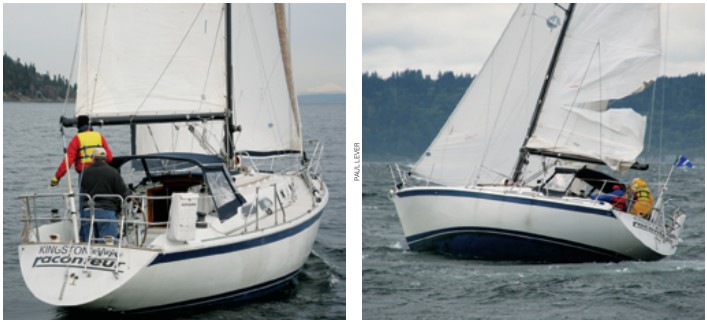
The most important difference in the 32-III compared to the 32-II, however, is the more vertical planform of the underwater appendages compared to the earlier model’s swept-back keel and rudder. These new shapes reflected departures from the CCA rating rule that influenced the design of earlier models during the 1950s and ’60s, as well as the current thinking about keels and rudders in the 1980s.
The Ericson 32-III also was designed by Bruce King and bears a strong family resemblance to the other Ericsons by King. For example, look for the pair of long trapezoidal deadlights in the after end of the cabin, and count the number of smaller portlights forward: the Ericson 34 and 35 have three, the 32 has two, the 27 has one, and the 25 gets by without any. Another common element is the wide sheer stripe that swoops up to the deck at the bow.
In a field of boats that had to respond to strong market forces, appeal to family cruising requirements, and race respectably, the Ericsons were tough competition. There is an attention to detail in the boats — a certain refinement — that helped establish Ericson’s reputation for being a cut above average. The overall appearance of the Ericson 32-III, both on deck and below, is one of unity and consistency, free of extremes, giving the impression of a good solid boat, conservative in styling, and wholesome in concept and execution.
Construction
Construction of the Ericson 32-III reflects standard practice during the 1980s. The hull is molded of solid hand-laid fiberglass and polyester resin. Deck and coachroof are fiberglass cored with end-grain balsa. Plywood is substituted for balsa in all highly stressed areas as well as in the cockpit construction. The hull/deck joint is encapsulated in four layers of 3-ounce mat and 7 1/2-ounce cloth. The joint is mechanically fastened and finished off with an aluminum extrusion that’s covered by a vinyl rubrail and terminates in fiberglass moldings. Ample molded-in bulwarks stiffen the hull and also provide secure footing on deck.
The 32-III was built with what Ericson termed a “Tri-Axial Force Grid” (TAFG), more commonly called a pan or inner liner, which replaced many interior components, like floors and stringers, previously made of plywood and solid wood. Unlike many pans, this one did not include the berth flats, which Ericson continued to make out of plywood. The TAFG is a single-unit network of hand-laminated fiberglass floor beams and other members intended to strengthen the hull while better distributing structural forces from the engine, mast, shrouds, backstay, and forestay. The whole armature is bonded to the hull during layup and adds pivotal resistance to the lead keel, which is bolted on, not encapsulated as it was in the earlier models. Ericson claimed the TAFG was engineered to save weight, allowing the use of large amounts of teak cabinetry without sacrificing overall performance. It also saved man-hours, which helped amortize the cost of making the tooling.
Among the deck fittings are four 10-inch mooring cleats, Lewmar deck hatches, an acrylic companionway sliding hatch, and Dorade cowl vents with stainless-steel guard rails.
As with most other boats of her day, Raconteur has a few stress cracks in the gelcoat, mostly in areas of sharp turns in the mold.
The rig
The Ericson 32-III is a masthead sloop with a keel-stepped, black-anodized aluminum mast tapered at the top to reduce weight and wind resistance. Standing rigging is a pair of cap shrouds incorporating two pairs of spreaders, fore and aft lower shrouds, a headstay, and a single backstay.
The 32-III carries a 207-square-foot mainsail. Sheeting arrangements for the main are midway on the boom and mounted on the cabin top. Raconteur is equipped with a Barient 17 one-speed halyard winch at the mast, two Barient 27 two-speed genoa sheet winches at the cockpit, a Barient 18 one-speed to the port side of the companionway, and a Barient 17 one-speed to the starboard side to handle the mainsheet, boom vang, and reefing requirements. All the winches are self-tailing except for the Barient 18.
Accommodations
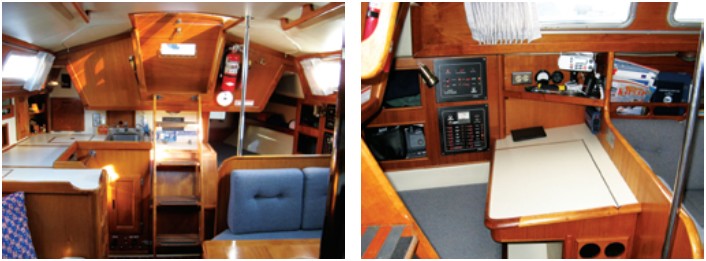
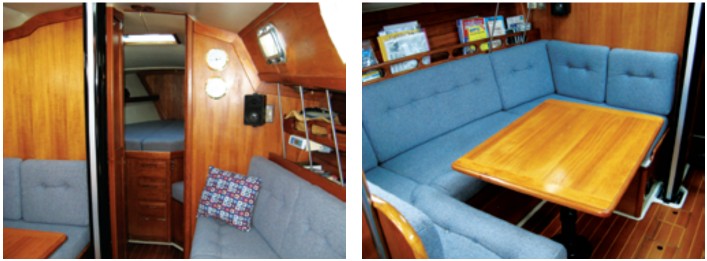
The Ericson 32-III has a very workable interior plan with 6 feet 2 inches of headroom. In the forward cabin, the V-berth is 6 feet 6 inches long and 6 feet 6 inches wide at the head. In the saloon, both the dining table with its surrounding seats and the single settee opposite are backed by ample shelving and solid fiddle rails that also serve as secure and convenient handholds. Between the saloon and the forward cabin are the head compartment and a hanging locker.
An 18-gallon fuel tank is mounted below the generous 6-foot 6-inch-long quarter berth, the end of which serves as a seat for the chart table. The galley is aft, to starboard, and is fitted with a two-burner gimbaled propane stove and oven and an ice box. Raconteur has hot and cold pressure water. Two water tanks amidships and one at the bow hold a total of 50 gallons.
Typical of Ericsons, the interior finish is largely teak, from the overhead handrails to the teak-and-holly sole. The joinery and upholstery meet high standards.
Auxiliary power
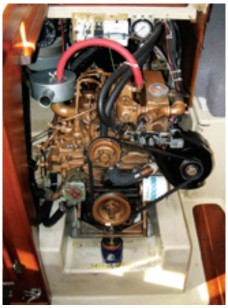
The standard engine was a 21-hp, 3-cylinder, freshwater-cooled Universal diesel. Access to it is excellent. Once the companionway ladder and engine box are removed and stored, it’s exposed for all to see and service.
As an engineer and former powerboat skipper, Jerry said the first thing he did was turn Raconteur into a good motorboat, making any changes necessary to bring maximum reliability and power to his propulsion system. He rewired as necessary and installed new motor mounts and several new engine-monitoring instruments. The engine compartment was rigorously soundproofed and, in order to eliminate stray odors, Jerry fitted a thermostatically controlled 4-inch exhaust-air duct leading from the engine compartment to a cowl vent on deck. Additionally, a ventilation hose redirects the flow of air from the crankcase to the engine air intake; the previous installation had it leading to the shallow bilge.
Under way
Friends suggested that Jerry learn the finer points of sailing by racing as a member of the Edmonds Corinthian Yacht Club. The weekend before I was to test sail Raconteur, Jerry entered her in the last race of the year from Edmonds, just north of Seattle, across about 6 miles of Puget Sound and back.
On a beam reach under full mainsail and a 130-percent genoa rolled to about 100 percent, the anemometer showed 20 knots, gusting to 25. Keeping the boat under 20 degrees of heel became difficult. When they rounded the buoy on the far side and turned for home close-hauled, the wind increased, and they put the first reef in the main.
By the time the fleet cleared the shipping lanes, wind speeds were 20 to 30 knots, gusting to 35 and 40. Waves were averaging 3 to 5 feet, making for a lumpy sea. Heeling was severe in the gusts. About a third of the fleet dropped out and the VHF crackled with reports of two dismastings. A crewmember went overboard from one boat but was retrieved quickly from the 50-degree water. The Coast Guard was standing by. All this was very exciting for Jerry and his crew, who had yet to meet winds like this in the Ericson.
Unfortunately, the crew was unable to set the second reef in the main for a variety of reasons, including waiting too long. Just before they crossed the finish line, a strong gust hit and Raconteur’s mainsail tore from leech to luff. It was a wild ride, but they hung on and finished fourth in their division of six boats. Jerry felt good as they cleared the breakwater and entered the marina, buoyed with confidence gained from having gotten through some difficult waters without injury to his crew. Raconteur had forgiven some serious mistakes in handling and gained the respect of captain and crew.
A few weeks later, Jerry and I took Raconteur out for trials with a repaired mainsail. Compared with the unpredictable but usually squirrelly performance of my scimitar-keeled Ericson 31C when backing, the 32-III maneuvered confidently. She handled well under power, accelerating smoothly and quietly. At about three-quarters throttle, she makes 6 to 6 1⁄2 knots, burning less than 1⁄2-gallon of fuel per hour. The engine seemed unusually quiet.
In the 15 to 20-knot winds we had on that day, the boat was well balanced under one reef and the 130-percent genoa. Though lively in the gusty conditions and considerable chop, she was easy on the helm, tracked well, and tacked through about 110 degrees. She came about quickly and surely with little effort.
Sailing the Ericson 32-III in heavy weather shows that it is well to anticipate the need to reef. To avoid excessive heeling and the strain that places on boat and crew, the first reef should go in well before the wind hits 20 knots. A second reef would have been most valuable under the race conditions Jerry faced.
It’s worth noting that the Ericson 32-III sails handily under either main or headsail, both on and off the wind, an especially desirable feature for the singlehander.
In most PHRF fleets, the 32-III rates from 156-162. This is very close to the Pearson 32 of the same vintage: 159-171, and an O’Day 32-2 at 158-165.
Conclusion
The Ericson 32-III has few, if any, vices. Predictably, there have been reports of softness or flexing in the deck but this is a possibility with any older balsa-cored deck. Some owners caution that chainplates must be checked for rot at the bulkhead. Good maintenance requires that all deck hardware be re-bedded from time to time to head off leaks. Adequate backing plates must be fitted, particularly under stanchions, to ensure that the deck isn’t subjected to crushing at these points of heavy and concentrated loads. The good news is that Ericson 32s built between 1975 and 1987 seem to be relatively free of blistering.
Prices gleaned from the Internet range from as low as $22,000 for 32s built in the mid-1970s to around $45,000 for 1986 and 1987 boats. Expect to pay $50,000 and more for boats built after 1990.
It is difficult to fault the Ericson 32-III as a cruiser and there is a likely trade-off between her plush accommodations and performance. She is easy to get to know and forgiving. Raconteur has been the ideal boat for Jerry and Jean, teaching them how to sail and introducing them to the world of racing. And she has enhanced their desire to continue boating in retirement — but under sail.
Richard Smith is a contributing editor with Good Old Boat. He has built, restored, and maintained a wide variety of boats and sailed them on Michigan lakes and Oregon reservoirs and from harbors and mud berths in the Irish Sea. He sails Kuma, an Ericson Cruising 31, with his wife, Beth.
Thank you to Sailrite Enterprises, Inc., for providing free access to back issues of Good Old Boat through intellectual property rights. Sailrite.com