An often-neglected, but vital, part of auxiliary care
Issue 56 : Sept/Oct 2007
If your auxiliary engine is to age gracefully while performing well, two things must be constantly controlled: friction and heat. In the July 2007 issue I discussed the role of proper lubrication in minimizing friction and dissipating heat. While motor oil does a great job, it can’t do it all. It needs the help of another key player: the engine coolant.
By some estimates, at least 50 percent of gasoline engines in boats are raw-water cooled. In these systems, water is taken from the sea in which the boat floats, pumped through the engine block, and discharged. The remaining gasoline engines, and all modern diesels, which must be fresh-water cooled, use a closed cooling-water loop. This freshwater closed loop is cooled by raw water circulated through a heat exchanger. While it is impossible to treat the raw-water system, the closed freshwater cooling loop is another matter. This is done by the addition of an engine coolant, commonly (and erroneously) referred to as antifreeze.
Most engine coolants are based on ethylene glycol or propylene glycol. Ethylene glycol was introduced in 1937 as “permanent antifreeze” and is still the most widely used form of engine coolant. It is usually green in color and is highly toxic.
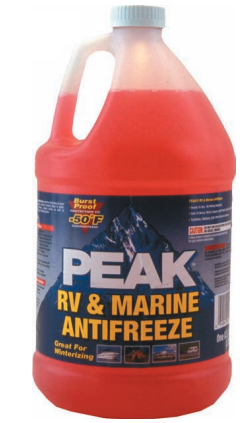
A relative newcomer, propylene glycol is considerably less toxic than ethylene glycol and is usually red or blue in color. While it can be used in place of ethylene glycol, it is more commonly used in systems where ethylene glycol would be inappropriate, such as in a boat’s potable water system. Since it is generally recognized as safe by the Food and Drug Administration (FDA), propylene glycol is often labeled as being non-toxic. Even so, it should not be thought of as safe for consumption.
How they work
Both ethylene glycol and propylene glycol engine coolants are alcohol-based compounds that are added to the cooling water in order to do the following:
- Lower the water’s freezing point.
- Increase the water’s boiling point.
- Inhibit corrosion of the engine’s cooling passages.
- Provide lubrication to the water pump.
In climates where the temperature can drop below freezing, water expands as it freezes and can crack an engine block as if it were an eggshell. A 1:1 ratio of coolant to water protects against freezing down to about minus 40° F.
This same 1:1 solution can increase the cooling water’s boiling point to about 265° F. This is especially important in warmer climates. In addition to being an antifreeze, the engine coolant is also an “anti-boil.”
Engine cooling systems often contain a range of electrochemically incompatible metals (aluminum, cast iron, copper, lead solder, etc.). This presents a potential for galvanic corrosion to take place. Over time, both glycol-based coolants degrade to oxalic acid, which is highly corrosive. To protect this mixed-metal environment and inhibit the gradual conversion of alcohol to acid, coolant manufacturers add corrosion inhibitors.
In addition, lubricants such as silicone are often added. These lubricate the water pump and various seals located throughout the cooling system.
Accepted norm
While separate standards have been published for gasoline and diesel engine use by the American Society for Testing Materials, a 1:1 ratio of engine coolant to water is the accepted industry norm. Fifty percent of this mixture is a known commodity, while the other 50 percent — the water — is not. Therefore, it is strongly recommended that only distilled water be used to dilute the engine coolant. The reason is that tap water generally contains dissolved minerals that, when heated, drop out of solution and form scale in the narrow cooling passages. This mineral scale can restrict water fl ow and inhibit heat transfer. Ultimately, engine over- heating can result.
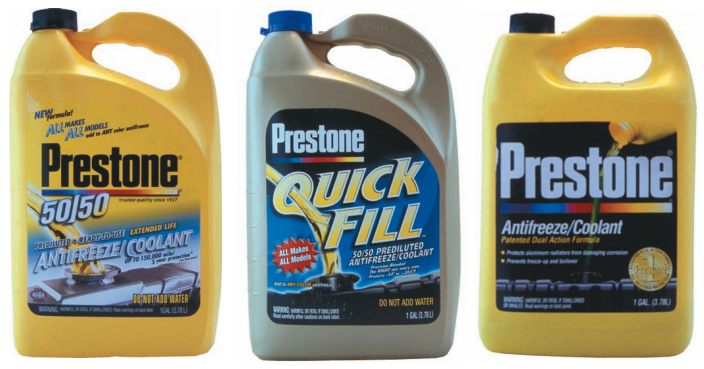
One way to eliminate the need for mixing coolant with water is to purchase a coolant that is already diluted with distilled water to form a 50/50 blend. This is also a convenient way to carry a spare supply of properly diluted coolant aboard ship. Should you have to occasionally top-off the cooling system, no mixing will be required.
To ensure that the proper concentration of coolant is present at all times, the cooling water must be tested periodically. Bear in mind that too much coolant can actually contribute to overheating and too little doesn’t afford adequate corrosion protection.
For systems containing ethylene glycol, an inexpensive hydrometer can be used. Hydrometers measure the specific gravity of the liquid. The specific gravity of ethylene glycol varies directly with its concentration. As the one increases, so does the other.
The concentration of propylene glycol cannot be determined by using a hydrometer. Instead, a coolant refractometer must be used. The refractometer will determine the refractive index of the coolant and relate it directly to a freezing point.
Corrosive acids
As stated, both ethylene glycol and propylene glycol degrade into corro sive acids over time. To inhibit this degradation, coolant manufacturers have added corrosion inhibitors to their products. These inhibitors include such inorganic materials as silicates, borates, and phosphates. The life expectancy of these additives is about two years. Hence the recommendation that the typical engine coolant be changed at two-year intervals.
New organic acid technology (OAT) coolants or extended life coolants (ELC) contain additives based on organic carboxylates rather than the traditional inorganics mentioned previously. As such, they offer an extended service life of five years. Typically, ELC engine coolants contain a red, pink, or yellow dye to differentiate them from conventional inorganic coolants, which are typically green or blue in color. ELC engine coolants are also considerably more expensive. Although these newer formulations still contain glycol, they may not be compatible with conventional engine coolants. Don’t mix the two. If changing from one to the other, a thorough flush, preferably professionally done with acid, is recommended.
While the coolant manufacturers are quick to point out their claims and recommended change intervals, the final word is best left to the engine manufacturer. They warrant the engine and have a compelling self-interest in its performance.
Gregg Nestor, a contributing editor with Good Old Boat, has had a lifelong interest in all things aquatic. Gregg and his wife, Joyce, cruise Lake Erie aboard their Pearson 28-2 and also trailersail an O’Day 222. He has just completed his second book: Twenty Affordable Sailboats to Take You Anywhere.
Thank you to Sailrite Enterprises, Inc., for providing free access to back issues of Good Old Boat through intellectual property rights. Sailrite.com