This simple upgrade stands the test of time
Issue 56 : Sept/Oct 2007
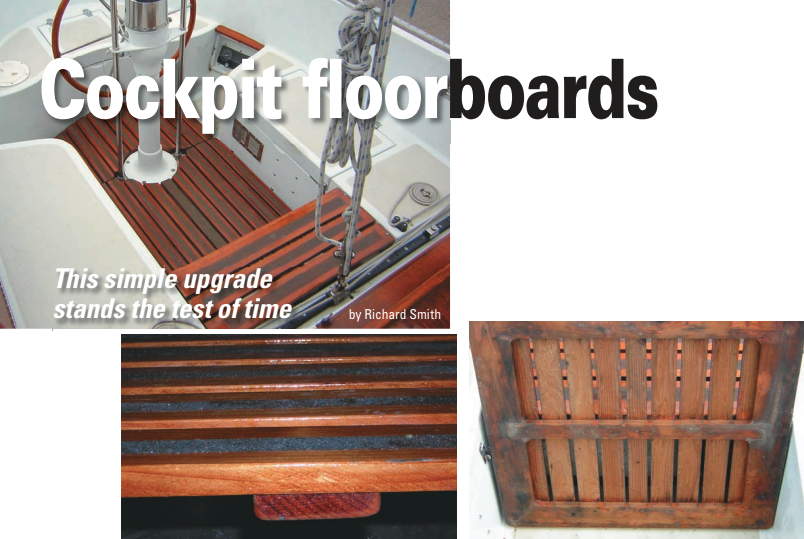
During cruising summers here in the Pacific Northwest, we practically live in the cockpit. The textured non-skid fiberglass sole of our Ericson Cruising 31 is practical but not especially comfortable underfoot. We thought we could improve its appearance with removable wooden floorboards that would blend with the teak companionway slides, iroko bridge deck, and other wood trim.
This was an inexpensive project, requiring few tools and not a lot of time or carpentry skills. But because our cockpit has a curved shape conforming to the helmsman’s seat and a binnacle pedestal right in the middle, I made a paper pattern to get the shapes right. The floorboards have two parts, one on each side of the binnacle. Each part is easily removed to get at the fiberglass underneath and to take home for refinishing and storage during the winter. The full-sized drawing was also useful in sizing and spacing the individual planks. The best widths worked out to be about 2 1⁄2 inches and I allowed about 1⁄2 inch between adjacent planks.
Materials were available from the local lumberyard — in this case, some good tight-knot western red cedar fence boards. This wood is relatively inexpensive and has several properties that are useful to the boatbuilder. It’s light in weight and easily sawed, planed, sanded, and glued. It’s resistant to decay and can be obtained in clear or tight-knot boards.
The supporting boards underneath hold the floorboard surface above the fiberglass and are close enough — something less than 10 inches — to lessen any springiness underfoot. The floorboards and the support boards were glued together with epoxy.
Rounded edges
The corners and edges of all boards were rounded to resist splintering, an important consideration when working with softwood. In addition, the rounded edges resist the penetration of moisture through the end grain, hold varnish better, and are comfortable to walk on. They also look good.
I sanded and gave the boards several coats of varnish. When the varnish was dry, I masked 1-inch strips down the middle of each board and applied another coat of varnish between the tapes. While that coating was still wet, I sprinkled the area with fine sand from a flour shaker. When it was good and dry, I vacuumed the residue and gave the embedded sand a couple more coats of varnish. This non-skid treatment works well and is easy on bare feet. After five years of hard wear, it has held up better than the self-adhesive strips of non-skid we put on the companionway ladder.
A floor of softwood doesn’t have the same resistance to hard knocks and abrasion as one made of fiberglass or hardwood, but we accept the traces of dropped winch handles, provisioning crates, and propane bottles as fair exchange for the pleasure we take in the comfort and appearance of our cedar floorboards.
Richard Smith is a contributing eidtor with Good Old Boat. He has owned and built several boats, including an Atkin Red Onion sloop, a 30-foot Alan Pape steel cutter outfitted from a bare hull, an Atalanta 26, five dinghies, and an Ericson Cruising 31.
Thank you to Sailrite Enterprises, Inc., for providing free access to back issues of Good Old Boat through intellectual property rights. Sailrite.com