Trimming your sails to the wind gradient
Issue 70 : Jan/Feb 2010
You can have a very happy life and never understand sail twist. You can even be a reasonably good sail trimmer without understanding all aspects of sail twist. On the other hand, it is an interesting phenomenon, and a better understanding is certain to improve your sail-trimming abilities.
If the wind blew from the same direction and at the same speed all the way from the water to the top of your rig, you wouldn’t need any sail twist. You may be familiar with the idea that upper winds — hundreds or even thousands of feet up — blow at higher velocities and often from different directions than the surface wind. This weather phenomenon, however, is not what causes the need for twist in your sails. For this discussion, we are interested only in the speed and direction of the wind from the water to the top of your mast. The characteristics of the wind in this zone are not shaped so much by gross weather patterns as they are by some simple laws of physics.
A clue to understanding this stuff is to remember that you can’t characterize the wind unless you speak of both the speed and the direction of the wind at a given location. If you try to separate speed from direction in your thinking, you’ll lose the concept.
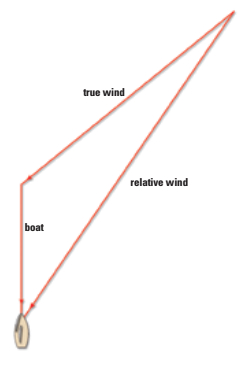
Another clue is that you are dealing with true wind, boat motion, and relative wind. The interaction between these three makes for some interesting events and leads to the need for sail twist.
Relative wind
When you’re sailing, the only wind you experience is the relative wind, often referred to as apparent wind. Someone sailing on a faster or slower boat, or just sailing in a different direction, will experience a different relative wind. The true wind is driving both experiences, but the motion of the two boats modifies the true wind and makes for different experiences on each boat.
Compounding the problem is that, even within the true wind, there is a variation in speed from the water to the top of the mast and perhaps a small variation in direction. For this discussion, let’s ignore the small variation in direction in the true wind from the water to the top of your mast. The significant variable is the speed of the true wind as it varies with height. The speed is slower at the water and increases as the height above the water increases.
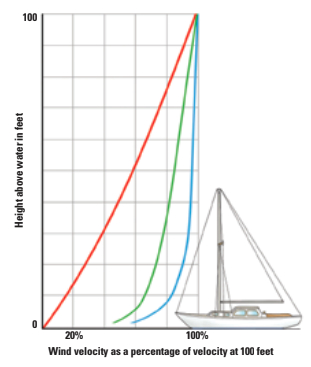
This variation in wind speed with height is called wind shear, or wind gradient, and it is caused by the drag of the water on the air flowing over it. At the water level, the drag is caused by . . . well, the surface of the water. The air just above the air at water level experiences drag from the air at the water level. The air above that experiences drag from the air below it, and tra-la-la as the amount of drag decreases all the way up your mast and beyond. So, the general condition is that the wind speed increases as the height increases above the water. This is not a weather thing; it’s just the physics of fluid flow.
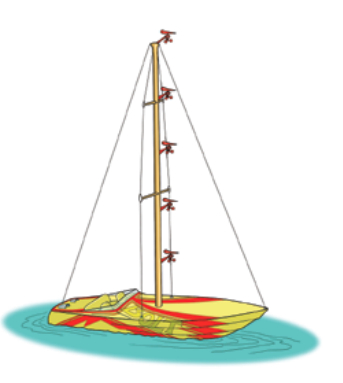
Let’s do a little mind model with this. Let’s build a nice tall mast, say 50 feet. While we’re at it, let’s put anemometers and wind arrows on the mast at 10-foot intervals, so we can see the wind speed and direction at different heights. We’ll put the mast on a speedboat. Remember, we can do whatever we want, since this is a mind model.
First, with the boat stopped, we observe that the wind is blowing from the north, as shown by all the wind arrows. In addition, we observe that there is some wind shear: 5 knots at water level, 10 knots at 20 feet, and 20 knots at 50 feet. The wind is blowing from the same direction but at different speeds, with the speed increasing with height.
Now, if we motor the boat dead upwind to the north at 5 knots, the wind direction (now relative wind and, in fact, the only kind of wind we can observe unless we stop the boat) is still from the north. But now each observation point on the mast shows an increased wind speed with an additional 5 knots being displayed by each anemometer. If we motor south, dead downwind at 5 knots, the relative wind will be 5 knots less than the true wind we recorded with the boat stopped. The wind direction is still from the north, but there is less velocity. So far this makes perfect sense and is very intuitive.
Stretching the mind
The reason for mind models is to stretch the mind, so now we’re going to motor south, at 20 knots. That’s why chose a powerboat.
Now we observe that the relative wind is mainly from the south. In fact, it is 15 knots from the south at the water and falls off to no wind at all at the masthead. Things are getting a little trickier here, but you can see that the speed of the boat can affect the direction of the relative wind, even making the relative wind blow in the opposite direction from the true wind.
That strains the mind a little bit, but what comes next strains it more. We’re going to motor at 5 knots to the east.
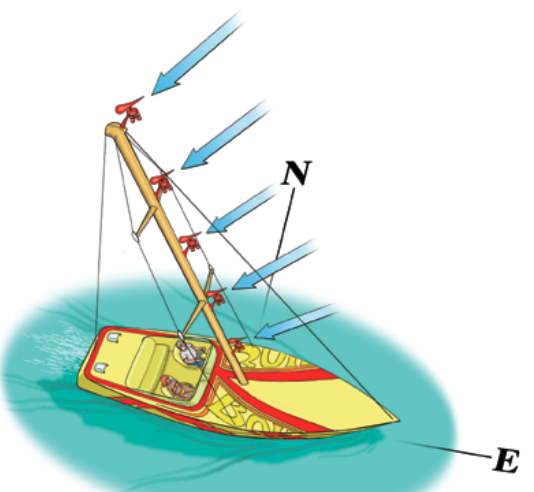
Now we see that the wind arrows on the mast no longer show the wind blowing from the same direction. This is not all that intuitive, but that’s the way it works. The relative wind direction at the water is northeast while the wind arrows show the wind blowing from an increasingly northerly direction the higher up they are. What we are seeing is that variations in wind speed at various heights have a different effect on the relative wind. The faster the wind blows from a given direction, the less the motion of the boat affects it, or rather, the less the motion of the boat affects its apparent or relative direction.
Having trouble with that? OK, take the boat up to 100 knots and drive it in any direction you want. Now the wind arrows will point pretty much straight forward and the relative wind will appear to be dead ahead no matter what direction you go.
So the speed of the boat affects both the speed and the direction of the relative wind. Furthermore, the faster the true wind, the less boat speed will affect it. And since the wind speed is faster the higher you go above the water, the less the motion of the boat will affect the relative wind direction up there. Now we’re really straining the mind, but not the mind model. The model is holding up OK . . . but if I don’t bring in sail twist soon, you’re going to be vexed for having been dragged through this. Remember, I said you can have a happy life without understanding this.
Variable angle of attack
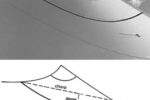
For a given foil (read: sail of a certain shape) there is a fairly narrow range of angles of attack that will give you good effect (high lift, low drag, and other aerodynamic terms of merit). If the angle of attack is outside that range, the sail will perform badly and, at extremes, will luff or stall. So you need to set your sail at the correct angle to the wind. That would be easy enough if the relative wind blew from the same direction all up and down your mast, but you have seen in the mind model that it does not. In fact, what you need to do is have a slightly different angle of attack at each height of the sail.
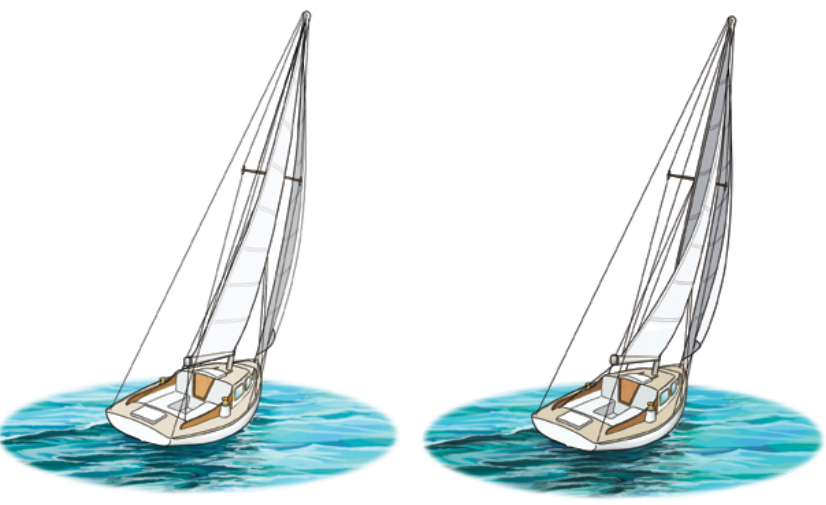
Luckily for us, modern sails have a tendency to twist a little with increasing height, and that is exactly what we need. Not quite so lucky for us is that the amount of twist needed varies with conditions. Fortunately, those who’ve gone before us have discovered the need for twist and how to either induce it in a sail or take most of it out of a sail. They have also discovered how to read telltales to trim sails with just about the right amount of twist.
Telltales just abaft the leading edge of a jib and on the trailing edge of a mainsail will tell the sail trimmer if he needs more or less twist. Move the jib fairlead block forward to decrease twist, aft to increase twist. You want the lead farther forward when reaching (so it pulls down on the leech) than when sailing close-hauled.
Also, if you don’t move the sheet lead forward whenever you partially roller-furl the sail, your twist will be way off. You have probably noticed novice sailors who, knowing nothing of handling a roller-furling jib, just leave the block set for full sail. Then, after furling a significant portion of the jib, they have so much twist in the sail the poor thing is flogging at the masthead. That’s why the sun cover won’t survive more than a couple of seasons.
Adjusting twist in the mainsail involves moving the traveler and adjusting the mainsheet so the telltales on the trailing edge stream aft, instead of being stalled. For more twist, move the traveler more to windward and ease the sheet.
Control with vangs
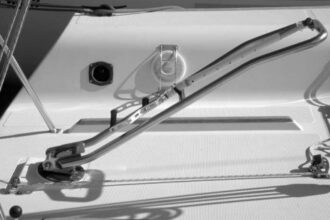
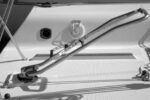
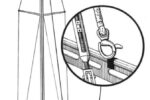
In theory, tightening a centerline vang will reduce twist and, in fact, this sail control does help considerably when sailing well off the wind. Unfortunately, it’s very difficult to mount a centerline vang so it has sufficient strength and mechanical advantage. For this reason, centerline vangs are nearly useless for fine control of sail twist on beats and reaches. This is particularly true for most cruising boats where the centerline vang gets stuffed into a small space close to the gooseneck. This is not a good place for a centerline vang, but it is often the only place left to put one.
The radial vang seen on scows and other all-out racers does an excellent job of controlling twist, but these controls are seldom seen on cruising boats.
The off-center vang, sometimes called the double vang or vang/preventer, is amazingly effective in controlling twist. This controversial control is so effective that it virtually eliminates the need for a traveler. We have had one on our boat for 15 years. After the first year of sailing with this rig, I removed the frail and aging traveler and never missed it.
Opinion is divided on the vang/preventer. One group considers it to be a risk to the rig when used offwind as a preventer in a heavy sea. Their contention is that the boom may dip into the sea, thus suffering breakage and possibly taking the mast down. The other group is having none of this. They reason that the ability to quickly set up a preventer from the helm more than compensates for any risk of dipping the boom and taking the rig down.
I’m in the second group. In 18 years of sailing on Lake Superior I’ve never gone downwind in conditions that bad. If we ever encounter such large seas while sailing downwind, my plan is to strike the main and replace it with our storm trysail, or just sail downwind under the jib alone.
Some general rules
To put precise values on all this, you could make true and relative wind observations up and down the mast and map out a bunch of vector diagram solutions and suchlike, but I won’t hold you to it. Here are some general rules to help you deal with the need for sail twist.
- When you’re moving, the only wind you can observe and the only wind affecting your boat and sails is the relative wind. It is as real as any wind can be. It is as real as the true wind, which you could think of as the relative wind for a stopped boat.
- Except for when you are going dead upwind or dead downwind:
a. The relative wind is always forward of the true wind.
b. The relative wind direction will be closer to the true wind direction the higher up the mast you measure it. - You need the most twist in light air, and less as the wind speed increases.
- Moving jib leads forward compensates for partial furling and also removes excessive twist when reaching.
- Moving the traveler more to windward increases mainsail twist, as does easing the sheet.
- Local conditions will vary the amount of twist you need, but your boat’s telltales are always right.
- An old dinghy-sailor’s trick is to induce more twist than is needed, to depower the rig. This makes the upper parts of the sail unload first, which reduces heel. Use this trick sparingly.
- In heavy seas, the helmsman will have trouble holding the boat tightly “in the groove” (pointed at the best angle to the wind). Adding a little more twist than might be needed in flat conditions will allow some part of the sail to be at the ideal angle of attack as the heading varies.
- In bendy fractional rigs, increasing mast bend by tensioning the backstay will increase mainsail twist.
There you have it. Do the twist. If some of this theoretical stuff does not stay with you, remember that in sailing, as in so many other pursuits, good skilled people often know what to do and when to do it without actually knowing why. That’s OK. You can have a very happy life without understanding this stuff.
Jerry Powlas first tasted the cruising life courtesy of Uncle Sam’s Navy. Later he discovered sailboat racing and got into Flying Scots in a big way. He gained a new twist in his life when he met and married Karen Larson, with whom he discovered cruising sailboats. Together, these two founded Good Old Boat magazine in 1997.
Thank you to Sailrite Enterprises, Inc., for providing free access to back issues of Good Old Boat through intellectual property rights. Sailrite.com