One man’s solution: Drag it backward
Issue 60 : May/Jun 2008
The perfect dinghy would be light, stable, unsinkable, indestructible, readily convertible to a life raft, and able to carry a large burden. That’s the easy part. It would also fold away into a package the size of a shoebox for stowage. That’s the hard part. Until someone creates The Incredible Shrinking Dinghy, we’ll have to stow our dinghies some other way — and a dinghy out of the water is a bulky, balky, cross-grained nuisance.
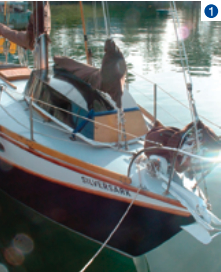
The traditional method is to stow the dinghy upside down on the coachroof or foredeck, which is the way I stow the custom-built dinghy on Silversark, my cold-molded cutter (1). That works, but the dinghy interferes with the helmsman’s view, and it’s not easy to hoist the skiff right over the lifelines on a halyard, and twirl it around in mid-air.
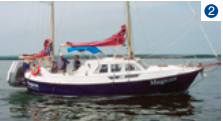
On Magnus, the Viksund MS-33 motorsailer that Marjorie and I bought for our trip from Nova Scotia to the Bahamas, there is no place on deck for a dinghy. The afterdeck and the coach-roof are too short, and a dinghy on the foredeck would make the inside steering station useless. So when we added a swim platform, I tried carrying the dinghy across the stern, motorboat style (2). With an inflatable dinghy, that worked pretty well and had the added advantage that, in a crew-overboard situation, the dinghy could be deployed as a boarding raft simply by slashing the lashing that held it to the stern rail.
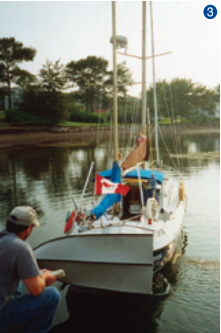
I replaced the inflatable with a Porta-Bote (Good Old Boat January 2005), expecting to use the same system (3). On a transom-sterned yacht the cross-transom system might work with a conventional dinghy, but Magnus has a canoe stern. On the third day out we punched into a head sea on Chedabucto Bay and every time we rolled the protruding lower corner of the dinghy’s transom scooped up gallons of water, punishing the Porta-Bote ferociously.
Towed all the way
So we towed the dinghy for the next six months, all the way to Florida, except during the long offshore passage down the New Jersey coast. The Porta-Bote towed remarkably well, though we swamped her twice. For the New Jersey coast, my crew and I folded the dinghy and carried it on the starboard sidedeck, where it interfered with the view from the inside helm, and blocked us from going forward on that side of the boat.
I found myself dreaming of davits . . . not easy to arrange on a canoe-sterned boat, but I saw davits in use in a photograph of a sister ship to my Viksund. Solvik was purchased by Erling Viksund, the founder of the still-thriving Viksund Boat company in Norway. Having built 6,000 vessels, he had retired and was setting out to roam the North Atlantic like his Viking ancestors.
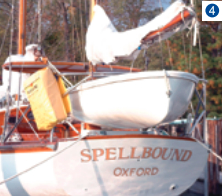
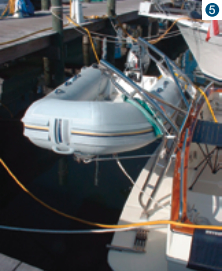
Meanwhile, I noticed two other imaginative solutions that might conceivably be applied to Magnus. In Oxford, Maryland, we saw a lovely ketch named Spellbound carrying her dinghy under the mizzen boom (4). The dinghy slid in from astern under a stern rail that had been beefed up to serve as a horse for the mizzen sheet. And in Cocoa, Florida, a husky motor cruiser had a nice variation on davits. Her davits were welded together and hinged as a unit. The whole structure dipped down to the water and clipped onto the dinghy. An electric winch then raised the whole apparatus to the mother ship’s transom (5).
On the foredeck
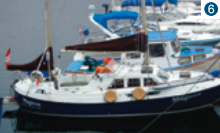
In Hollywood, Florida, we prepared to cross the Gulf Stream. I folded the Porta-Bote on the dock. A neighboring skipper suggested that it might be lashed flat on the foredeck, even if the curve of the bow did protrude a couple of inches beyond the lifelines. We tried it and, to my surprise, the lashed dinghy didn’t interfere with visibility from the inside helm at all. That became the solution for open-water passages (6).
But what about shorter runs, when we didn’t want the trouble of folding and unfolding the dinghy? In West End, Bahamas, I saw an arrangement on a big sloop from Texas that made me sit up and blink (7). The boat had a scoop stern with molded swim steps on the centerline. The skipper had discovered that the back ends of his inflatable’s tubes would fit tidily inside the scoop, placing the outboard inside the swim steps. A single line looped under the dinghy supported the bow and held the boat snugly, bum-to-bum, against the transom. In an emergency, a single slash of the knife would release the dinghy.
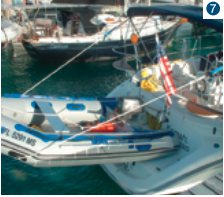
“How did this novel arrangement perform at sea?” I wondered
“Great,” said the skipper. “I’ve sailed hundreds of miles offshore with the dinghy like that and never shipped a teaspoon of water in it. It’s as stable as can be.”
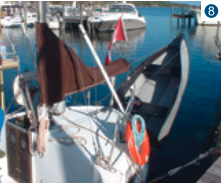
Was there a way of making a bum-to-bum arrangement for Magnus and the Porta-Bote? I experimented. My version (8) wasn’t as simple and elegant — the outboard motor had to come off, the system required more lashings and, ultimately, I added a PVC pipe strut to prevent the dinghy from blowing upward and forward. The whole affair made a very unusual motorsailer look even more unusual.
Worked perfectly
But it worked. Carrying the Porta-Bote bum-to-bum, Marjorie and I cruised northward all the way from Florida to Chesapeake Bay, and the system worked perfectly. It was infinitely better than towing and had cost almost nothing.
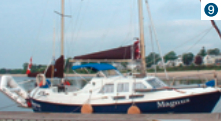
We left Magnus in Maryland for a month, and then I returned with two robust lads of middle years to take her home to Nova Scotia. We planned to cover most of the distance in two long offshore hops: from Delaware Bay to Block Island and from Cape Cod to Halifax. I brought the inflatable as a backup for the life raft. We folded the Porta-Bote and lashed it on the foredeck and installed the inflatable bum-to-bum on the swim platform (9). The inflatable fit as though it had been made for that location. Once, it was knocked sideways when the lines slacked during the night. Otherwise, during 800 offshore miles to Halifax, neither dinghy moved.
Even for boats with other options, bum-to-bum stowage has great advantages. The dinghy is near the water and easy to launch and recover. It is completely out of the way and obstructs nothing, not even visibility. In an emergency, it can be instantly available. The cost is negligible. If a marina wants to charge extra for the overhang, you can haul the dinghy vertical and be back to your normal LOA.
The only downside is that the arrangement is unfamiliar and seems ungainly . . . but so did davits, stern arches, and dodgers when they first appeared. Bum-to-bum dinghy stowage is not for everyone, but for some boats, it is almost the only seamanlike resolution to a universal problem.
Silver Donald Cameron is the author of several books about ships and the sea, including the award-winning Wind, Whales and Whiskey, the story of a circumnavigation of Cape Breton Island, and Sailing Away from Winter about his cruise south on Magnus.
Thank you to Sailrite Enterprises, Inc., for providing free access to back issues of Good Old Boat through intellectual property rights. Sailrite.com