Using an electric drill to drive sheet, halyard, and anchor winches
Issue 33 : Nov/Dec 2003
The idea originated with Jim Schmitt, a friend and Freedom 33 owner, who said, “There is a lot of talk on the Freedom website about using a battery-powered electric cordless drill as power for a sailboat winch.” It sounded possible . . . except for the “power” factor. All the cordless drills I was acquainted with were too small to power a winch under load.
However, Scandvik, Inc., makes an electric 12-volt winch handle that, it claims, draws 60 to 100 amps and generates 52 foot-pounds of torque. It is completely waterproof. It is also expensive, listing for close to $5,000 and selling in discount catalogs for $2,500.
The idea of using a powered winch handle is very interesting but a little expensive for my budget. I’d like the same capability or nearly so at a much lower price. I set out on a quest to find a cordless drill that would work on my boat.
The first step was to find the most powerful cordless drill I could. I wanted it to be a right-angle drive, as this would be the easiest to handle. My search turned up only one right-angle cordless drill. Fortunately, it turned out to be the most powerful as well. The drill, a Milwaukee model 3109-24, generates 50 foot-pounds of torque at 335 rpm. It has a 1⁄2-inch chuck and an 18-volt battery.
I researched the products of Makita, De Walt, Porter Cable, Bosch, Black and Decker, and Sears but was unable to find a comparable product. No one else offered a right-angle drill, and no one had close to the torque level of the Milwaukee product. As this was an experiment, I thought it best to start out with the most powerful drill and see if the idea was even worth pursuing. If it did not work, at least I had a very powerful right-angle drill for my boat. The cost of the drill through the Internet was $319 plus shipping.
Designing a bit
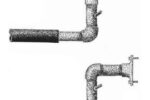
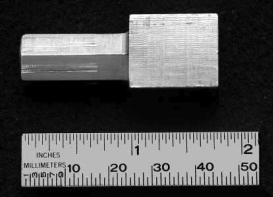
The next step was to design a bit that would fit the drill’s 1⁄2-inch chuck and the winch insert. For this I asked my friend Robin, a CAD expert, to create a design I could take to a machine shop. He turned out a design in short order, and I took it to another friend, Scott, at Coastal Precision Machine Works in Bay St. Louis, Mississippi, for implementation. Scott had a piece of 304 stainless steel that would work. Three hours and $125 later, I had my bit. It’s a little like a pocket charm: very pretty but plenty strong (see photo below).
I was ready to begin the operational test. As this was Jim’s idea in the first place, I had no qualms about asking him for help in conducting the tests. Jim had been complaining about the amount of effort it takes to sweat his main halyard up the last few feet, so this test was first on the list.
To make a fair comparison, I first raised the mainsail manually with the normal winch system. I got the halyard as tight as I could. Then, using a Loos tension meter, I took a reading of 30 on the halyard. I lowered the sail and used the drill motor instead. One person can control the drill motor and tail the halyard if necessary. Jim’s winches are self-tailing, so this was not necessary. If you don’t have self-tailing winches, it still works easily. We raised the sail to its fully-raised position and measured the tension on the halyard with the Loos meter — a reading of 37 this time with no sweat on my part. Jim indicated that he had never had the halyard so tight. It was true: the halyard was like an iron bar.
Up the mast
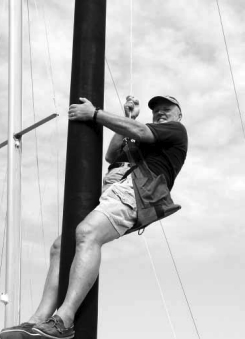
The next test was to see if Gayla, Jim’s wife, who weighs all of 100 pounds, could hoist all 217 pounds of me up the mast using the drill motor. We used my wife, Genie, as a safety person and tailer. I never go up a mast unless I have a safety person tailing the winch. Jim’s winches are #23 Barients and not overly large for the job. We led the halyard back to the same winch we had used for the mainsail test, and I got into the bosun’s chair. I did not have long to wait as Gayla easily hoisted me up to the masthead using the drill motor. She had no trouble controlling the drill motor, as it set down easily on top of the vertically oriented winch. Later we’d see if it was so easy to control with a horizontally oriented winch, such as the one on the mast of my boat. I actually was hoisted up the mast faster than Jim could have done it manually and without all of the labor.
By now the drill was slowing down a little bit, which indicated the battery was running out of juice. We had used it consistently for about 10 minutes of comparatively hard work.
The next test was to see if we could recharge the drill battery on board using Jim’s small inverter. This product, called Power On Board, is available from Sam’s Club for $28. It is rated for 350 watts continuous. The inverter is important, as it’s no good to have a drill on board that cannot be recharged at sea.
The drill came with a one-hour charger, so we gave it a try. The charger draws 3.4 amps, so it was not a problem for Jim’s onboard battery bank. The battery was recharged as advertised, and we went back to testing.
Anchoring test
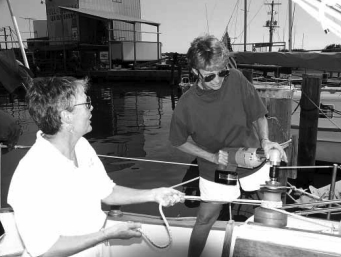
The next test was on my boat. We anchored out in about 15 feet of water with a mixed bottom of sand and mud with my usual 22-pound Danforth anchor. As I had work to do on the boat, cleaning the prop as usual, we stayed anchored for about two hours. The anchor was well dug in as I had set it under power to start with, and it had two hours to dig in. When we were ready to get underway, I led the anchor rode to my horizontally mounted main mast winch, a #6 Lewmar. The drill motor pulled all 11,000 pounds of my boat up to the anchor, broke the anchor out, and housed it. I know I should have used the boat’s motor to power up to the anchor, but this was a test of the drill’s strength.
Genie tailed the anchor rode, and I controlled the drill motor. We had no problems doing this, but it was definitely a two-person job. The wind was light that day, about 6 to 8 knots, so sea conditions were not a consideration. Once again it was a “no sweat” job. I usually haul in the rode manually while Genie motors up to the anchor, but I still have to house the anchor. This was a lot easier.
So far the drill motor has done everything we asked of it. When I first proposed this test, Genie was unhappy with the idea and cost involved. She is now a true believer and thinks this will really save my back from the weight of the anchor.
Where do we go from here and what are the negatives about using a drill motor as a powered winch handle? First of all, the drill motor is not waterproof and probably would not work in heavy rain or spray. Secondly, the drill has all of the power needed to get the job done, but the battery is only good for about 15 minutes at the maximum. On a sailboat there are not too many jobs that require more than 15 minutes of continuous effort, but you must be able to recharge the drill’s battery on board.
What is the upside to this test? We proved the drill motor is up to the job with plenty of power. It never stalled except when the battery got really low. Milwaukee says you need to charge and discharge the battery four or more times before it will be truly fully charged, so maybe a drill would operate longer than I think, but I would not want to count on it.
The drill was easy to control with the right-angle adapter. I do not know if a straight-drive drill would be as easy to control. The size of the drill may be overkill in most cases. There are several direct-drive 33-foot-pound drills that cost substantially less than the Milwaukee model. I did not try them, but I will in the future.
It’s definitely a good concept. The marine version is more expensive, draws a lot of juice, and is limited to the length of the 12-volt cord attached to the winch motor. I can use the cordless powered drill motor anywhere on the boat for all kinds of jobs. I can even use it as a drill!
Thank you to Sailrite Enterprises, Inc., for providing free access to back issues of Good Old Boat through intellectual property rights. Sailrite.com