The big sister to a pair of classic cruisers is one Tough Old Bird
Issue 56 : Sept/Oct 2007
Whether they’ve actually sailed one or not, most sailors have a soft spot in their hearts for the classic Contessa 26 and 32. For their relatively diminutive size, both have registered more than their fair share of notable journeys. The Contessa 26, Varuna, was the platform aboard which young Tania Aebi circumnavigated the globe in the mid-1980s, a solo rite of passage that’s the subject of her book, Maiden Voyage.
Like the 26, the Contessa 32 was designed by David Sadler and brought to existence by British builder Jeremy Rogers (though Tania’s 26, a later version, was built by J.J. Taylor in Canada). It also recorded some well-chronicled voyages: Willie Ker completed the infamous, deadly 1979 Fastnet Race aboard his 32-footer, Assent, the sole finisher of 58 entries in the decimated small-boat class. And in 1984, sailor and writer John Kretschmer took his Contessa 32, Gigi, on an epic trip from New York to San Francisco, the account of which is the topic of his book, Cape Horn to Starboard.
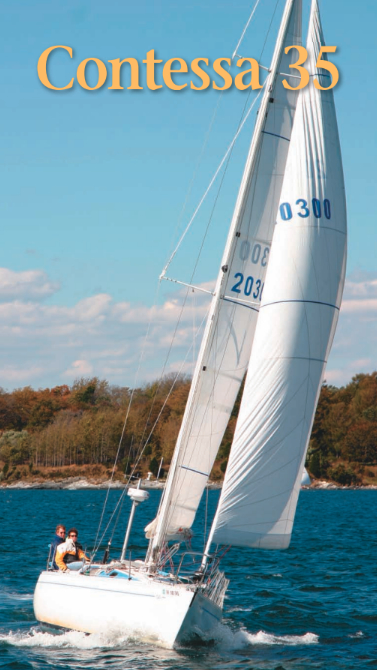
Not every sailor, however, is aware that the Contessa franchise did not end with those low, sleek, well-known siblings. The Contessa 35 was conceived as a racer, rather than a cruiser, but like so many 1970s-era, performance-oriented designs, she’s stood the test of time and today can serve double duty as a fun club racer and a very serviceable coastal cruiser with the strength and gumption to handle an occasional offshore foray.
Background
These days, Contessa 35 designer Doug Peterson is recognized as one of the legends of modern yacht design. An America’s Cup winner with Bill Koch’s America Cubed syndicate in 1992, Doug also designed America’s Cup boats for Team New Zealand and Italy’s Prada group. Beyond that lofty arena, Peterson raceboats have been winning regattas for more than three decades, and his Peterson 44 is a fantastic long-distance cruiser that’s well respected in the cruising community. But his career was launched with a radical — for its time — yacht called Ganbare, which took the racing world by storm in 1973 when Doug sailed it to Sardinia and throttled the competition in that year’s One-Ton world championships.
Jeremy Rogers remembers his first encounter with Doug: “He was almost penniless, having only just managed to bring the boat across ‘the pond,’ and his somewhat hippy and decidedly untidy appearance did not go down at all well with the very smartly dressed Italians. We had taken our Sparkman & Stephens-designed Thunder to the series and, although we did moderately well with this heavy-displacement boat, it was immediately clear to us that a Ganbare derivative would show the way for the future of yacht racing. She was that innovative and exciting. So we commissioned Doug to design exactly that for us. He was extremely glad to oblige!”
Jeremy and Doug became good friends and launched a creative collaboration that lasted for almost 10 years and produced two other Contessas — a 39 and a 43 — that competed in the Admiral’s Cup. But first came the 35, a boat that was light for its time and which, like Ganbare, featured a tall masthead rig and a “pin-tailed” stern that was looked upon kindly by the IOR rating rule of the day. “I sailed my prototype production Contessa 35, Gumboots, to overall victory in the 1974 One Ton Cup Series in Torquay, England,” Jeremy remembers, “and my order books were filled for several years after that.” The production run for the Contessa 35 lasted from 1974 to 1980, with two versions produced from the same hull mold: a flat-out racer with dual cockpits for the helmsman and crew and a minimalist interior, and a cruiser/racer with a single cockpit and full accommodations below. Jeremy built around 15 of the racing model and about 120 cruiser/racers.
Performance
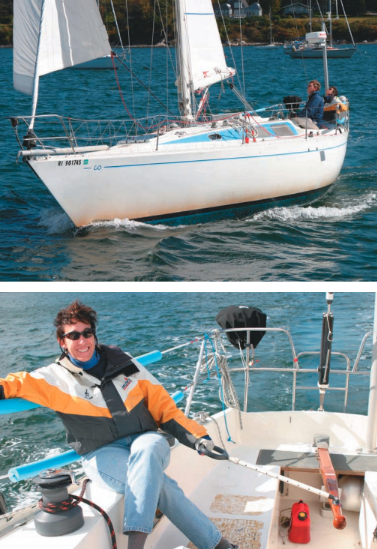
Charlie and Mary Zechel are great folks to go sailing with. Charlie, executive director of Boston’s Community Boating http://www.community-boating.org, is a seasoned racer and cruiser with a talent for getting the most out of a vessel. Mary is also an accomplished sailor with a great touch on the helm. So the Zechels didn’t need to ask twice last October when they invited me for the season’s final sail aboard their Contessa 35, Tough Old Bird, from their mooring in Jamestown, Rhode Island, to their boatyard in Fall River, Massachusetts.
Our ultimate destination was north via Narragansett Bay, and we had an ideal day for the trip with a solid southwesterly breeze of 16 to 18 knots gusting up into the 22- to 25-knot range. Just so we could get a feel for the boat — hull number 22, a cruiser/racer version — we decided to take a few tacks upwind before bearing off to our proper heading. Like most boats of its era, the Contessa 35 sports a high-aspect mainsail in a sail plan that relies heavily on big, overlapping headsails for power and drive. As I was soon to learn, however, the primary winches for those headsails are a tad undersized; you can skip your Nautilus workout after a windy beat to weather on the 35.
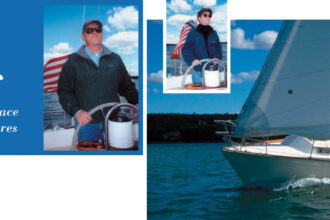
Once we’d dropped the mooring, Charlie and Mary tucked a single reef into the fully battened mainsail and rolled out about three-quarters of the 135-percent genoa, then they handed me the tiller. Let’s put it this way: I was instantly impressed. There was a pretty good chop in the harbor and the 35 just shouldered into it, making a steady 6 knots. The boat felt extremely close-winded and the tiller was light and balanced, with just the slightest hint of weather helm. From my perspective, sitting up on the windward coaming with a clear view of the telltales, the boat was a lot of fun to steer.
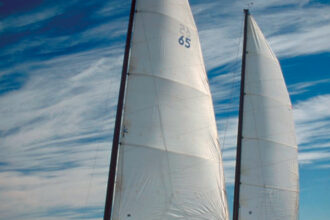
But Tough Old Bird really came into her own once we cracked off and began what turned out to be a “jibe-fest” to Fall River. Dead downwind, with the mainsheet eased all the way, she reveled in the conditions, making a good 7.5 to 7.7 knots. When we came up on a beam reach to round the northern tip of Conanicut Island, it got even better, and we fairly flew along, making anywhere from 7.9 to 8.5 knots. It was really effortless sailing. And while it’s always better to test a boat in steady wind, I got the impression — and Charlie and Mary confirmed it — that the boat would also be a stellar performer in light air. It’s one of those boats that feels strong and slippery at the same time.
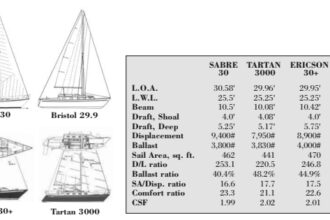
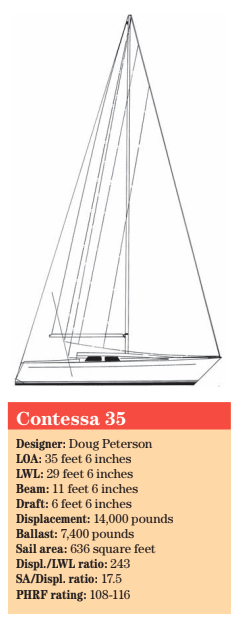
PHRF ratings for the 35 range from 108 to 116 seconds per mile. For comparison, a J/35 rates just 72, a Sabre 36 rates 117 in its largest fleet on Lake Michigan, an Irwin Citation 35 about 150, and an Island Packet 35 (a heavy cruising boat with no racing pretensions) rates in the 180s in several fleets around the country.
Deck layout
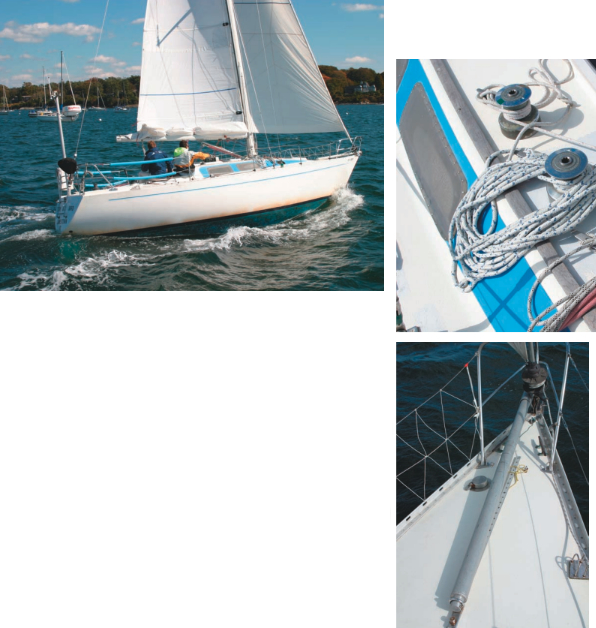
The focal point of the Contessa 35 deck layout — to me, at least — is the long, user-friendly cockpit, which in many ways was also ahead of its time. It’s deep and self-bailing and there’s abundant room to drive, trim sails, or even stretch right out with little chance of bumping into another crewmember. The boat came with a choice of wheel or tiller (which is what Tough Old Bird has). The tiller would be my choice as the boat is responsive and maneuverable and doesn’t require the extra leverage a wheel provides. A tiller extension is mandatory, however. An Autohelm tillerpilot handles self-steering chores.
The double-spreader, keel-stepped Stearns aluminum mast is amply supported and tuned by rod rigging, a Navtec hydraulic backstay adjuster, and a removable checkstay set up on its own hardware just forward of the spar. Tough Old Bird is equipped with Schaeffer Battslides for the big, full-battened main, which made hoisting and dropping the sail fast and hassle-free. All halyards and reefing lines are led to a series of Lewmar winches atop the low-profile coachroof at the base of the mast, where the business end of the Hall QuikVang mechanical boom vang also resides.
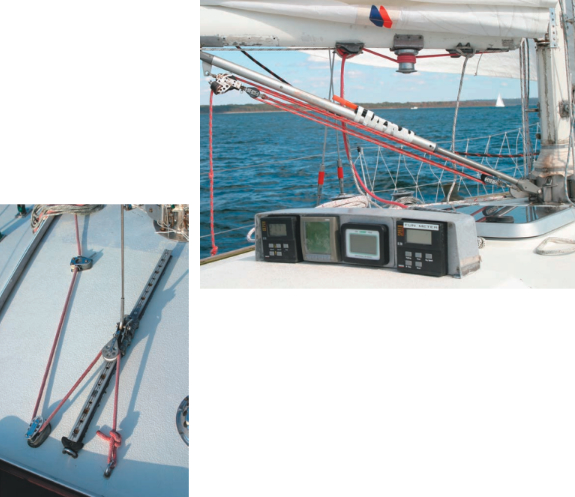
Though the Zechels employ their boat strictly for cruising, the previous owners raced it extensively, and a lot of their on-deck gear is a reflection of that. The primary sheet winches are Italian-built Antal 22S self-tailers, and the two-part mainsheet system, with coarse and fine trim, is also from Antal. “They make very durable gear,” Charlie says. The traveler system is by Harken and there’s a very handy adjustable sheet-lead system for making easy headsail tweaks on the fly. The genoa is set or stashed off its Furlex roller furler. The former owners fabricated a ’sprit pole on the bow for flying asymmetrical cruising spinnakers.
The sidedecks are wide and accessible, and footing is made more secure by a husky aluminum toerail. There’s a serviceable instrument pod above the companionway that is clearly visible from the helm. The 10-gallon propane tank is situated in a dedicated locker at the rear of the cockpit. A drop-down swim ladder off the transom completes the package.
Accommodations
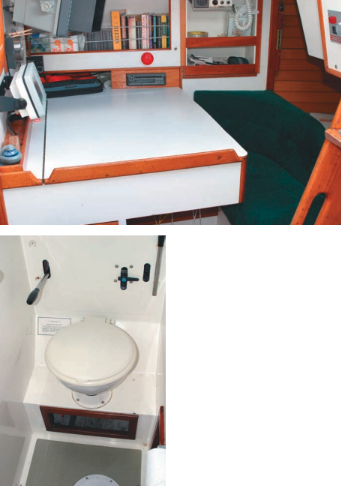
The Contessa 35 has a very traditional layout below. There’s the standard V-berth forward with lots of stowage space beneath it, followed by the head (Lavac toilet) to port, and another big stowage area — with shelves, drawers, and a generous hanging locker — to starboard. The saloon is comfortable with a pair of long settees sandwiching a central dining table and two snug honest-to-goodness pilot berths above the settees (one of the pilot berths on Tough Old Bird has been compromised by the addition of a holding tank). Two water tanks under the settees hold about 25 gallons of water; fuel tank capacity is about 12 gallons.
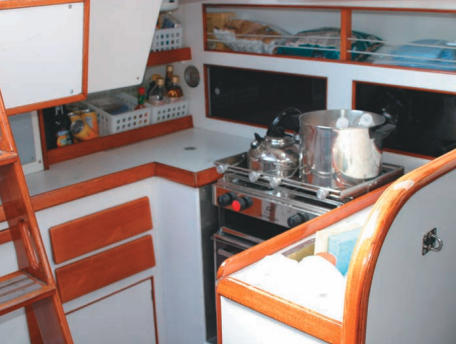
The U-shaped galley to port of the four-step companionway ladder is compact, but serviceable, with a Sea Frost 12-volt refrigerator and a Plastimo Neptune 2000 propane range and oven. As in keeping with the general theme, there’s good stowage an arm’s length away. The navigation station to starboard is also well laid-out with a forward-facing seat and chart table and a handy bookshelf. There’s plenty of room for instrumentation, as evidenced by the GPS unit and Raytheon R10X radar display. A quarter berth aft of the nav space makes a good sea berth.
The auxiliary is a Yanmar 27-hp diesel engine and the boat’s electrical power is supplied by a series of five small AGM batteries under the quarter berth. The engine has good access via a big door behind the companionway and through a port in the quarter berth area.
Construction
Other than the fact that the boat was laid up using isopthalic resin — which was far from the norm in the mid-1970s and which helped guard against hull blisters — there’s nothing fancy about the construction. While balsa core was employed in the deck’s construction, there’s no core in the solid fiberglass hull layup, though Jeremy Rogers says the floor frames in the boat’s interior grid were foam-cored.
“We pushed the loads out from the bottom of the boat,” he notes. “There are stringers in the topsides, and all the interior furniture and fittings are bonded in. Structurally, the boat is very, very strong.”
The boat is externally ballasted with a lead keel bolted through transverse floors bonded to the inside of the hull to distribute keel loads. The bilge is shallow with a small sump. Yacht designer Bill Lee calls such arrangements “bean-can sumps,” presumably for what can be stored therein. There’s no skeg, and the rudder is a separate, free-standing blade. The two-bladed feathering propeller is housed in what Jeremy calls a “P-bracket.” The bottom of the boat has a fairly flat run.
Summing up
The Zechels have a nickname for their boat: “The Beast.” I understand where they get it, as a delicate flower she’s not. Especially on a windy day, you need a bit of elbow grease to address sail-handling maneuvers and everything about the boat is robust to the point of being almost industrial. It’s a no-nonsense yacht. Don’t get me wrong, I found it a joy to sail, but when all was said and done, I knew I’d gone sailing.
Over the years, the Contessa 35 has held its value in the used-boat market, particularly when you consider that a new boat, in the mid-1970s, fetched about 25,000 British pounds. The Zechels paid about $40,000 for their boat, though a quick surf of the Internet revealed quite a disparity in pricing. A pair of 35s in Europe had list prices of 55,000 and 69,500 Euros ($76,000 and $96,000), respectively, which seems very dear. A well-equipped 35 in the Dominican Republic had an asking price of $45,000, which Charlie says is the ballpark figure he sees when boats come on the U.S. market, though a listing in a San Francisco sailing magazine several months ago had an asking price of just $30,000. “I’m not sure why, but they cost more overseas,” he says. “We clearly need to sail ours over there if we ever decide to sell!”
That said, it’s not necessarily easy to find a used model, which always tells a lot about how owners regard their vessels. Strong and quick, the Contessa 35 is yet another well-built, well-designed old racing boat that may have a lot of miles under the keel but surely has many more to go.
Herb McCormick is a career sailing writer and editor whose work has appeared in magazines and newspapers around the globe. He’s the former editor of Cruising World and has been the sailing correspondent for the New York Times. He’s a long-time sailor whose voyages have taken him from Antarctica to Alaska, with plenty of stops in between.
Thank you to Sailrite Enterprises, Inc., for providing free access to back issues of Good Old Boat through intellectual property rights. Sailrite.com