Build yourself a comfortable place for boatwork
Issue 56 : Sept/Oct 2007
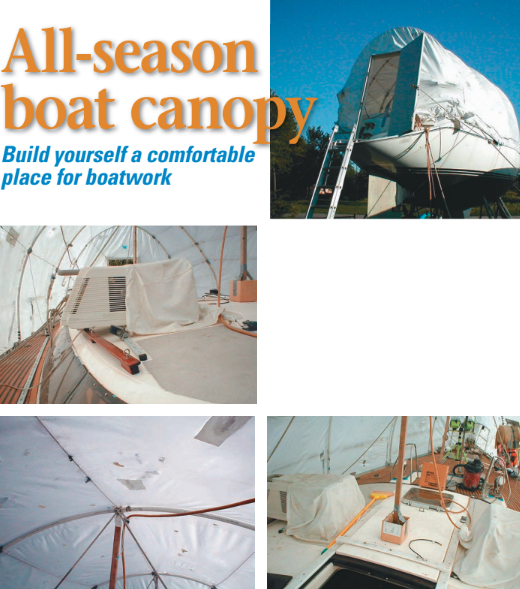
I needed a work canopy that would provide a dry, comfortable place to work on a 50-foot restoration project and I did not want to spend more than $500. As I wrote this, my canopy was going on its fifth season. (Note: Vespera, Stan’s project, was completed; see our January and May 2007 issues. –Eds.) After five years — though patched after receiving heavy wind and snow damage — the canopy was still going strong. One October the canopy withstood gusts up to 65 mph from the port side, while 45-mph gusts have occurred each season. On four occasions snow completely collapsed the top, crushing it to the level of the cabintop.
How does the thin plastic canopy survive such abuse? Just like a hoop tent, my canopy is flexible and works with the wind. PVC bows allow the canopy to work with the weather, rather than resist it. PVC tubing is far more flexible — even in 20-degree-below-zero weather — than you’d ever imagine.
The basic PVC hoop design came from a boatyard on the Chesapeake. I added a few refinements for heavy winds and snow. I also added a door so I could come and go throughout the season. The design is pretty much common sense, but a few tricks save a lot of headaches.
Make the hoops. Determine how many hoops you will need. PVC is very cheap; go with more rather than less. The PVC tubes are 1 1⁄4 inches outside diameter. There will be one hoop per stanchion. From the center of the boat to the aft end, the hoops are 8 feet higher than the deck. Because my boat is 15 feet wide, the tubes I used were 25 feet long. The 8-foot height offers an open feeling, which is important to anyone who is going to spend many hours working within. Going forward on my boat, the height tapers to 5 1⁄2 feet.
Drill holes. Drill a hole in each end and the center of each hoop. The end holes will be used to tie the hoops to the toerail. The center holes will be used to tie support poles as shown in the photo on the facing page.
Set up the hoops. Assuming that you have some fairly strong stanchions, you can weave each leg of the PVC tube inside the upper lifeline and outside the lower lifeline adjacent to each stanchion. Then tie the base of the hoop to the rail.
Tie the hoops together. Tie the hoops forward to aft. Use a light line from a hardware store. The final framework will resemble the frame of a blimp.
Remove your stanchions. This is important. Strong winds will bend or break your stanchions if you do not remove them. I learned this the hard way.
Make a door frame. This is optional. Mount a door frame in the aft end of the cockpit. An inexpensive metal door from a lumber store will work. This will permit years of access.
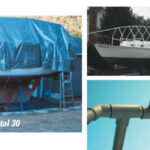
Have the boat shrink-wrapped. Unless you have a small boat, do not attempt to shrink-wrap your own boat. Also, use white, rather than blue, shrink-wrap poly. Workmen claim the bluish cast becomes very annoying and the workspace under a blue tarp is much hotter. If you have a large boat, do not let your contractor shrink-wrap it on a windy day. The end result will be a canopy with too many patched holes. If you will work on your boat for several seasons, the patches will eventually become a maintenance problem. Holes in this poly are easy to patch with shrink-wrap tape, but the adhesive in that tape is designed for just one season of use.
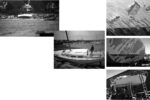
Make support posts. This is optional. If you are in an area with high winds or heavy snow, cut 2 x 2 support posts for the center of the PVC bows. Drill a hole in the top center of each bow and the top of the posts and tie each post to a bow. Pad the bottom of the supports with a rag and duct tape. Place the bottom of each post in a small cardboard box and duct tape the box to the deck or cabintop as illustrated below. This allows the post to lift and move as the wind comes up but without losing its footing. Loosely tie the top of each post to the port and starboard rail, creating a triangle. This will allow the top of the post to move, but not too much.
The support posts will keep the structure from distorting in strong winds and stop it from collapsing under the weight of heavy snow. This does not mean that you can let 6 inches of wet, heavy snow build up on your canopy. In these conditions, someone must go inside the boat and remove the snow by shaking the PVC bows. It’s a 10-minute job if you can get to your boat before the frame collapses.
Ventilate. Small plastic ventilators, designed for shrink-wrapped boats, can be installed. I eliminated this passive ventilation system on my boat because the ventilators can leak, and they are attached with shrink-wrap tape that fails after a season. If you keep your canopy watertight, you shouldn’t need these passive ventilators. Active ventilation is a good thing, however. I put a standard 3- by 2-foot zipout door forward and added a large construction fan. I also installed a portable marine air conditioner in a hatch opening for a summer’s worth of work down below. Because the deck was sheltered from direct sun, the air conditioner worked well.
Heat. The greenhouse effect will give you a 10- to 15-degree bump under the canopy all year. For added heat in the winter, do not use propane unless you are heating for a short time or the temperature outside is above freezing. Propane produces a lot of water vapor that will condense and then freeze as the boat cools. Boatyards use an old house furnace mounted on a utility trailer with a fuel tank. The boatyard will run a flexible duct through a plywood cutout attached to the shrink-wrap. Another approach is the use of a self-contained garage furnace. I decided to forgo the heat and wore heavy winter clothes when I worked on the boat. For messy sanding and grinding jobs, this was a plus. Save that gritty work for winter.
Canopy maintenance. To patch holes in the top, use GE Silicone II. A dab of silicone will do for small holes. Bigger holes will require that you add some extra shrink-wrap material that can be glued with silicone. Sand the surfaces of the shrink-wrap a little with 100-grit and wash them with alcohol. Most of the holes in my top were made when the top collapsed under heavy snow before I modified the design. Once I added support posts and learned that I had to get to the boat to shake it off when the snow was wet and heavy, I had fewer holes to patch.
Stan Sroga and his wife, Kathy, spent many enjoyable years family-sailing on a wooden King’s Cruiser, a Columbia 32, and a Hunter 34. Throughout that time, boat restoration and cruising with a plan for a sailing school has been their goal. The restoration of Vespera, a Jeanneau Trinidad, began in 2001. The school was established in the fall of 2006. For more information go to http://www.sailtraininginc.com.
Thank you to Sailrite Enterprises, Inc., for providing free access to back issues of Good Old Boat through intellectual property rights. Sailrite.com