Issue 12 : May/Jun 2000
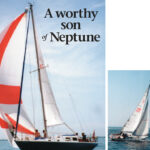
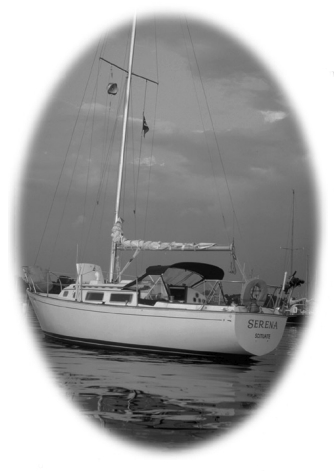
You’re not thinking sailing!” my husband once admonished me after a particularly stupid error on my part. Not only was I not thinking sailing, I was resenting what had come to seem a sort of imprisonment imposed on me — not by my husband, but by my sense of duty and loyalty. Though I loved the man, I did not at that juncture love the sport that absorbed him so utterly. After eight years and some months of boating — three in company with our children aboard our 31-foot cabin cruiser, Lady Mary, four as crew (my husband and I) on two large yawls owned in succession by a friend and his wife, and later as owners of our Sabre 28-foot sloop, Serena (shown on Pages 54-56) — I found myself suffering from a kind of “cruise fatigue.”
Instinctively, some of us shrink from all but agreeable experiences — and what a myriad of discomforts one encounters on the water. To rude weather and sea conditions, add anxiety, ennui, physical crotchetiness, and complaints. Add, for me at that point in time, maternal concern over children old enough to be left alone at home, but only just. In addition, there had been, perhaps, just too much frustration resulting from confinement; too much exhaustion, both mental and physical; too many stretches of days without a shower (so that even my soul felt grubby).
I was like Somerset Maugham, who once confessed that it was one of the faults of his nature that he suffered more from the pains of life than he gained enjoyment from the pleasures. Where boating was concerned, I was too uncomfortable, too continuously, to be an enthusiast. Indeed, I was conceiving something like aversion for the activity.
Challenged and nourished
I had always known that I was not a real sailor. Real sailors, I recognize, have a spring in their step as they advance toward the water. Real sailors are challenged and nourished by everything they encounter, from line squalls to idyllic weather. Real sailors need the ocean as a painter needs his palette, a composer his keyboard. And among real sailors I include women, some of whom are as competent as men aboard a boat; though the majority of women, I believe, are like myself, neither natural sailors nor completely disaffected by the sea. Though I admired and envied those real sailors, I understood that while the ocean was their essential element, mine was the earth in all its gracious variety.
Some wives, I’m aware, will never go aboard; others, only under perfect conditions, and thus infrequently. Since, at that (or any) stage of our life together, I didn’t want my husband going one way and me another, I sailed on a regular basis. A boat is too expensive a possession not to use, not to mention its being the skipper’s glory. So for us, six months of every year were affected, including weekends, several three- and four-day junkets over the season, and a two-week cruise.
If I was weary of the pastime, I knew I couldn’t just “jump ship.” My husband was completely supportive of me in all my personal endeavors; how could I be less generous toward him? As long as he was committed to the water, I was too. That being the case, it was clear that some taking of stock and some positive actions were in order.
Inordinately proud
I knew I possessed some definite strengths as a mariner. I trusted our sloop, to begin with, and the skills and judgment of its skipper. I was inordinately proud, in fact, of the latter’s expert seamanship and the respect in which he was held by other sailors. I was not in the least discomfited by heeling. Going forward to take down sails in high winds and rough seas didn’t reduce me to jelly. On many an occasion I enjoyed the ride. Not for anything would I have missed the challenge and excitement of those sails that were a sail-and-a-half; or the tense milling just prior to a race, even an informal one, which was about the only kind we entered.
I could suffer fog, rain, and cold without complaint, though steam-bath conditions were a bit of a trial. Even in a heavy sea I could steer a good compass course. Blessed with good eyes and ears, I was a good lookout, and eternally vigilant for lobster pots. I was also a willing worker, pitching in with all the ordinary work of the boat as well as the extraordinary tasks of commissioning our vessel and laying her up. I took pride in tying fenders and docklines properly, and in being able to pick up moorings.
Boating as a spectacle was a constant delight, from all those wonders “marvelous and strange” you encounter while cruising, to the life in our homeport of Scituate, Mass. I was moved most profoundly, perhaps, by the aesthetic side of life at sea — by a flock of terns veering and swooping over the water; by the high, proud arch of a spinnaker or the solemn loom of spruce; by those days that had an austere yet opulent beauty, the sea a deep blue and stippled with whitecaps, the sunlight almost like moonlight as it gleamed on its swells.
Not instinctive
As for sea-sense, I wish I could say that I functioned instinctively, but I didn’t. What I did well is what I was told, however that might horrify the feminists. (“Put the tiller that way,” my husband directed me from the bow as I stood by the helm while anchoring. “Back her down. Come forward a little.”)
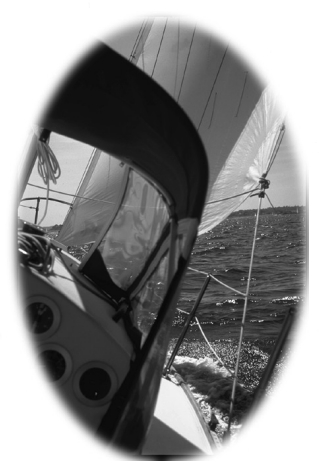
If I could count on some positive traits in myself, I had also to admit to some liabilities. I didn’t like steering in a busy harbor or when we were running — though I never minded the helm while beating. I didn’t like wallowing, either, and would have chosen a beat over a run on almost any passage. Motion at an anchorage or on our mooring was a strain on my muscles and nerves. Clare Francis or Margaret Roth I was not. Whatever the conditions during the day, at night I liked to sit on a vessel that was as solid as a rock.
Since being below for any length of time while underway disturbed my equilibrium, I wasn’t enthusiastic about cooking en route to a port. My need for air was yet another limitation. I couldn’t sleep in a shut-up cabin. Even when it was raining, the hatch had to be cracked at least an inch. If the hatch absolutely had to be shut, I moved from the V-bunk to the main cabin, sleeping as near that hatch as possible, with the hatchboards placed so as to deflect the rain. Heat was the most disabling circumstance. For me, sultry weather was insufferable weather. When temperatures and humidity were extreme, my whole soul went slack, and I was practically useless aboard a boat.
Compassionate
One of the chief factors in helping me to become a happier sailor wasn’t my character at all, but that of my husband. I am blessed with a considerate helpmate. As I wanted to enjoy boating, he also wanted me to enjoy it and did all he could to ensure that enjoyment. A man of compassion and common sense along with his practical aptitude, my husband always puts the security and comfort of his crew uppermost. Once we owned a boat, we had far more choice, obviously, as to cruising in this condition or that, though we had never deliberately put out in bad weather when crewing aboard our friends’ boats. If wind and wave weren’t to our liking, we canceled our plans or changed them. We also tried never to sail ourselves into weariness.
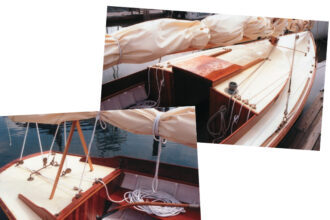
Neither were we purists. Not content to make half a knot for six straight hours, we’d “fire up the iron monster” when our speed fell below three knots. To combat my sensitivity to the sun, my husband had a canopy custom-made for our sloop. He also had a mooring service install a pickup buoy with a long spindle to make it easy for me to reach and pull aboard every time.
Both of us enjoy listening to the Red Sox baseball games, and when I grumbled one night about the weakness of the radio signal after sunset, he showed up the next day with a dandy AM-FM transistor radio.
“Surprises” of another sort he was careful to avoid, giving me adequate notice whenever possible about plans to take a day off, or about boarding our boat on a Friday night instead of a Saturday morning, since some preparation and planning have to go into even a weekend spent aboard.
Soft pillows
I, too, feathered my cruising nest with as many comforts as possible. I love to read, so I always had an absorbing book with me. I also like to embroider and found that I had more time to work on my samplers aboard than at home. Long ago, I had purchased small, soft pillows to wedge against our backs when reclining in the cabin or sitting in the cockpit.
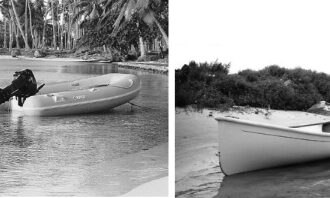
I replenished my cruising self by going ashore and taking daily walks, if possible. At our mooring, on weekends, I hailed our boat club’s launch when it was running and once ashore walked downtown for a paper or just strolled along the harbor. If the launch wasn’t running or if we were off cruising, my husband dinghied me in and picked me up later. I even walked in the rain, appropriately garbed in my foul-weather gear. If the rocking and rolling at an anchorage were pronounced, and I could get off the boat, I did. If I couldn’t, I lay down in my bunk whenever feasible, since prone and with my eyes shut, I felt better.
When hot, we swam off our dinghy to cool off. When cold, we donned warm hats, sweaters, and ski-type socks kept aboard even in summer, along with mittens and lined rubber gloves. Other permanent gear and stores included suntan oil, aspirin, a well-equipped first-aid kit, extra sunglasses, binoculars, coffee, and soup.
If there was comfort in comfort, there was also comfort, I discovered, in competence and consistency; in knowing exactly what you had to do, and when, and doing it time and again. Of necessity — since we were almost always sailing by ourselves — my husband and I had developed a system. When first we went aboard, I went below and put away the stores while my husband warmed up the engine, removed the sail cover, hanked on the genny, and readied the sheets. Setting out, I was at the helm while the sails were being raised. Returning, I went forward to guide and contain the sails and then back to the helm while my husband furled and tied the main and bagged the genny to get it out of the way for my next task, picking up the mooring. En route, we spelled each other at the tiller, although my husband always had the helm while tacking, each of us responsible for a particular sheet.
Losing my husband overboard was the thing I most feared at sea. I knew that if I should accidentally go into the water, he would be able to pick me up; but I didn’t have the same confidence in my own skills of retrieving him. I knew that the two most important actions I would have to take, should he go overboard, were to throw him a life ring and then get the engine started, while not, of course, losing sight of the skipper. Decidedly unmechanical, on almost every cruise and even daysailing, I practiced starting the engine, turning the key with one hand, while keeping the other on the tiller. I was more sure of myself about the other aspects of the man-overboard drill: tightening the mainsheet, turning into the wind, dropping the jib, and so forth.
For the following season, and at my request, we purchased one of those life rings with a flag and light attached, my husband having promised me in the meantime — and teasingly! — not to fall overboard. A second source of anxiety used to be the double-threaded main halyard shackle “freezing” when I was trying to unscrew it and take it to the lifeline, usually at the worst possible time, in a stiff wind while we were entering a crowded harbor. To allay that concern my husband now kept it well lubricated with regular squirts of WD-40.
Mindful that other emergencies might arise, I also familiarized myself with our VHF radio and with the location and manipulation of our seven seacocks.
The conflict of children who remained at home, partly because they were students bent on paying their own way through school, was partially resolved by nightly phone calls, from dockside pay phones if possible, because they were less expensive, or through the marine operator, if necessary. (Today, of course, cell phones are used increasingly.) In this way, our offspring always knew where we could be reached if the need arose. Along with emergency numbers for immediate help, we also left a safety checklist at home: “Iron unplugged? All stove buttons off? All doors and windows locked when leaving the house?” All of us are human, and young people don’t have these measures and precautions cranked into their consciousness as absolutely as their parents have.
Organized zombie
Since seven day’s worth of home and yardwork had to be compressed into five over the summer, and since I was usually a zombie on my first day out on any extended cruise, (from having left the house clean, the yard in order, provisions, money and instructions for those remaining at home, not to mention food and other supplies for the boat), I learned to be organized, resorting to master checklists against which to check items, from weekend sailing to our two-week cruise.
Basically I am not a negative person. I don’t fancy myself in the role of grumbler, complainer, or martyr, I might add. Nothing blights your joy like the company of an unwilling companion. But each of us is many people and one of my selves is timorous. To that persona I addressed from time to time a line from Herodotus: “It is better by noble boldness to run the risk of being subject to half the evils we anticipate,” that ancient traveler once wrote, “than to remain in cowardly listlessness for fear of what may happen.”
Another self is lazy, which self was made to perform — being sent below to get coffee or snacks or to turn on the radio or fetch the camera — since the less you do on a boat the less you want to do or are even capable, perhaps, of doing. My stick-in-the-mud self that would never cross a forecast, or veer in any way from routine or the known, is under permanent orders to defer to judgment more mature than her own.
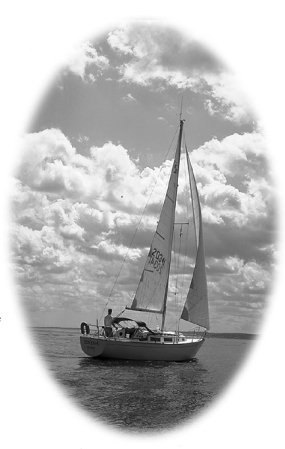
One self, however, I never had to lecture. That is the self that enjoys my husband’s happiness when afloat. On the decks of a boat his character and abilities come into perfect focus. I watch his tensions dissolve. (Sailing has its own tensions, of course, but those rise out of an activity freely chosen.) I see a man quite at ease or fully engaged. Through all of the substance of boating, through the delights when conditions are right and everything is working on the boat, through the frustrations, the challenges, even the drudgery — drudgery, I hasten to add, for which he is eager — I bear witness to one of the finest things life has to offer — the sight of a soul fulfilling itself.
Today, on balance, and largely due to the foregoing, boating is much more fun for me than it is endurance. Oh, it’s still sweet, sometimes, after endless miles at sea to close with a coast and then pick up a mooring or drop the hook. To exchange solitude for society, to breathe not brine but the fresh smell of trees. I can still be peevish when constricted too long and can still view boating more as a rigorous discipline than as an adventure and romance. But I’ve passed, thank goodness, through the “narrows” of the cruising experience — never, I think, to return.
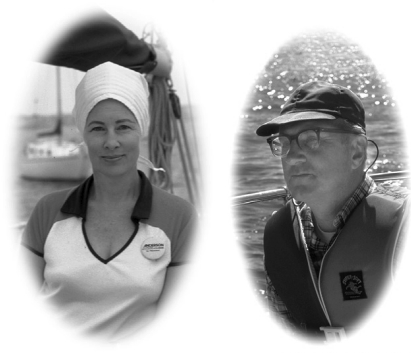
Mary Jane and her husband, Warren, have been boating for more than 25 years. She found ways to enjoy the water as a photographer and writer (who has appeared often in Good Old Boat). She is the author of Eye on the Sea: Reflections on the Boating Life, which was just awarded First Prize by Boating Writers International in their contest for the best book on recreational boating published in the years 1998 and 1999.
Thank you to Sailrite Enterprises, Inc., for providing free access to back issues of Good Old Boat through intellectual property rights. Sailrite.com