Sounds like a car, but this trailerable cruiser sails like a pedigree Herreshoff

Issue 33 : Nov/Dec 2003
In 1965, the Chrysler Corporation entered the marine marketplace by acquiring Lone Star Boats and West Bend Outboards. During that first year of production, all three of the names (Lone Star, Chrysler, and Chrysler/West Bend) were noted in its literature and on its products.
In the 1966 model year, Chrysler began marketing its own line of boats and outboard motors. Using the Lone Star Boats production facilities in Plano, Texas, Chrysler Marine built thousands of powerboats and sailboats. In the sailboat division alone, the company offered more than a dozen different classes. These comprised about eight daysailers and two catamarans with the balance being trailerable cruisers, including the Chrysler 22.
For their daysailers, Chrysler Marine benefited from the talents of design engineer Rod McAlpine-Downey. He was responsible for designing the C-13 Privateer, C-14 Dagger, C-15 Mutineer, and C-18 Buccaneer. Of these four classes, the popularity of the C-18 Buccaneer is as strong today as ever.
To insure the success of the cruising sailboat division, Chrysler enlisted Halsey Herreshoff as the design engineer. Halsey, the grandson of famous boat designer/builder, Nathanael Herreshoff, had a reputation for designing many interesting boats, including the Bristol 29.9, the Herreshoff 31, and the Freedom 40. Halsey also designed the Chrysler 22, which made its debut in 1975. The production run of the Chrysler 22 lasted approximately 4 years. The exact number of boats produced is not known.
Not so fortunate
Unfortunately, while Chrysler Marine was enjoying great success, the auto-mobile division was not so fortunate. In 1979, Lee Iacocca, chairman of Chrysler Corporation, secured federal loan guarantees to prop up his ailing company. One of the requirements for the government bailout was that Chrysler Corporation had to divest itself of any non-automobile-related businesses. Chrysler Marine disappeared in 1980. The outboard motor division followed in 1984.
Whether it’s the Herreshoff design, the novelty of owning a boat built by a car company, or an interest in a vintage, proven trailerable cruiser, the Chrysler 22 is still a popular boat. It has an overall length of 22 feet, a waterline length of 19 feet, and a beam of 7 feet 9 inches. It displaces 3,000 pounds, 825 pounds of which is ballast.
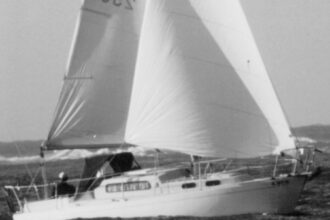
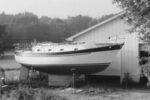
The profile of the Chrysler 22 shows a little sheer, moderately low freeboard, a straight bow, and a slightly rounded, reverse transom. The rudder is inboard, and the cabintop slopes all the way to the bow, initially giving the boat a raised deck appearance. However there are narrow (8-inch) sidedecks. Overall the boat looks clean and uncluttered. The hull and deck are fiberglass. The hull is solid, hand-laminated fiberglass, and the decks, along with the cabintop, are a sandwich of two fiberglass layers with a synthetic honeycomb core. Foam flotation is standard, and the boat is said to be self-righting. The foredeck is free from clutter except for a large hatch made of alternating ribs of opaque and translucent fi berglass.
The companionway hatch is also made of this alternating rib construction and was available in an optional pop-top version. All deck surfaces, including the cockpit seats, are skid resistant. There is a full-length, anodized aluminum, combination genoa track and toerail. Even though the shrouds are inboard, and although there’s a toerail, it would be more prudent to use the cabintop rather than the narrow sidedecks when going forward in rough weather.

Little brightwork
Brightwork has been kept to a minimum, with teak present only as companionway hatchboards and as trim on the companionway sliding hatch. All deck hardware is of satisfactory quality, some of it secured with backing plates and some relying on areas of solid fiberglass. The hull-to-deck joint is lapped, sealed, mechanically fastened, and covered with a vinyl gunwale.
The Chrysler 22 was available in two keel configurations: an optional 1,010-pound fixed keel model that draws 3 feet 9 inches, and the more popular 825-pound swing-keel version. By means of a winch located inside the cabin beneath the bridge deck, the swing keel can be raised or lowered. With the swing keel in the up position, the boat draws only 1 foot 11 inches as compared to 4 feet 6 inches when down.
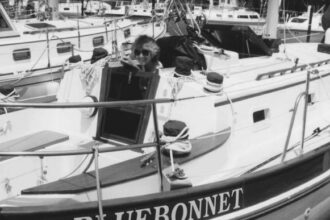
Located in the cockpit along the transom is a separate, ventilated, fuel-tank locker that avoids fuel spills and fumes inside the cabin. Just forward of the fuel-tank locker is the inboard, through-hull, rudder-and-tiller assembly. In shallow waters and for trailering, the rudder can be raised by control lines at the base of the tiller. The cockpit is self-bailing and has a bona fide bridge deck to prevent water from cascading below, should a wave fill the cockpit. The boat has amply large port and starboard cockpit seat lockers. While the cockpit is 6 feet in length, the tiller extends to a position just short of the bridge deck and tends to interfere with everyone except maybe the helmsman. The cockpit coamings are high and smoothly lead into adequate backrests.
Down below
To enter the cabin, one uses the optional portable cooler as a step. Without this option, stepping from the cockpit into the cabin is awkward unless the port dinette seat is used as a step. Down below, the Chrysler 22 uses a molded fiberglass liner or pan for added structural support. Bright-work here is kept to a minimum, too, with teak solely used as fiddle boards or to trim the plastic/wood laminate forward bulkhead. The majority of the interior (headliner, sides, and sole) is the exposed smooth finish of the fiberglass pan. Forward is a surprisingly comfortable 6-foot 3-inch V-berth with a maximum width of 65 inches. Overhead is the large forward hatch for light and ventilation.

Centered under the aft end of the V-berth is space for a Porta Potti. (A toilet with a holding tank and deck pumpout was optional.) The bulkhead separating the V-berth from the main cabin has been opened up, giving a sense of spaciousness. It also allows for easier forward access. A privacy curtain separates the V-berth from the main cabin.

In addition to the forward hatch and the companionway hatch, there are four fixed portlights illuminating
the main cabin. To port is a dinette that converts to a 6-foot 3-inch double berth, and to starboard a settee/single berth of the same length. To achieve this length, both berths extend partway beneath the cockpit seats and merge with the cockpit lockers, which are open to the cabin. With the optional slide-away galley in use, the starboard settee is lost; and when the galley is stowed, the remaining berth shrinks to 4 feet 6 inches.
There is full sitting headroom of 34 inches, while the optional pop-top allows for standing headroom. Unlimited headroom is available, of course, if one stands at the foot of the companionway with the sliding hatch open. There are 18 bins, shelves, and places to stow gear in the forepeak, under all of the settees/berths, behind the settee backs, and along the sides of the V-berth.
The rig
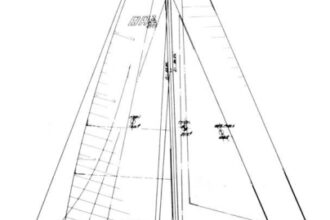
The Chrysler 22 sports a 26-foot 6-inch mast, stepped on deck with a hinged tabernacle, supported belowdecks by an aluminum compression post. Both the mast and boom are made of anodized aluminum. It is a single-spreader rig with single upper and lower side shrouds and a split backstay. (A backstay adjuster was optional.) The standard sail area of this masthead-rigged sloop is 202 square feet, comprised of an 88-square-foot mainsail and a 110-percent genoa of 114 square feet. This arrangement makes for a headsail-driven boat.
Halyards are external, wire with rope tails, and are cleated at the base of the mast. The full-length anodized aluminum toerails eliminate the need for genoa tracks. Blocks may be positioned anywhere and are easily moved. Two Barlow #15 winches are located on either side of the aft portion of the cabinhouse. Boom-end sheeting is attached to a traveler just aft of the tiller, between it and the dedicated fuel locker. This arrangement clears the cockpit of loose running rigging.

Under way
The Chrysler 22 is a satisfactory trailerable cruiser for beginners. It’s no bluewater sailor, but it is comfortable in relatively protected waters. Like most trailerable sailboats, it suffers from initial tenderness. The Chrysler 22 quickly heels to about 20 degrees, at which point it stiffens. The boat’s 3,000-pound displacement, combined with its conservative sail area, makes its light-air performance unexemplary. The boat comes into its own and performs best in moderate winds of 15 knots or more. When weather helm develops, adjusting the angle of the swing keel helps minimize it. To realize the boat’s potential, larger genoas, a boom vang, and topping lift are worth considering. However, the stock controls will balance the boat out fairly well. When balance is achieved, the Chrysler 22 will tell you. The swing-keel cable will begin to hum, setting up a vibration that is amplified by the hull. This song is loved and hated by owners of Chrysler 22s. Remember to keep the swing keel down when going to windward to help the boat point better and to lift it up on a run to reduce drag and pick up speed.
A checklist
Before you do anything, keep in mind that any Chrysler 22 will be approximately 25 years old. Some of the boats you see will be in great shape, while others may require extensive work, especially if they have been “owner customized.”
Two areas require careful inspection. The first is the kick-up rudder/tiller assembly. The original rudder stock was made of aluminum, as was much of its associated hardware. Perhaps because it was hollow, it was a source of many rudder failures. If it has not been upgraded or replaced with stainless steel, plan on spending some time with a custom fabricator. The swing-keel pivot pin is the other area that may require attention. The keel, at 825 pounds, is a significant amount of weight to carry, and half of it is borne by the pivot pin with the remainder carried by the control cable. Check for excessive play as well as seepage at the pivot pin. Also check the condition of the control cable. Depending upon what you find, replacement or modifications may be warranted. Like any boat of this vintage, other areas to investigate are deck delamination, hull blistering, and leaks at the hull-to-deck joint and around ports, hatches, and fittings.

Summing it up
The overall appearance of the boat is clean and uncluttered, with smooth lines. At 3,000 pounds, it’s a bit heavier than its contemporaries and does not lend itself well to more than occasional trailering. The inherent swing keel and rudder problems are disconcerting, but if these are properly addressed and upgraded, concerns quickly focus on the general condition of the boat. Since this is a somewhat heavy trailerable cruiser, the quality of the trailer and the strength of the intended tow vehicle should also be considered.
The overall construction of the boat is above average, and the standing rigging is stout. While the fittings are satisfactory, they are Spartan and should be candidates for upgrades. The large V-berth is a real plus, but the remaining cabin area tries to pack too much into too little, with the sacrifices being made to the cockpit area. To complicate matters, add the long tiller.
Whether you like to heel or not, this boat loves it. In the blink of an eye it’ll heel to over 20 degrees and then abruptly stiffen, daring you to put its rail in the water.
The Chrysler 22 is not the fastest boat out of the box, so upgrading and possibly some rigging changes may be necessary to get it to full potential. Fortunately, like many of the boat manufacturers of that era, Chrysler Marine offered an extensive list of options, including safety equipment, performance hardware, and sails, as well as creature-comfort items. Most boats on the market today sport many of these options.
Depending upon condition and equipment, especially the trailer and outboard, prices for a Chrysler 22 range between $2,000 and $5,000. If you’re really lucky and a purist, you might even find a boat with an original Chrysler Sailor outboard.
For more information about Chrysler Marine and to hook up with other Chrysler owners, check out the Chrysler Sailing Association website.
Thank you to Sailrite Enterprises, Inc., for providing free access to back issues of Good Old Boat through intellectual property rights. Sailrite.com