A keen racer, this Canadian started out as a journalist before teaching himself yacht design

Issue 33 : Nov/Dec 2003
“Cheat the nursing home — die in your Laser.” That catch-phrase appears on bumper stickers, Laser trailers, and websites as far away as Sweden. It’s only one indication of the loyalty Laser sailors worldwide feel toward their one-design, single-sail boats. To date, 178,000 Lasers have been built, making them the world’s most popular singlehanded racing boat. Each year, another 3,000 Lasers are cranked out in factories in the U.S., Chile, Great Britain, Japan, and Australia.
The Laser has been raced in 122 nations. It has spawned clubs, associations, books, and of course endless regattas wherever people can put a sailboat in the water. Many former racers — today’s cruisers — learned sail handling on a Laser. In 1991, it became an Olympic class boat, and when 58 Lasers from 58 nations entered the 1996 Atlanta Olympics, it marked the largest number of countries to participate in any Olympic event in any sport.
“It was the first competitive boat I sailed,” says British Columbia sailor Jeffrey Eckard, who competed in the 1988 and 1992 Olympics and won gold in the 1991 Pan American Games sailing 470s. “I was in sailing school, 11 years old, and 20 pounds too light, but to me, to be able to sail a Laser was ‘gold.’ Today, to get my Laser ready, it takes two minutes, and I’m comfortable. You just point the boat. It’s natural. Fits like a glove.”
The phenomenal success of this centerboard catboat was not something Bruce Kirby foresaw when, in 1969, he doodled a “cartopper” sailboat during a telephone conversation with Ian Bruce, a Montreal product developer and builder of dinghies. Ian represented a client who wanted to manufacture outdoor equipment and asked Bruce Kirby for a small-sailboat concept. Although Ian also warned that getting such a boat into production was a long shot, Bruce took his sketch home and developed in-depth drawings.
Surprisingly, he was not a boat designer by profession. Bruce Kirby, born and raised in Canada’s capital, Ottawa, was a professional journalist who had worked for both the Ottawa Journal and the Montreal Star before being lured to the U.S. to assume the editorship of One-Design Yachtsman (a magazine whose ever changing name tracks the evolving sailing scene — it was rebaptized One Design and Offshore Yachtsman, then Yacht Racing, then Yacht Racing/Cruising; today, it’s published as Sailing World). He considered himself more of a “hobby” boat designer, albeit one with a lot of sailing experience.

Born to sail
From his earliest memories, boats were part of Bruce Kirby’s life. His family were members of the Britannia Yacht Club on the Ottawa River, where his father and two uncles served as commodore. Although the Depression started shortly after Bruce’s birth — he was born the year of the great stock market crash of 1929 — he was able to sail with his father and older brother, David, on the family’s 24-foot sloop, Velvet, although they couldn’t afford a new mainsail. In high school, he excelled at history and English, rather than math and science, and often studied old copies of Yachting instead of doing his homework.
But he remembers one science teacher who inspired him. “He always told us to aim high,” recalls Bruce. “Aim at a star; you’ll shoot higher than if you aim at a tree.” Bruce also loved sailing dinghies and, having grown to 6 foot 2 inches as a teenager, he easily handled the International 14s in which he competed in Montreal and Toronto. After several wins, he left Canada for the first time and raced in Connecticut, not knowing that one day the state would become his permanent home. In 1948, he tried out for the first post-World War II Olympic Games, racing a Firefly. He lost in the final heats and returned home to finish high school.
By age 20, Bruce was an Ottawa newspaper reporter and worked there for three years until he was invited to join another reporter on a “sail around the world.” He accepted almost instantly. “Let’s do it,” he decided, a phrase that could be the leitmotif of his life. He and his friend, who’d inherited money, ended up on a 73-foot ketch in England and sailed in the Mediterranean for a year until family circumstances caused his friend to move back ashore. Bruce returned to Ottawa to say good-bye to his fatally ill father and rejoined the newspaper, to which he’d also contributed while sailing. He met, courted, and eventually married Margo Dancey and jokes that he had a verbal “pre-nup” allowing him to try out for the 1956 Olympics. The singlehanded boat in that contest was the Finn, with Bruce Kirby representing Canada and competing against such well-known names as Paul Elvstrom, who went on to win the gold in Melbourne, Australia, that year. Bruce was eighth out of 25.
His next venture was the prestigious International 14 team race in Cowes, England, and it was this event that determined his career as a yacht designer. Although his team won, he observed that the New Zealanders sailed much faster in heavy winds. He vowed to create a better boat for himself and “eyeballed” a design on shelf paper, dubbing it the “Kirby Mark I International 14.” After having the boat built, he won several races in it. He also studied Norman Skene’s Elements of Yacht Design, which taught him to calculate prismatic coefficients, sail area, and wetted surface ratios. What he learned led to his bringing out the Kirby Mark II International 14. Over the years, he continued to improve the model through six reiterations, all of which became popular in the U.S., Britain, and Canada.
Editing, sailing, designing
In 1956, he moved to take a job at the Montreal Star. Although responsible for the news desk, he managed to persuade his boss to let him cover the 1962 America’s Cup in Newport, Rhode Island. Two years later, he entered the 1964 Olympics in Japan and competed in the Finn class, again returning without a medal. But his name as a designer, racer, and writer had become so well-known he received an offer to take on the editorship of One-Design Yachtsman. After he held out for the unheard of salary of $15,000 per year, Bruce and Margo, along with their two young daughters, Janice and Kelly, moved to Chicago in the winter of 1965. He got the magazine to sail properly, enjoyed the editing, and continued racing on Lake Michigan. He entered the world’s longest annual freshwater race, the Chicago-Mackinac, an event that caused his magazine to start covering distance racing. He also sailed Stars, which led to his competing for Canada in the 1968 Olympics in Mexico. A year later, after Bruce Kirby, his family, and the magazine’s operations had moved to Connecticut, he received the auspicious telephone call from Ian Bruce.
It took some doing to get the boat that eventually became known as the Laser into the marketplace. After Bruce drew the lines plan, sailplan, rudder, and centerboard, he sent the drawings off to Ian. As Ian predicted, his outdoor manufacturer didn’t follow through, and the sailboat remained a blueprint only. A year later, Yacht Racing’s marketing manager proposed a regatta — calling it “The America’s Teacup” — for new, small sailboats that could be launched from a beach and would cost no more than $1,000 for a monohull or $1,200 for a multihull. (Incidentally, Hobie Alter introduced his Hobie Cat at the same regatta.)
Bruce and Ian agreed to enter the regatta with a prototype of the “cartopper,” and Ian, who was already manufacturing the Mark III International 14s, produced a pink-and-purple dinghy from the plans. He drove from Montreal and picked up sailmaker Hans Fogh in Toronto on the way to the regatta venue — the Playboy Club at Wisconsin’s Lake Geneva. Hans had built the sails without ever having seen the actual boat. Although the “Weekender,” as it was originally called, came in first and second during the race’s opening day, the mast-sail combination lacked precision. Hans managed to get the use of a colleague’s sail loft and recut the sails overnight. Performance improved markedly, and the dinghy created quite a buzz at the regatta.
After finally having seen his boat in three dimensions and having tested it on the racecourse, Bruce literally returned to the drawing board. He worked with Ian to improve the hull’s stiffness and the helm balance while also adding a movable mast step. By late 1970, the boat’s parameters were laid out and have remained intact since then. (The single major adjustment is the “Laser formula,” which allows for alternate rigs for people of different weights, thus allowing women and youths to compete.)
The only thing the dinghy lacked was a sexy name. In an article, Bruce wrote that at a yacht club party, a McGill University science student said to Ian Bruce, ‘“Why don’t you call it something modern and scientific, something that would suit the space age and that young people would identify with?’ Ian blurted out, ‘Something like laser?’ When I heard the term, I answered, ‘Let’s do it.’ That’s how the new class got its name.”
With two new boats out of the mold — officially the first Lasers — Ian and Bruce went to the New York Boat Show in January 1971. The sailboat was priced at $695. A record 144 were sold, which was more than any other boat in the show’s history. The Laser became a status boat for singlehanders, and Ian began mass producing them in Pointe Claire, Quebec. Success spurred Bruce to design more small boats.
Just two years after the Laser’s introduction — and although he knew little about measurement rules — he designed an IOR (International Offshore Rule) keelboat, the San Juan 24. More than 1,200 were built, and the racer’s popularity was only eclipsed by the introduction of the J/24. San Juan 24 owners’ groups still swap information and regularly congregate for regattas.
For about four years, Bruce continued at the helm of Yacht Racing, but found that the combination of editing and designing was too time-consuming. Royalties from the Laser and San Juan were sufficient for the family to purchase the spacious home they still occupy today. Located in Rowayton, Connecticut, the house overlooks Long Island Sound and has its own dock. It’s a convenient location only 45 miles from New York City in a region where American competitive sailing was born. In 1975, he turned to full-time boat design and has drawn more than 60 different boats over the past quarter century.

The America’s Cup
In 1981, the phone rang again. This time the caller was Marvin McDill, the leader of a team of lawyers Bruce calls the “Calgary Group.” The lawyers had decided Canada needed an entry into the 1983 America’s Cup (the race in which Australia was to wrest away the trophy from the New York Yacht Club after 132 years) and Bruce Kirby should design it. With characteristic enthusiasm (“Let’s do it”), Bruce accepted the challenge, believing that his sailing experience, design skills, and intuition derived from decades of looking at how boats sail gave him the confidence to create a competitive 12-Meter for the most prestigious yacht race in the world.
Canada I, as the 12-Meter was called, was built in Ontario. “We made it to the semi-finals,” Bruce says. “If you consider our dollar-to-success ratio, we did extremely well. We just didn’t have the bucks the others did. And the yacht served again four years later, when she was refurbished in Victoria as Canada II. We had even less money then. I even added a wing keel without tank testing!” Boatbuilder and three-time world-champion Star racer Eric Jespersen served as crew on Canada I. He recalls this period with fondness and built a close friendship with Bruce.
“My boatbuilding background came in handy when I went to the training camp in Florida,” Eric remembers. “While working on the keel’s trim tab, I noticed the fitting hung down one-quarter inch below the rest of the keel.” He knew instantly the tiny protrusion would violate the boat’s 12-Meter rule and that the extra draft would be paid for by reduced sail area. “Bruce was alarmed,” Eric says, grinning. “The measurer was coming at 0700, so I worked all night to shorten the trim tab and recess the fitting. Fortunately, the boat measured to the millimeter for maximum draft. I saved Bruce’s bacon.”

His name on a boat
In the late 1970s, Bruce designed a 25-footer for Quebec boatbuilder Dick Steffen, who wanted a fast boat to beat the J/24 on the racecourse. The Kirby 25 did just that. When J/Boats launched its 30-footer, Bruce followed with his Kirby 30, which again passed the J on the racecourse. Both of these boats, of which several hundred were built by Mirage Yachts between 1978 and 1983, maintain good old boat status, have spawned user groups, and continue to compete in one-design races. Bruce also did some custom designs. “Jespersen Boatbuilders constructed my 8-Meter, Octavia, and then a 6-Meter for another client,” he says.
And he’s always liked a challenge. That’s what led to his creating a 23-foot pedal-powered boat 15 years ago for an ex-Navy Seal who wanted to cross the Atlantic using his own muscle. The pedals activated the propeller, and the adventurer broke the previous self-propelled record by 12 days.
The Norwalk Island Sharpie, which Bruce says was basically a modernized, flat-bottomed Sharpie made of marine plywood, was another success. Several different companies built the cat-rigged, shallow-draft boat ranging in length from 18 to 31 feet, which is highly suitable for places like the Chesapeake Bay and other shallow waters. “I’ve also sold between 400 and 500 plans to [home-based] boatbuilders,” adds Bruce. The Ideal 18, of which about 300 have been built by Ontario Yachts, is another of his popular yachts used in team racing on Long Island Sound.
No retirement
When you hear Bruce’s voice over the telephone wires, you’d think he was about 38 instead of a wise 74 years of age, with a gray, “old salts” beard. And 38 is how he feels at heart. He continues to race, design, and write. “You know, Olin Stephens [of Sparkman & Stephens] is 95 and is still taking computer courses. That’s something to emulate.”
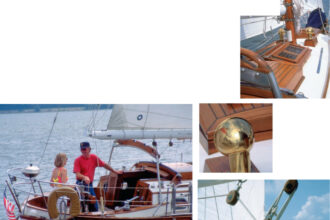
Bruce has attended every America’s Cup race for the past 40 years and covered them for various publications. Naturally, he serves on the America’s Cup Hall of Fame selection committee. At the dock in front of his house, his personal boat, a Nightwind 35 he designed in 1980 and which is actually called Nightwind, gets used at the Wednesday night races. “Ryder Yachts only built 13 of these centerboarders,” he says. “But they draw only 2 feet 10 inches, and we cruise ours for a couple of weeks every year. We have two granddaughters, aged seven and five, and we’re starting them daysailing on the boat.”
For serious racing, he uses his Sonar 23 on Sundays. That’s another one-design production boat he developed when his yacht club, the Noroton Yacht Club in Darien, Connecticut, lacked a proper boat for club racing. Bruce was asked to design something fast and exciting but also capable of being handled by sailors of all ages, strengths, and skill levels. It also had to be trailerable and safe. Enter the Sonar, with its deep spade rudder and generous keel. It’s become an international class boat, and more than 700 have been built and compete in many races including the U.S. Women’s Championship, Cowes Week, and the U.S. Junior Championship.

Disabled sailing
A young friend who’d won junior races was hurt in an automobile accident and lost the use of his legs. Another close friend, Robbie Pierce, adapted the Sonar so it could be used by people with disabilities. “With its 75-percent fractional rig, it moves well in light air, allowing people with disabilities to manage the boat,” Bruce says. “Robbie added a transverse seat so sailors can slide to either side of the boat. I’m proud the Sonar was used in the 1996 and 2000 Paralympics and will serve again in 2004.”
Surprisingly, Bruce is also involved with boats in which no one can sit. He’s developed a passion for radio-controlled Lasers. In the 1990s he collaborated with international champion Jon Elmaleh to produce a patented radio-controlled, one-quarter scale version of the Laser. At just over a yard long, the yacht has a bulb keel, comes as a kit that can snap together in less than five minutes, and requires no life jacket. It’s another one-design class, and the racing — both in the U.S. and U.K. — is taken seriously.
Bruce has not confined himself to drawing small racing boats only. In between the International 14 and Canada I, perhaps his most loved vessel is the Admiral’s Cupper, Runaway ̧ a one-off 39-foot cold-molded boat built in 1979. A recent addition is a custom 43-foot cruiser based again on the flat-bottom, shallow-draft Sharpie. Another cruiser, of which several have been built, is the Georgian 34, named after the beautiful bay in Lake Huron. That said, he has no clear favorite design: “I guess my favorite would be the one that most satisfies the client and thus, by sheer numbers, it should be the Laser.”
Does one have to be a degreed engineer to be a sailboat designer? Bruce’s extraordinary success demonstrates one does not. But what he does advocate is early experience on a sailboat. “You must sail to design,” he says with emphasis. “Engineers aren’t necessarily good sailors. And look at all those designers without formal design training — Bob Perry, Doug Peterson, Olin Stephens. But you must have the ability to see, to re-create the visual aspect. I foresee many advances in boat design dictated by materials. I might prefer wood, but fiberglass and now carbon fibers and Kevlar offer more flexibility. The new materials will create much higher ballast ratios and change design. But in the end, to design you must combine a good computer background with lots of time on the water while keeping your eye on the sails.”
Thank you to Sailrite Enterprises, Inc., for providing free access to back issues of Good Old Boat through intellectual property rights. Sailrite.com