This famous builder of mahogany runabouts and cabin cruisers also built fiberglass sailboats
Issue 29 : Mar/Apr 2003
Tell someone your sailboat is a Chris-Craft and the usual response is, “Chris-Craft? I didn’t know they made sailboats.”
But yes, Chris-Craft, founded at the dawn of the 20th century and the largest American builder of pleasure boats during the 1960s, did indeed build sailboats. Between 1964 and 1973 Chris-Craft produced nine different models (10 if you count one hull with two deck designs). Today they’re still turning up in boatyards, backyards, and yacht clubs on both coasts, on the Great Lakes, and in a few harbors overseas. Several have even graced the pages of Good Old Boat (May 2001, “The Quick Haulout”).
They aren’t the fastest, fanciest, or saltiest of sailboats. And there never were very many of them — most models had production runs of less than 100.
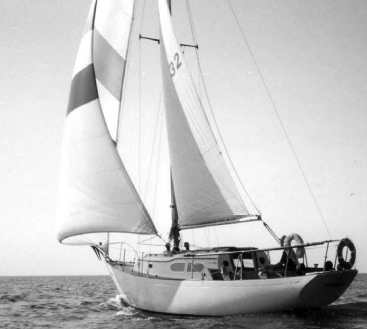
Chris-Craft’s line of sailboats belongs to the classic glass fleet from the 1960s and early 1970s when most designs were heavily influenced by the Cruising Club of America (CCA) rule that predated the International Offshore Rule (IOR). They are generally slender of beam, have moderate displacement, low freeboard, large mainsails and small foretriangles, and show fairly long overhangs and a nice sheer. They are less roomy below than modern designs, but some authorities maintain these types of hulls are more seakindly when compared to newer designs with wide beams and nearly flat bottoms.
These 30-year-old yachts still sail sweetly, working up eagerly to windward in the puffs, meeting the waves with a bold bow, and coming through when conditions grow lively. And they still do it with style.
Company history
Chris-Craft’s corporate history dates back to the early 1900s, originating on the inland waters of Michigan. It was founded by Christopher Columbus Smith, born May 20, 1861. He and his brother, Henry, were professional hunters, so their first boats were sinkboxes and duck boats for shooting birds on the St. Clair River, north of Detroit. In 1919, the brothers began building boats for hunting clients.
Soon, Henry left to pursue other interests, and Chris set off on his own. By 1921, the famous raceboat driver, Gar Wood, invested heavily in the company. At the end of the decade, sales of its varnished mahogany runabouts totaled nearly $3.5 million. Chris Smith died in 1939, leaving the business in the hands of his son, Jay W. Smith.
By the century’s midpoint, Chris-Craft was one of the largest American boatbuilders, with more than 100 different models of powerboats in production. Its name became synonymous with sport and class. And it was all-American — the first boat to land on a Normandy beach, heralding the Allied invasion of Europe, was a Chris-Craft personnel carrier.
In the late 1950s, Chris-Craft began experimenting with fiberglass construction, though it had such a huge investment in wooden-boat production that it was slow to embrace the new technology. In 1957, it bought a company called Lake ’n Sea that built runabouts of plywood and Styrofoam covered with fiberglass. Predictably, these hulls delaminated badly, furthering Chris-Craft’s skepticism of fiberglass. Finally, however, they could no longer ignore the inevitable, and in 1962 the company established a research-and-development department to learn to build more successfully with the material.
By the time their sailboat models were in production in the mid- to late 1960s, the company’s designers and shop workers had a thorough understanding of how to work with fiberglass and polyester resins. But Chris-Craft’s wooden boat production didn’t cease until 1972.
In 1960, Chris-Craft was sold to National Automotive Fiber, a maker of automobile seat covers. According to Robert Pemberton, founder and secretary of the Sailboat Division of the Chris-Craft Antique Boat Club, it was interest in sailing yachts on the part of major shareholder Cornelius Shields, a keenly competitive yachtsman, that probably led to the launch of Chris-Craft’s first sailboat, a heavy, 35-foot sloop.
The Sail Yacht
Chris-Craft had the resources to hire the best for their new sailboat line and chose the firm of Sparkman & Stephens to design it. S&S had drawn the lines of high-profile America’s Cup winners, like Intrepid, and ocean racers, such as Finisterre and Dorade.
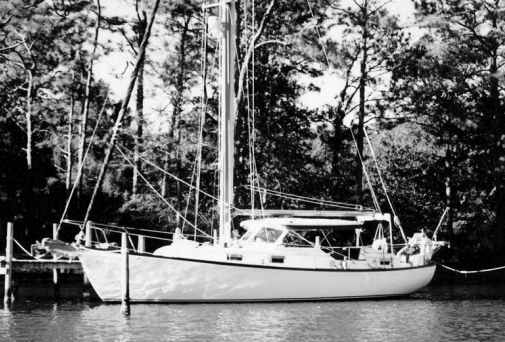
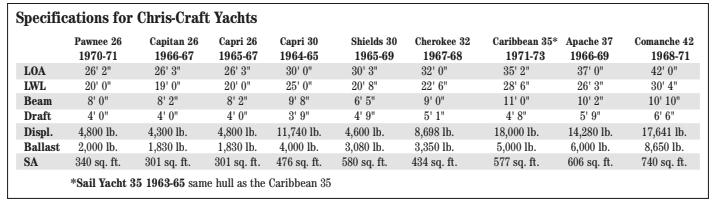
The company’s first sailboat, the 35-foot Sail Yacht (pictured on the facing page), was introduced in 1963 and billed as a motorsailer due to its 563 square feet of working sail area and 18,000-pound displacement. The Sail Yacht’s sail area/displacement ratio is 13.1, definitely low for lively sailing performance, and its displacement/length ratio is a moderately heavy 347. Perhaps this was a reasonable marketing approach considering the company’s reputation as a builder of powerboats. She has a full keel and a simple sloop rig designed for comfortable cruising. She has a midships cockpit, and some models came with the company’s hardtop option that converted the cockpit and its windshield into a pilothouse of sorts. (This predates by many years its use by Hallberg-Rassy, which now markets the windshield as a trademark design element (See January 2003 Good Old Boat). Draft is 4 feet 8 inches and beam is 11 feet.
Like a number of early fiberglass boats, the first Sail Yachts had cabin sides of mahogany and cabintops of plywood. The original power plant was a husky 60-hp gasoline engine in keeping with the motorsailer concept and, unlike some of the later Chris-Craft sailboats, the Sail Yacht, according to sales literature, carried a goodly amount of fuel — 160 gallons — so she had a cruising range under power of more than 1,000 miles.
The Sail Yacht’s moderate draft, low cabin profile, and full keel, along with the midship cockpit and the pilothouse option, are appealing to many people who like conservative designs, private accommodations, and comfortable coastal cruising. She is a steady, surefooted cruiser that will get you to your destination comfortably, if not with blazing speed.
About 80 Sail Yachts were built. The hull was then reworked and given new topsides and cabin and sold as the Caribbean 35, with either a sloop or ketch rig. This was Chris-Craft’s last sailboat design; production ceased in 1973 with hull number 110.
Other offerings
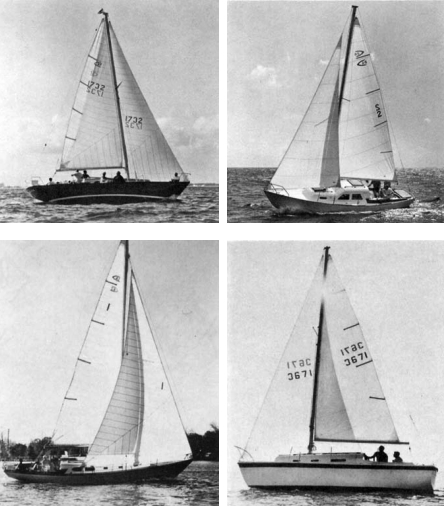
Chris-Craft’s next offerings were the 30-foot Capri, followed by the Shields 30 one-design, and the 26-foot Capri and Capitan. Both 26-footers have the same fin-keel hull but very different cabin and deck layouts. The Capri has a rather bulky cabin for maximum headroom, while the Capitan was given a minimal cuddy and a huge cockpit. Aimed at a hardier set of yachtsmen, both are considerably livelier sailers than the easy-going Sail Yacht.
The Capri 30 is a keel centerboarder that draws just 3 feet 9 inches with the board up. She displaces 11,700 pounds with 4,000 pounds of lead in her keel, and she spreads 476 feet of sail. The Capri 30 came equipped with a 25-hp Graymarine gas inboard engine. According to the sales literature, she was intended for “the sailing family of modest income.”
The 30-foot Capri, the 35-foot Sail Yacht, and the Caribbean were cruisers first and foremost. Chris-Craft built with good-quality materials and workmanship and, for the most part, the boats have held up well through the decades.
Three of the larger boats that S&S designed — the Cherokee, Apache, and Comanche — were intended like many of their CCA contemporaries to serve as racers and cruisers. The two smaller sloops — the 26-foot Capri and Capitan — were designed to race under the MORC (Midget Ocean Racing Club) rule. The company also produced the 30-foot Shield’s one-design, designed by S&S and commissioned, of course, by shareholder Cornelius Shields. Several other yards also built these one-designs, and a number are still in use today as trainers and racers at colleges and sailing schools around the country.
The so-called Indian series — the 26-foot Pawnee, the 32-foot Cherokee, the 37-foot Apache, and the 42-foot Comanche — were built between 1967 and Only 40 Cherokees, 65 Apaches, and about 25 Comanches were built in 1967 and 1968. All three are handsome, sweet-lined sailers and reasonably good performers, with a strong family resemblance to one another.
A quick end
Chris-Craft had a long association with speed and the racecourse. For many decades, racing was the test bed for design and construction. Chris-Craft promoted its sailboats as sharp performers and winners on the racing circuit just as it had for the previous 50 years of powerboat production. A full-page ad in Yachting magazine for the Comanche touted her windward ability and her overall lively performance, while the 26-foot Capitan, with its big cockpit and small cuddy, was billed as an “out and out racer.” A newly commissioned Comanche won the Chicago-Mackinac Race, and fleets of Capitans raced as one-designs in Canada. Yet after just 12 years of production the company abandoned them and nearly all their other sailboats.
So what went wrong?
They were well-designed boats and as well made as contemporary competitors’ boats. Robert Pemberton explains that one reason for the short-lived foray into sailboats was the difficulty Chris-Craft had with its distribution system. Most boat sales were through dealers, and most Chris-Craft dealers knew and serviced only powerboats. Mastering the peculiarities of sailboats was another game altogether, and the learning curve associated with servicing this new “culture” was a steep one. The wide gulf between sail and power is illustrated by an anecdote (possibly apocryphal) regarding the new owner of a Comanche who stipulated that the customary trademark Chris-Craft builder’s plate not be affixed to his new yacht’s cabin.
Scattered production
Another reason, Robert writes in the sailboat owners’ newsletter, is that (unlike most smaller builders) Chris-Craft scattered its production around the country at four different plants. For the short production runs of sailboats (at least compared to the huge volume of powerboats turned out), this was neither efficient nor economical. With engineering and service departments spread widely at a time when inter-company communications weren’t as easy as they are today, inefficiencies and production glitches resulted.
In analyzing the rapid demise of Chris-Craft’s sailboat line, Robert points out that most small builders launch a boat, test it, campaign it on the racecourse, and then tool up for production after working the bugs out. Chris-Craft, he says, worked on the inevitable bugs and problems after they had already begun production.
Partly because of this and the generally high-quality construction, Chris-Craft sailboats were not cheap compared to other offerings of the time. But while this probably contributed to the company’s brief dalliance with sailboats, it was to the benefit of those budget-minded sailors who sought quality and bought a Chris-Craft in the closing years of the 20th century. While the boats aren’t perfect, they have held up very well on the whole.
Construction
The general quality of the deck hardware and fittings on Chris-Craft sailboats is at least as good as, if not better than, other comparable contemporary production boats — Monel fuel and water tanks, heavy bronze seacocks, and open-body turnbuckles. And the keel-stepped spar, sturdy bridge deck, comfortable cockpit, and a deck cored with foam (that has well resisted water absorption) are additional pluses.
But no boat, even a 30-year-old plastic classic, is perfect, and when Robert surveyed the membership of the sailboat owners’ association a few years ago, he found a few consistent complaints and problems, a couple of which are also detailed on Internet websites.
Some problems, such as deck leaks, are fairly common among sailboats built at that time. But a couple of fairly specific and chronic problems also show up.
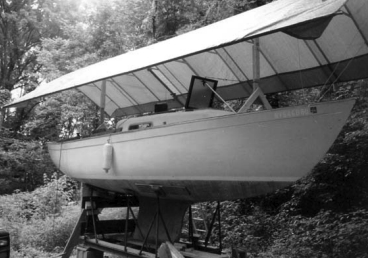
One is the skeg-and-rudder arrangement present on the fin keel Capitan 26, Capri 26, Cherokee 42, and Apache 37. These boats have rudders attached to skegs that sometimes develop cracks and other structural weaknesses. And on the Cherokee and Apache, the so-called balanced rudder was quite shoal. Several owners have replaced these rudders with deeper, higher-aspect-ratio blades and have reported excellent results. The original low-aspect-ratio rudder has a tendency to stall in heavy seas. And under power the balanced rudders cause an excessive pull on the boat’s helm, generated by prop wash hitting the leading edge of the blade. It’s so obnoxious on the Cherokee that it is wise to keep speed below 6 knots. One owner said it’s only proper that a powerboat company would design a sailboat that sails sweetly and motors badly. On the plus side, the Cherokee is very maneuverable in reverse.
Backing plates
Several models have steel backing plates embedded in their decks. When saltwater penetrates the deck they rust and swell, causing cracking and delamination of the deck. One owner of a saltwater Apache faced with this problem cut out the old rusted steel plates and glassed in replacement stainless plates, working from below to make the repair less conspicuous. The fin-keelers have cast-iron keels and galvanized keel bolts, also suffering a predictable problem with corrosion and sometimes with subsequent leaks at the keel-hull joint. A few well-meaning owners have replaced the original bolts with stainless-steel ones (see Mail Buoy in the November 2001 issue of Good Old Boat for why this is not a good idea).
Another design flaw that some of the Chris-Craft boats share with a number of other older sailboats is that of chainplate attachment. Both the Capitan and Capri use the plywood bulkheads belowdecks to anchor the chainplates. If (when) the water finds its way through the deck and down along the chainplate, the result is a rotten spot. If not noticed and repaired, dismasting may be the result, as it was a few years ago with a 26-foot Capri that was in a close race on a blustery day off Sodus Bay, Lake Ontario.
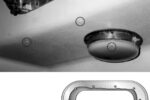
The Cherokee, for one, has a lot of holes in its bottom. Two of the through-hulls that seem a bit unnecessary
are connected to a pair of deck scuppers. At least one owner has closed them and redirected deck drainage overboard through the rail.
A loyal following
So the boats aren’t perfect. But the relatively small number of Chris-Craft sailboats that were produced still seem to have gathered an intensely loyal following. David and Robyn Waltrip, who recently purchased a Caribbean 35 ketch, wrote in the sailboat owners’ newsletter, “Due to our experience with the Capri, we only seriously considered other Chris-Crafts as an option.”
Another long-time owner of a Capri 30 is Jack Klang, who has sailed his boat since 1974. He writes of his “trusted friend,” Hells Bells: “I hope that our family will enjoy sailing her for many, many years. After all, a good friendship lasts forever.”
Chris-Craft changed hands several times during the 1980s. In 1981, G. Dale Murray, celebrity attorney F Lee Bailey, Walt Schumacher, and Tonight Show host Ed McMahon bought the company. Murray then sold $32 million worth of interest to Saudi Arabian billionaire Ghaith R. Pharaon, who brought in aircraft-industry executive Chuck Husick to jump-start the financially feeble outfit. But debts mounted — $69 million in 1989 against assets of $61 million — and in 1989 it was purchased by OMC (Outboard Marine Corporation). That onetime giant of the industry, maker of Evinrude and Johnson outboard motors, declared bankruptcy in 2000. Arch rival Genmar Holdings bought Chris-Craft at auction and then resold it to Stephen Julius and Stephen Heese, who now run the company.
Today, Chris-Craft builds a small line of fast power cruisers — nine models ranging from the Launch 22 to the Roamer 43 — but no sailboats. It’s doubtful it ever will again. But people still remember the Chris-Craft sailboats of the 1960s and ’70s, which now are a legendary part of modern sailing history.
Thank you to Sailrite Enterprises, Inc., for providing free access to back issues of Good Old Boat through intellectual property rights. Sailrite.com