Boating writer’s circuitous voyage to the Pacific Northwest
Issue 29 : Mar/Apr 2003
Spend a day with John Vigor (pronounced VIGH-gor) and you’ll soon be creating Turk’s Head knots and delving into long-forgotten nautical lore. John’s the author of The Practical Mariner’s Book of Knowledge, The Sailor’s Assistant (now in paperback also as Boatowner’s Handbook), and a 150,000-word volume to be published by International Marine called The Practical A-Z Encyclopedia of Boating.
All these are well-known collections of facts and information of use to mariners. Good Old Boat readers know him as the author of Twenty Small Sailboats to Take You Anywhere (one chapter is featured in this issue on Page 37) and The Seaworthy Offshore Sailboat. But John may go down in history for two concepts that won devoted fans from coast to coast: Vigor’s Black Box Theory and his popular boat “denaming” ceremony.
How does a British-born and South Africa-raised journalist wind up in the Pacific Northwest sailing, writing books, and doing freelance writing and editing for U.S. publishers as diverse as International Marine and Good Old Boat? To understand where John is today you have to start at the beginning. The story includes a transatlantic voyage in a 31-foot sailboat and a dinghy class national championship.
The son of a British Royal Navy Chief ERA (chief petty officer) and the woman he met while stationed in South Africa, John was destined to live periods of his young life at opposite ends of the globe — Britain and one of its far-flung colonies. He was born in Britain where his parents spent the early years of their marriage during the darkest days of World War II.
Watched dogfights
“From the school playground I watched dogfights between Spitfires and Messerschmitts,” John recalls. Not long after the war was over John’s father retired from active duty, and the Vigors chose to return to South Africa’s balmier climate. John, by now a young teenager, finished his education in South Africa. “The schooling was completely different,” John says.
“I had to learn Afrikaans in order to pass.” He had less than a year to conquer his new country’s other official language. He passed.
It was in Simonstown, South Africa, that John discovered sailing. The family lived near the beach, and John had his first sailing experience at age 13.
A few years later, his family moved to Durban, and Point Yacht Club became a favorite hangout. “This is a working man’s yacht club,” John points out, “not one of those snobbish affairs. These were practical men who had come home from the war. They built their own boats out of plywood.” John was able to crew on larger boats and take 14-foot dinghies out for racing and pleasure sailing. “It was fun to go out amongst the big swells,” John recalls. “It’s 3,000 miles to Australia. That’s a big fetch.”
The ocean introduced John to sailing, and it started him on a career path as well. He had a Yashica camera that he used to take photos of cruisers arriving in Durban. He’d write captions for these photos and sell them to the newspaper. Sometimes he’d sell stories he’d written about people who were sailing around the world.
When an Australian who owned a 52-foot cutter announced that he was sailing to England and needed a crew of four, John was hired. But the day before the boat was to set forth, a court bailiff nailed a writ to the mast for the non-payment of taxes. The cutter was impounded.
But John, who knew the remainder of the crew, was aware that one of them had quit his job as a reporter on a local daily newspaper. John also knew that the fellow didn’t want that job anymore. John did. He applied for the opening and became a journalist in training.
Photographic stint
The newspaper sent him to school and provided on-the-job training. So his editors were mightily disappointed when John — as so many 20-somethings before and since — decided he had pretty much learned all there was to know about the beats he covered and chose to concentrate on becoming a photographer instead. He apprenticed for a couple of years with a well-known photographer.
At the time it was understood that “European kids” in South Africa would spend a year or so in Britain, Canada, New Zealand, or Australia. So, while still in his early 20s, John next worked a passage to London, washing dishes on a Union-Castle passenger liner.
While he still had his sea legs John was offered the job as mate on a 72-foot ketch named Thelma II, which was headed for the Mediterranean on a promotional tour sponsored by the British Federation of Industries. John spent six weeks aboard as navigator. Then he returned to England to take a job with the Kent Messenger as a photojournalist. Later he learned that the Thelma had sunk in the West Indies.
His life took a new twist when a young American woman, a fellow journalist with the Kent Messenger, caught his eye. John and June Vigor were married in England and returned to South Africa a few years later, when John was offered a reporter’s job there. The couple found the good life in Durban and raised three sons there. They both had jobs they enjoyed: John with a daily newspaper and June with a prominent parenting magazine. They were active in the community. John introduced the International Mirror-class dinghy designed by British naval architect Jack Holt, one of the most successful home-built plywood designs ever, with more than 70,000 built, including thousands in the United States. It’s an 11-foot stitch-and-glue sailboat. He built four of these boats himself and started a class in South Africa. In 1972, John and June won the South African Mirror-Class National Championship.
Increasing violence
But the South African political environment in the 1980s was unpleasant and sometimes frightening as the African National Congress turned increasingly violent. When John was spotted doing manual labor at his own home (bricklaying), something that was considered “black man’s work,” their home was sprayed with graffiti, and they feared they had been singled out for special terrorist attention.
Their two oldest sons, Trent and Terry, had finished school and reached the age of conscription into the army, but they had no heart for the black-vs.-white battle that was coming to a head. The Vigors bought them one-way tickets to the United States, vowing to catch up with them soon. June and her sons were American citizens, which made this transition easier.
That left Kevin, the youngest son, who was still in school. The Vigors sold their home, bought a five-year-old boat, and prepared for an ocean voyage. The boat, a Performance 31, designed by Cape Town naval architect Angelo Lavranos, was named Freelance. They sold her when they arrived in the States, but they miss Freelance and wish they had her still.
Finances were tight, however. The South African Reserve Bank allowed emigrant families to take a maximum of $39,000 from the country. The cost of their boat was deducted from this amount, leaving them with not quite $6,000 with which to finance their needs during the six-month voyage, to start searching for work in America, and to get Kevin started in college.
Smuggled coins
Against the rules, John bought one-ounce Krugerrands to smuggle out of the country in order to capture some of the family’s capital that would otherwise be seized. Smuggling anything is a risky business, and the two were terrified of having their deception discovered before leaving the country. They also had to find a way to turn these coins into U.S. dollars before arriving in this country. New coins could not be imported into the United States because of trade embargoes imposed against South Africa. “We needed two miracles,” John says.
Both miracles happened. They left the country without being caught, and the coins were converted in St. Maarten. As a result, the family was able to bring an additional $7,500 of their savings along on their voyage. This is not a worldly sum, but together with the sale of their boat, the Vigors were able to begin their new lives.
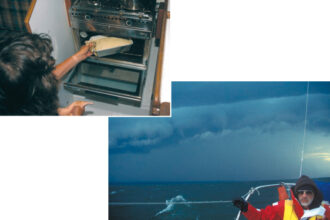
The voyage itself was perhaps the most arduous at the southernmost tip of Africa, where they encountered one storm after another. A total of seven gales hit Freelance while they rounded the so-named “Cape of Storms.” Thanks to their involvement with the Mirror-class sailing program, June and Kevin were experienced dinghy sailors, but they had never been to sea overnight on a sailboat. Theirs was a “baptism by storm.”
That first offshore passage was from Cape Town to St. Helena, 1,700 miles to the northwest. In a story of their voyage, John writes, “Watching Africa drop astern, we felt no joy. We felt nothing but deep sadness, too deep for tears or even words.” He tells that story in two parts in Cruising World, January and February 1992. As it ends, the Vigors are still “finding themselves” in this country. June Vigor remembers the pain of returning to the country she left so long ago. “I’d been out of the country long enough that I felt totally foreign. . . in fact worse than foreign, because it was my country,” she says.
Began search
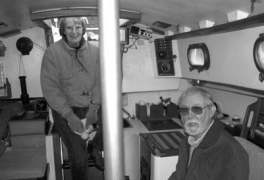
After arrival in Fort Lauderdale in June 1987, the threesome toasted their safe arrival, sold the boat, and began the search for the rest of their lives. It’s not easy to start from scratch at any point in your life. It’s harder still when you’re in your 50s. Kevin went off to study computer science in Salt Lake City. John and June bought a car and traveled from Key West to Seattle and partway back, looking for jobs for two experienced journalists. But the large newspapers weren’t hiring, and the small ones didn’t pay a living wage. Southern California was home for a while, but they were uncomfortable there. Neither the jobs nor the communities in which they lived were right for them.
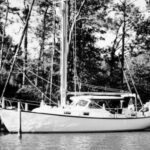
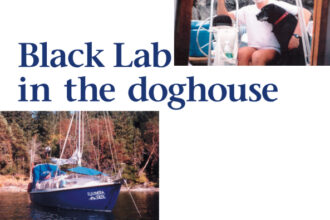
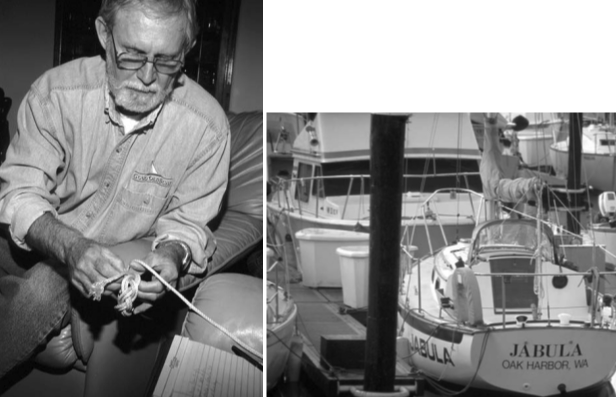
These days June is a copy editor with the Bellingham Herald in northwest Washington state, and John works at writing books, editing other people’s books, and freelancing articles for sailing publications. When we met with them last winter, they were sailing Jabula, a Cape Dory 25D, with which they were exploring the Pacific Northwest, including a circumnavigation of Vancouver Island one summer.
For her part, Jabula, which means joy or happiness in Zulu, was a shipshape and seaworthy replacement for their trusted friend. She was decked out in Turk’s Heads “for luck,” John explains. Since then, Jabula has been replaced by a slightly larger sister, a Cape Dory 27 called Sangoma. It stands to reason that this new boat will also be properly decorated for luck.
Naturally the visitor, upon hearing that luck can be had with a piece of string and a bit of skill, will want to acquire the skill for use on his own boat. Thus, before he knows it, the unwary will be passing the evening winding small rope into impossible patterns. Kind of like the pattern of John and June Vigor’s lives. Its very complexity is what makes this knot so interesting. The same can be said of John Vigor.
Thank you to Sailrite Enterprises, Inc., for providing free access to back issues of Good Old Boat through intellectual property rights. Sailrite.com