A roomy good-looker
Issue 19 : Jul/Aug 2001
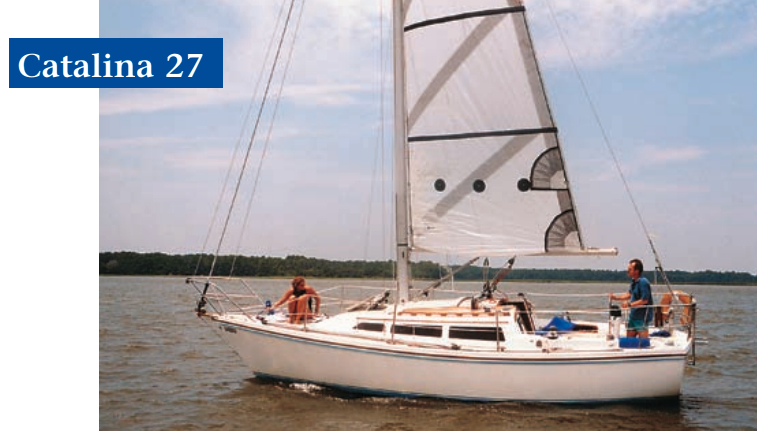
It might come as a surprise to find the Catalina 27 described as sea-worthy enough to sail around the world. I can think of some dedicated traditionalists who would faint dead away at the very suggestion.
But she is included (in the book Twenty Small Boats to Take You Anywhere) for some very practical reasons. First, a lot of people are going to be tempted to take the Catalina 27 offshore. They should know what her limitations are. Second, Catalina 27s have sailed around the world very successfully. Prospective adventurers need to know how that success was achieved. Third, Catalina 27s are very available. They’re belly-button boats. Everyone seems to have one. And they’re cheap. More than 6,000 27s have been produced since Frank Butler started building them in California in 1971. It’s the largest production run of a 27-foot sailboat in the history of boatbuilding.
Perhaps it’s important to state the obvious right at the beginning: a good sailor could sail around the world in almost anything. Just because the Catalina 27 has made circumnavigations, it doesn’t make her anything like the ideal boat. Nevertheless, her weak points are well known, and she is capable of being improved substantially by enthusiastic amateurs. She’s not the kind of boat you’d want to take around Cape Horn in winter, but with a lot of caution and seamanlike preparation you could sail her around the Cape of Good Hope in summer.
Before you rush out and start looking at secondhand Catalina 27s, be aware that there are several different models, some more suitable than others for ocean work. There are models with deep keels and shoal-draft keels. Some have tall rigs, and others have standard rigs. About half have outboard engines, and the rest have inboard engines. The two standard interior designs are the traditional version, with the galley located aft, and the dinette version, which has the galley amidships.
For our purposes, the deep-keel, tall-rig, aft-galley, outboard engine version is most suitable. With a tall rig, you can fly plenty of sail to get you through calms. Why an outboard? We’ll come to that in a bit.
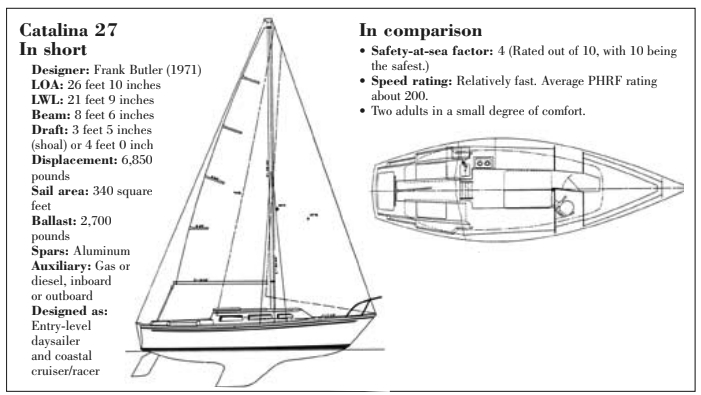
The original displacement of the deep-keel outboard model was about 5,600 pounds, while the shoal-draft 27 displaced about 6,100 pounds, the extra 500 pounds being carried as added ballast in the keel.
But as the years have rolled by, the Catalina 27 has put on weight along with the rest of us. Displacement of later boats has crept up to 6,800 pounds or more as the interior has become more sophisticated and loaded down with inboard engines and the paraphernalia of sewage holding tanks, Y-valves, fuel tanks, and so on.
An older, lighter boat is probably the best bet for an extended sea voyage. You’re going to add plenty of weight in the form of food and water, and you don’t want to destroy this boat’s main asset — her speed and sailing ability — by burdening her too much.
Basic design
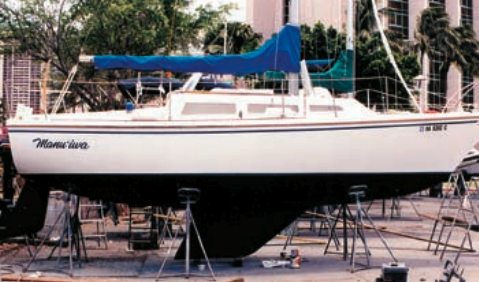
The first thing you could say about the Catalina 27 is that she was designed to be affordable. That is, cheap. There is no expensive overbuilding here, no redundant overlapping systems, no salty bronze opening ports at more than $100 a smack. She was designed for a purpose, and she fulfills that purpose well. Let’s just not kid ourselves that she was designed to sail around the world.
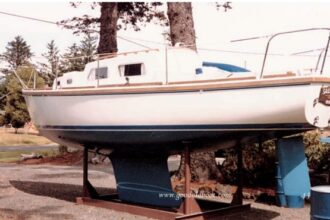
The Catalina 27 is a fin-keeler with a free-standing rudder extending aft underwater beneath the transom. There is no support from a skeg. The first thing you notice about her is that she handles like a dinghy, which is hardly surprising since that’s what she basically is — a dinghy with delusions of grandeur.
She’s light and beamy. The tall rig is skinny and efficient. She is reasonably stiff and stands up well to her canvas. All this makes her a fast, maneuverable, and easily controlled boat, but it doesn’t do much for seaworthiness.
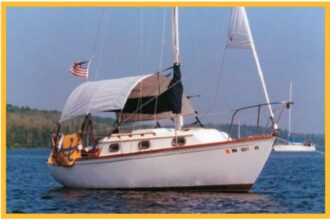
With a beam of 8 feet 6 inches (later increased to 8 feet 10 inches) the hull needs to be fairly shallow, so as not toincrease displacement and underwater resistance. That, in turn, limits the space inside for accommodations and stowage. But what the Catalina 27 lacks below the waterline is more than compensated for by what’s above it.This boat is a good example of nautical trompe-l’oeil. She deceives the eye. Her topsides are deep and her cabintop high, so that her interior is actually about the biggest you’ll find on any boat with a 22-foot waterline. But you wouldn’t think so by just looking at her from the outside. Through some cunning design, or by pure luck, Frank Butler happened on a bulky design that is not aesthetically offensive. Far from it. She’s not a bad looker at all. The deep crown in the cabintop helps considerably, and the fairly straight sheerline gives her a look of modern sleekness. But there’s something else at work there, too, some magic mingling of line, curve, and proportion that brings pleasure to the eye.
The decks and cockpits of older boats were what you might call uncluttered, even with essentials such as a bow roller, but that can be an advantage, too. Sometimes it’s easier to start with a clean sheet and add your own custom fittings. Incidentally, in the beginning there were no backing plates on the fittings that were supplied. That kind of pennypinching inevitably leads to cracked gelcoats and possible delamination of the GRP around the bases of stanchions, cleats, and rails. Happily, things changed for the better on later boats.
The 27’s cockpit is fairly large and lacks a proper bridge deck to stop heavy water from entering the saloon. There are ways around this problem that we will discuss later, but they bring with them the usual penalties — inconvenience and the need for constant vigilance.
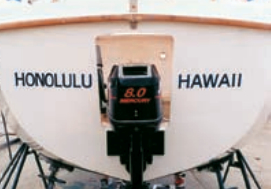
A little earlier we asked why an outboard engine is the type recommended for an extended voyage. The answer is simple. Although about half of all Catalina 27s are fitted with inboard engines, they shouldn’t be. It’s possible to squeeze one of those sweet-running little Universal 14-hp twins into the space aft of the saloon, and then bolt the deck and cockpit on top of it, but there’s practically no way to get to it after that. You might as well kiss it goodbye.
As a result of poor access and the consequent problems of routine servicing, the inboard engine of a used boat is likely to have been neglected unless the previous owner was double-jointed and could change the oil by feel alone.
The outboard-engined versions of the 27 free up a lot of stowage space down below and avoid most of the problems of servicing, although they’re not exactly easy to manhandle in and out of the well at the aft end of the cockpit. In fact, if you’re planning to cross an ocean, it would be better to mount the outboard on a bracket attached to the outer face of the transom. That further frees up valuable lazarette space.
A 9.9-hp outboard is about the right size for the Catalina 27, though you can go as low as 5 hp if you intend to motor only when there’s not enough wind to sail. And then you could use the same engine on your inflatable dinghy. The Catalina 27 can’t carry much gasoline, of course, so her range under power will be limited, but she sails so well that you’ll only need the engine for getting through the odd pass in a coral reef or for maneuvering in port.
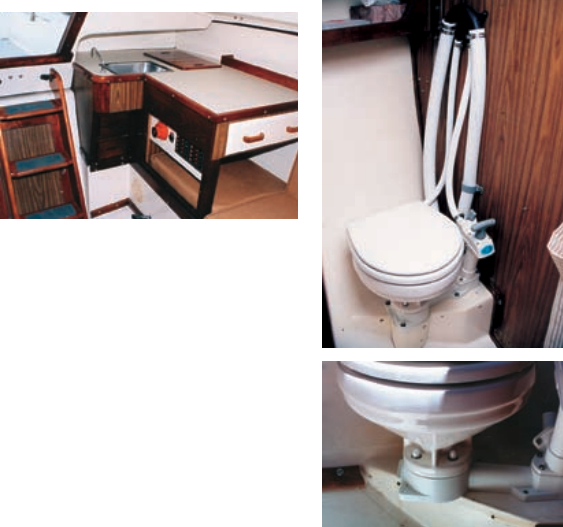
Accommodations
There’s hardly another 27-footer around that compares with the Catalina 27 for a feeling of bright airiness and space down below. Despite her faults, and they are many, this boat offers so much in the way of accommodations that owners are prepared to overlook the rest.
The companionway hatch is responsible for much of the spacious feeling.
It’s very wide. When it’s fully opened, the heavens appear to invade the boat’s interior, letting in light, air, and the sweet smell of the sea. At the same time, a large hatch is a danger at sea, not only because it is structurally weaker than a smaller one, but also because of the vast volume of water it would admit if the boat were suddenly capsized while it was open.
There is standing headroom of 6-feet 1 inch in the main cabin, but it tapers down as you move forward. Still, for a 27-footer, it’s very generous.
The traditional aft-galley layout supports six berths. They aren’t all comfortable to sleep in — the two in the forecabin and the one on the port side of the main cabin are short — but nobody should even contemplate sleeping six adults in a Catalina 27 anyway. The settee berth on the starboard side converts into a double bed for cozy cuddling in port, but the only really decent sea bed is the starboard quarterberth.
Just aft of the forecabin, on the starboard side, there’s an enclosed head that is reasonably comfortable to use. As is usual on a boat of this size, there’s precious little locker space, although many owners have found that they can open up extra stowage pockets by cutting into the plastic interior liner in strategic places.
The original galley equipment was a two-burner alcohol stove, which can be recommended only if you have plenty of time on your hands and enjoy spending a lot of money on a little heat. Propane is quicker, easier, and more efficient. It can also be dangerous. But then, so can going to sea in a Catalina 27. Traditionalists will change over to kerosene, which is smellier, messier, and more trouble, but safer and cheaper.
Over the years, the Catalina 27’s rather austere looks down below have been softened by the addition of more wooden trim, but its side effects are detrimental, both on the speed of the boat and the checkbook of the owner. This boat will never look like a Hinckley or a Hallberg-Rassy, no matter how much trim is added.
The rig
The Catalina 27 is not dressed for the sea. Her rig is weak and needs to be beefed up. Shrouds and stays should be replaced with wire at least one size bigger. The chainplates for the aft lower shrouds should be strengthened, too. Owners of older boats like to tell how they watched the deck bowing upward at the chainplates in heavy weather. Some bolted new stainless steel chainplates through the topsides, as was the fashion in the good old days, and fastened the shrouds to them. It means the jib won’t sheet at such a narrow angle, but it’s a good trade for keeping the mast up.
Change the spreader sockets, too. The old ones were made of cast aluminum, which has a reputation of cracking under stress. You can get new stainless steel ones from the factory.
Otherwise, the rig is pretty simple and efficient — a single-spreader mast-head sloop of 340 square feet with the sail area fairly evenly divided between the main and foretriangle. The spars are aluminum, of course, and she uses jiffy reefing on the mainsail.
Performance
The tall-rig, deep-keel, outboard-engined Catalina 27 that is best suited to deep-sea work is also the best performer. The secret of making fast passages in this boat is to keep her light. She will not only sail faster and go to windward better, but she’ll be safer because she’ll put less strain on her hull and rigging. When she’s pounded by a wave, a boat like this must be able to give way fast. She hasn’t got the strength to resist like a solid rock taking everything that comes. She must submit. Her narrow keel helps her to slip sideways through the water, reducing the force of the blow, but too much weight will sink her lower, slow her responses, and punish her accordingly. A Catalina 27 must be lively to live.
So be careful how you load her. Take only enough food and water for the passage in hand. Resist the temptation to stock up on canned goods for three years because your local supermarket is having the sale of a lifetime. Keep that weight down.
The outboard version is faster than the inboard version for two reasons: an outboard is a fraction of the weight of an inboard engine, and you can raise an outboard’s propeller out of the water to avoid drag.
Under sail she’s lively, but you can control her with one finger on the tiller until it really starts to blow. She won’t hold her course faithfully for 10 minutes while you clean up the mess the anchor made on the foredeck, of course, although she tracks better than you might expect from a fin keeler. The lightness of the helm is an advantage in at least one respect: you can use a small self-steering windvane, such as the Navik, which weighs only 41 pounds.
Like most beamy little lightweights, she tends to gather weather helm as the wind rises and makes her heel excessively. Weather helm describes a sailboat’s continuous attempt to gripe, or turn into the wind, which must be counteracted by pulling the tiller to weather.
There are ways to deal with excessive weather helm, either by varying the amount of sail fore and aft, so that she is forced to turn away from the wind by more sail area forward, or by changing the depth of draft in a sail. But the best way to reduce weather helm and maintain control on a boat like the Catalina 27 is to reef down. As soon as she comes more upright, the tendency to gripe is greatly reduced.
You can try this for yourself in the bathtub with a model yacht. If you push the mast from directly behind when she’s dead upright, the yacht will go straight ahead. If you push in the same spot while she’s heeled over to starboard, she’ll spin around to port. The mast acts as a sideways lever to screw her into the wind. And the more she heels, the more effective that lever is.
So keep your Catalina 27 upright — or at least reduce that excessive angle of heel — by reefing down as soon as you experience that feeling that she’s getting out of control.
Known weaknesses
We’ve already mentioned the backing plates for deck fittings, the standing rigging, the chainplates, and the spreader sockets.
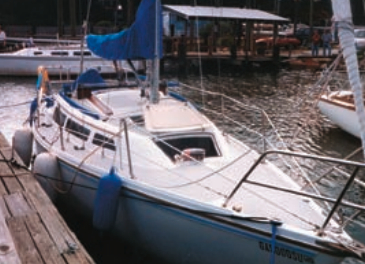
The lack of a bridge deck means you’ll have to keep one or more hatch-boards in place in the companionway, and you must be sure they’re solidly fixed in place so you won’t lose them in a capsize. They will hamper your access to the cockpit — you will have to high-step over them every darned time you come and go — but it’s a small penalty to pay for the security they provide.
Check the seacocks. You must have a bronze seacock on every through-hull opening. Some of the original through-hull fittings on the Catalina 27 were simply pipe nipples glassed into the hull. Change them for proper flanged, bolt-through bronze through-hulls. And if your boat has gate valves fitted to the through-hulls instead of seacocks, change them, too. Gate valves, no matter what material they’re made of, are not seagoing fittings. Change them for bronze ball seacocks, or the traditional tapered barrel type. Check the icebox drain. There have been reports of water running back into the box when the boat heels over. Fit a seacock to the through-hull.
Owner’s opinion
I once tested a Catalina 27 for a week for Cruising World magazine and found her quite free of vices under sail and power. I didn’t have the opportunity to test her in extreme conditions at sea, but I discovered a man who did. He’s Patrick Childress, of Newport, Rhode Island, who sailed his secondhand Catalina 27, Juggernaut, around the world alone in the 1980s.
He experienced the worst weather of his trip in the cantankerous and unpredictable Indian Ocean. During a particularly bad storm he stripped Juggernaut down to a storm jib. He then sheeted it in tightly and set his Navik windvane self-steering gear to keep Juggernaut close on the wind.
With the boat heeled well over, even under the tiny jib, she gained weather helm, so there was not much work for the Navik to do to keep her heading about 45 degrees into the waves as she forged slowly ahead. This is a classic hove-to position, but very few classic boats ever manage to achieve it, and it’s ironic that a boat normally considered unsuitable for deep-sea work should be able to heave to so well in extreme conditions.
She occasionally got lifted up by an extra-big wave and dumped down sideways, but she always recovered quickly, so Childress left her at it until the storm blew itself out.
Childress got his boat very cheaply and worked full-time for three months to make her fit for sea. Here are some of the major changes he made:
He stiffened the hull by installing mini-bulkheads in all storage areas beneath the berths. This also divided the stowage into more conveniently sized compartments, of course.
He installed a 1-inch-thick mahogany plank inside the starboard side of the transom as a stiffener and backing plate for an outboard engine bracket.
He improved cockpit drainage by installing four large hoses leading downward between the aft end of the cockpit and the transom. There were through-hull fittings at each end of each pipe.
He stopped water from forcing its way through the front and sides of the closed main hatch by making new, tighter-fitting runners. He also fixed plastic tabs on the front of the hatch.
He bolted new chainplates through the hull.
He changed the stove burners from alcohol to kerosene. The threads are the same, so it is a simple matter of unscrewing the old burner and screwing in the new one.
He installed double headstays.
He fitted heavier topmast shrouds and aft lower shrouds. The forward lower shrouds stayed the same.
He installed open-faced, stronger turnbuckles.
He installed double backstays, with a backstay adjuster.
He removed the forward bolt on the rudder bracket, the one that goes through the tiller, and replaced it with two stainless steel hose clamps.
He installed a 1⁄2-inch bolt through the rudderpost cap, where the cap attaches to the rudder stock. The original bolt is too small and will eventually wear an oblong hole.
He installed a medium-duty electric bilge pump in the bilge, fitted with a float switch and manual override. He also installed a large-capacity electric pump with a float switch in the protected area under the cockpit for extreme emergencies in case the cabin became flooded. (He used a solar panel to charge his one battery, aided occasionally by a small-capacity generator on his outboard motor.)
He caulked the hull-deck joint with 3M-5200 sealant to fill the void behind the rubrail, which was leaking.
He boarded over the outboard engine well and fitted his Navik self-steering gear there.
Conclusion
We live in an age when it is both fashionable and legally advisable to warn people about the many ways in which they can harm or kill themselves. One is forced to wonder how people ever managed to survive before this fashion was all the rage and how the human population of the world ever managed to grow to the record level it is at today.
So while it is correct to say that going to sea in a Catalina 27 can be harmful to your health, one always harbors the hope that anyone imbued with the human spirit of adventure and the need to explore will deem the risks necessary, even invigorating.
Of course you shouldn’t go to sea in a Catalina 27 if you’re an absolute beginner with no knowledge of sailing or navigation. But if you’re a reasonably experienced sailor with a good deal of common sense and are prepared to work to get the boat right and to study to make sure you’re in the right places at the right seasons, there’s no practical reason why you shouldn’t sail an old Catalina 27 around the world as others have before you. And a whole lot of us would cheer you on.
John Vigor has sailed for more than 40 years and logged some 15,000 miles of ocean voyaging. In 1987 he and his wife, June, and their 17-year-old-son sailed their 31- foot sloop from South Africa to the U.S. This and other reviews are reprinted from John Vigor’s book, Twenty Small Sailboats to Take You Anywhere. Also see his book, The Seaworthy Offshore Sailboat, which devotes a chapter to beefing up a Catalina 27 for offshore sailing.
Thank you to Sailrite Enterprises, Inc., for providing free access to back issues of Good Old Boat through intellectual property rights. Sailrite.com