… And Two Other Interpretations of Timeless Cutter Design
Issue 129: Nov/Dec 2019
It is relatively easy to assign a time or decade to the design of most production fiberglass sailboats.
That’s particularly true for boats drawn to a specific rating rule. There’s no mistaking a boat designed to the 1950s and ’60s CCA rule or to the 1970s and ’80s IOR. Nor is it difficult to pigeon- hole more modern cruising sailboats with their high freeboards, wide walk-through transoms, twin wheels, bulb keels, plum stems, and a certain European design flair. However, there are still a few designs that do perhaps warrant the adjective timeless, boats untethered to a particular time or date but influenced by traditional boats of the past.
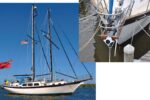
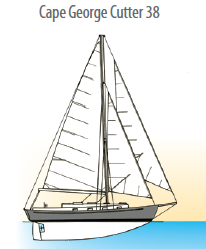
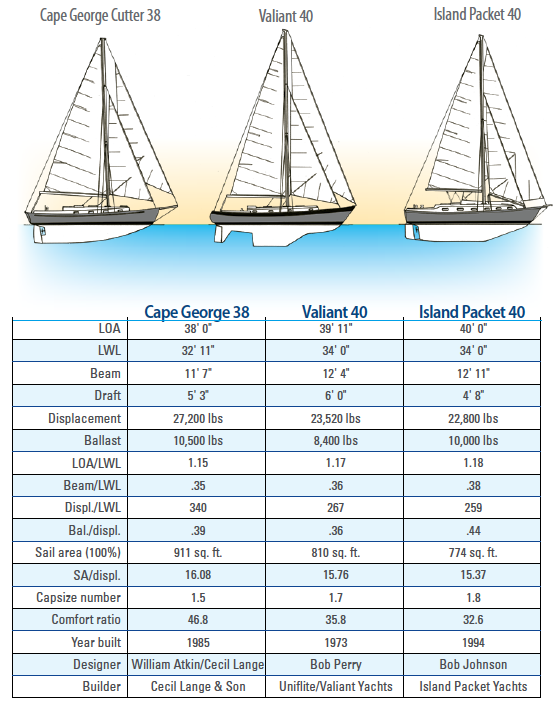
The three boats we’re looking at fall under that description. One, the Valiant 40, updated the traditional aesthetic with more modern design considerations, while the Island Packet 40 is a more recent interpretation with an eye toward better sailing performance. Certainly, the Cape George 38, which hews most closely to the traditional cutter concept, owes its lineage to the previous work of William and John Atkin, not to mention Colin Archer, or even G.L. Watson. Her plum stem, long bowsprit, cutter rig, full keel, and cutaway forefoot certainly tie her to a design tradition in yachting and ocean voyaging from the late 19th and early 20th centuries that still holds a strong following today. That design philosophy is also reflected in her 27,200 pounds of displacement, producing a very conservative displacement/waterline (Displ./LWL) ratio of 340. Her very low capsize number of 1.5 and high comfort ratio of 46.8 also are reflective of that older design concept of narrower beam and heavy displacement. However, note that this boat was designed and built in 1985, not 1885. This truly is a timeless design concept that has bridged a century of bluewater cruising (or at least the dream of bluewater cruising).
So it’s especially interesting to include Bob Perry’s 1973-designed Valiant 40 in this comparison. Perry took that older design aesthetic of Colin Archer and Albert Strange and combined it with a longer waterline and a more modern and efficient underbody of fin keel and separate rudder. He also designed a lighter displacement of 23,520 pounds, resulting in a more favorable Displ./LWL ratio of 267. The Valiant 40 also has the greater draft which, when combined with the fin keel and separate rudder, can’t help but produce better upwind performance.
It’s interesting to point out that Perry’s modern update of the classic “offshore” design came a full 12 years before the Cape George 38 hit the water! The other more extreme example that comes to mind of applying a modern underbody to a traditional design concept is Mark Ellis’ 1978 Nonsuch 30, which also included an update on the traditional catboat rig with a freestanding tapered aluminum mast and wishbone boom.
To further demonstrate the timelessness of the traditional cutter, I have also included Bob Johnson’s 1994 interpretation of the concept in his Island Packet 40, which possesses the same attributes of the Cape George of full keel, cutaway forefoot, and cutter rig, but with a longer bow, shorter bowsprit, and the lightest displacement of 22,800 pounds, producing the lowest Displ./LWL ratio of 259. These three boats span over 20 years of yacht design history, with the most modern in fact being the oldest of the three.
Interestingly, all three of these boats have sail plans that achieve quite acceptable cruising sail area/ displacement (SA/Displ.) ratios in the 15 and 16 range. However, in the case of the Cape George, and even the Valiant 40, that large foretriangle incorporates smaller staysails and non-over- lapping jibs. Only the Island Packet carries a headsail that completely fills the foretriangle and achieves any meaningful overlap of the mainsail. This would certainly benefit her light-air and reaching performance.
Of the three boats, it’s the Cape George that follows that 19th-century cutter concept the closest. The Valiant 40 has certainly updated the concept the most with her more modern underbody, but the Island Packet too incorporates lighter displacement and longer waterline with an eye toward improved performance. Note that all three have capsize numbers under 2, signifying their ability to venture safely far from shore, and all have comfort ratios that would indicate a less sickness-prone passage.
These are three large, comfortable passagemakers that would benefit from a good stiff breeze but may be a little frustrating in lighter airs. I think we can all agree that none was designed with around-the-buoys racing involved, which ain’t necessarily bad.
Rob Mazza is a Good Old Boat contributing editor. He set out on his career as a naval architect in the late 1960s, when he began working for Cuthbertson & Cassian. He’s been familiar with good old boats from the time they were new and had a hand in designing a good many of them.
Thank you to Sailrite Enterprises, Inc., for providing free access to back issues of Good Old Boat through intellectual property rights. Sailrite.com