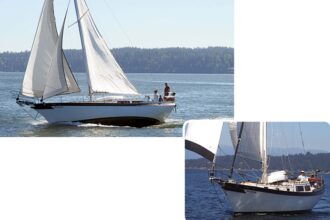

A lovely full-keel cruiser in the classic CCA style
Issue 123: Nov/Dec 2018
Bristol. The very name fires in the imagination of sailors a multitude of visions: Bristol, Rhode Island, the home of the legendary Herreshoff clan of builders and designers; and Bristol, England, home to the Admiral Benbow Inn and to the renowned Bristol Channel pilot cutters in which eccentric adventurer Bill Tilman made many bold voyages.
History
Bristol, Rhode Island, was for 33 years, in the heyday of fiberglass production boats, home to the builder of Bristol sailboats, which introduced entire generations of folks to this thing we do called sailing and aboard which many American sailors have had so many sailing adventures.
Clint Pearson founded Bristol Yachts after leaving Pearson Yachts, the company he’d formed with his cousin Everett, in 1964. He originally set up shop at the former Herreshoff Manufacturing Co. property in Bristol, and made good use of the design skills of the famous names of the day: the first Bristols were designed by the likes of Carl Alberg and Halsey Herreshoff.
For his 32-foot Bristol, Clint drew upon another designer whose name has become synonymous with yachts and the sea, Ted Hood. Not surprisingly, Hood came up with a pretty little boat that, by the standards of its time, sailed very nicely. According to SailboatData.com, 322 Bristol 32s were built between 1966 and 1983.
Design
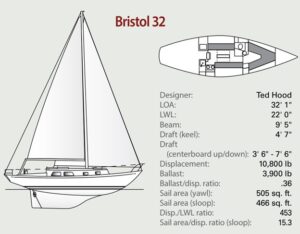
Ted Hood and his contemporaries were very sympathetic to the aesthetics—the look of the boat above the waterline—of the last days of wooden boats, particularly their cabintops and sheerlines and the subtle curves of the stems and counters. These lines make the difference between a boat that prompts a “wow!” and one that doesn’t attract a second look. The sail-plan profile is the kind of finely detailed drawing a committed dreamer can stare at indefinitely.
In those days, and to some extent today, production cruising-boat designs were based around those of contemporary performance raceboats. The Bristol 32 was drawn in the era of the CCA (Cruising Club of America) Rule, which encouraged the long overhangs, narrow beam, and low-aspect-ratio sail plans, commonly yawl rigs, typified by Finisterre, the legendary design by Sparkman & Stephens. After the massive success of Finisterre, all the designers were gunning for her and S&S, and were drawing boats that were similar, as a quick review of Finisterre, the Bristol 32, and a Hood 37 (Hood’s answer to the S&S design) reveal. The ratios of LWL to LOA and beam to LWL are all very close.
The point here is that the LWL and beam are the driving force behind volume and speed. This is why the 32, like her contemporaries, is a bit tender initially and the interior volume is small—some say cozy—compared to today’s boats. There is not much form stability in the hull; the bilges are quite round and so the boats heel readily at first. They stiffen as the topsides, at the overhangs, enter the water, providing more volume to leeward and so stiffness, but you need to get used to sailing at 25 degrees of heel. There is certainly enough volume in the hull below the waterline to carry the necessities for a solo sailor or couple to cruise comfortably for a weekend or two-week vacation, even with the kids.
A question often asked on the sailing forums is: “Can a Bristol 32 be taken offshore?” The answer is unequivocally yes, as has been amply demonstrated by several significant offshore passages, which include a circumnavigation and an Atlantic circle, largely solo, made by one owner.
Rigs
The Bristol 32’s rig was typical of the day, comprising a deck-stepped aluminum mast, single spreaders, and forward and aft lowers. A few examples were rigged as yawls, but most were masthead sloops, and there are two rig sizes. The smaller, or standard, rig has an I dimension, roughly the mast height, of 38 feet, while the tall rig has an I of 40 feet.
The sail plan proper is a straightforward low-aspect-ratio rig that again matches the trends of the day and is ideal for easy offshore sailing. The boats were delivered with headstays requiring hanks, but by now one would be hard pressed to find an example that has not been retrofitted with roller furling. A few owners have installed inner forestays for offshore versatility.
Construction
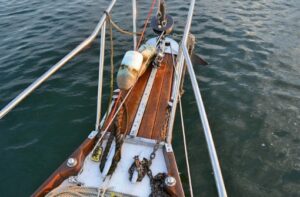
Clint Pearson already had some years of working with fiberglass when building the Pearson line, but in the half-dozen or so years between the first Pearson Triton and the Bristol 32, the new materials were becoming better understood. In the 1960s, fiberglass meant a simple solid laminate of fibers, usually mat and woven roving, and resin, called single skin. This laminate is clearly visible in the interior areas where the hull is exposed. The exception in the Bristols is in the deck, where balsa was used as a core material. This technique, common today, provides stiffness in the structure and some degree of insulation, but because balsa rots when it gets wet, close attention is needed when surveying the deck to identify soft spots, typically where hardware is attached. Posts on internet forums proclaim the boats to be robust and overbuilt.
Any material subjected to continuous exposure to sun, the flexing of sailing, and people leaning or hauling on attached hardware will ultimately fall prey to gelcoat cracks and crazes. These are typically found at stanchion bases and other stress points.
The Bristol 32s were built before the concept of the molded-fiberglass liner or pan had taken off, so much of the interior furniture is tabbed directly to the hull, allowing easy inspection of the hull’s innards. This is not so with the cabin overhead, which is covered with a molded liner fitted up under the cabintop. Such an arrangement brightens the cabin but makes retrofitting deck hardware a bit of a chore.
At the hull-to-deck joint, the edge of the deck mates to an inward-turning 6- to 7-inch flange on the hull. A permanently elastic material seals the joint, which is further strengthened with through-bolts.
On deck
To maximize interior volume, Hood made the cabin trunk as wide as he could. Coupled with the boat’s narrow beam, this means the sidedecks are not as wide as some might wish for ease of movement when going forward or aft. On the windward side, the lower shrouds aggravate the situation.
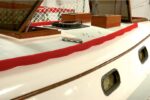
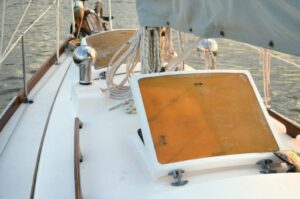
Of two pairs of opening portlights at the forward end of the trunk, one pair opens into the forecabin and the other into the head and over the lockers to starboard. A Dorade box is molded into the cabintop each side of the mast. The forward hatch is located on the cabintop just forward of the mast, where it is right over the heads of the slumbering crew in the forecabin. It can be opened to face either forward or aft. Another hatch is located above the saloon. The original hatches were manufactured fiberglass pieces, and photographs show that on some boats they have been replaced with modern hinged hatches.
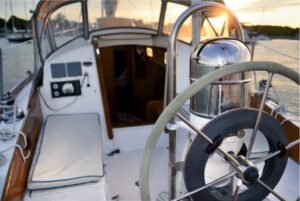
One of the most critical elements in a cruising boat, in my opinion, is the ability of the crew to lie down and nap on the cockpit seats, ideally under a full-cover awning. The Bristol 32 checks that important box in spades, and also those of the critical relationships between the angle between the cockpit seats and the coamings and, for bracing the feet when the boat heels, the distance to the edge of the seat opposite.
The forward end of the cockpit has a step-over sill for access to the companionway, not the bridge deck some might desire for going off soundings. (One boat’s owner, preparing for an Atlantic circle, installed a bridge deck.) The sill is a small step and does make getting below less of a scramble.
Bristol 32s were built with either wheel steering, in which case the mainsheet traveler is located immediately in front of the pedestal, or tiller steering, when it is located on the deck aft of the cockpit. Some owners have relocated the traveler to the top of the cabin across the sea hood. A nice detail in the deck molding is the cowling for the spray dodger to fit onto.
There is a running debate over wheel versus tiller steering in the fight for cockpit space. For me, on a boat of this size and proportions, the tiller wins hands down over a wheel.
Accommodations
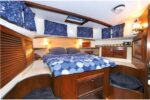
The Bristol 32 interior was offered in two fairly straightforward versions that are typical of the period. They differed only in offering either a dinette to port and a settee to starboard or twin settees opposite each other. Marketers took the opportunity to say the boat sleeps six, yet in the summary statistics, sleeping capacity is cited as five. Provision was made for pipe berths above the settee/dinette, so there are certainly five berths and technically the six the brochure describes.
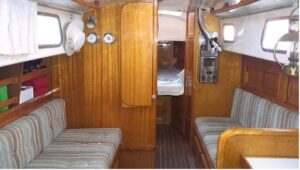
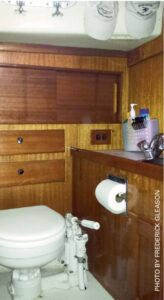
Forward is a V-berth, the foot end of which comes up against a bulkhead that separates it from the anchor-rode locker. On both versions, on the port side aft of the forward cabin, there is a head of serviceable size to port and multiple lockers to starboard. A nice detail is the storage in the head, where six sliding drawers make it actually possible to organize the contents. Adjacent to these drawers are two largish opening lockers with another locker under the sink. There are drawers, too, under the saloon berths and the V-berth. These little touches are reminders of the days when even small boats would put to sea, and their interiors had to be set up to allow proper organization of the ship’s stores and crew gear. My father, a founding member of the “A place for everything and everything in its place” society, would be impressed.
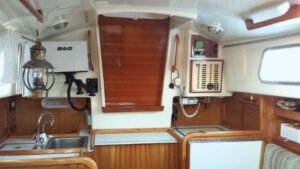
Aft of the saloon berths, to starboard, is the galley, which is also fitted out with several lockers of varying sizes. A picture in the original brochure shows a stove with a two-burner top and a monstrous oven below it, operating on alcohol. A sink is adjacent to the stove, and on the port side is an icebox with a flat top that is usable as a chart table.
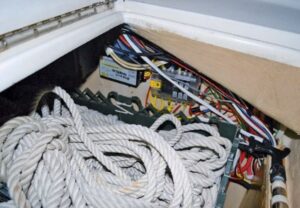
In most boats, the original Atomic 4 gas auxiliary has more than likely been replaced by a small diesel. Regardless of the power plant, one detail remarked on in the Bristol 32 forums is that access to the engine, and especially the shaft log, is tight.

Performance
All sailboats need to have the sail area and trim matched to the wind and sea state to keep the boat balanced and the helm easy. A Bristol 32 so trimmed will sail upwind more or less indefinitely with only a nudge needed on the helm once in a while.
The length and thickness of the keel paired with a low-aspect-ratio sail plan, the long spreaders, and a relatively wide chainplate staying base constrain the Bristol from matching the close apparent-wind angles of today’s boats. Bristol sailors are content with around 35 degrees in flat water and wider in light air or chop. Close-windedness is not a Bristol 32 virtue.
The common formula gives a maximum hull speed of 6.3 knots. Under windy conditions, less sail area is better, for no matter how much you cram on, the boat will make 5 to 7 knots, or 8 knots in the surges. Overpowering the boat will make it hard on the helm and needlessly overload everything, including the driver, human or otherwise.
When sailing downwind, anything that can be done to keep the boat up to full speed will make it stable and minimize rolling. A cruising spinnaker, and getting acquainted with the math of sailing downwind angles, will be a great help.
Some owners report that the boat has a tendency to hobbyhorse when underpowered in light winds or in a sloppy sea.
The fixed-blade propeller operates in a cutout in the rudder, so some practice in learning how the boat handles in reverse will be time well spent.
A Bristol 32 will not deliver hair-on-fire performance, but it will cover the modest miles gently and kindly and bring its crew to its destination content and not beat up.
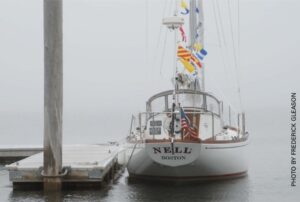
Conclusion
A scan of brokerage boats offered at Yachtworld.com showed eight Bristol 32s for sale, including one yawl. They were spread around the country, although the bulk were east of the Mississippi. List prices ranged from $7,900 (with a note that the price reflects high moisture readings) to $29,000.
So, what does a Bristol 32 purchaser get for the money? Name recognition, for one thing, and the backing of a pretty solid community. About two years ago, Bristol owners came from all over the East Coast on boats large and small to a Bristol owners’ shindig at the Herreshoff Museum in Bristol, Rhode Island.
For a seeker of creature comforts, hot and cold pressure water for instance, the Bristol 32 might not be a good fit, unless previous owners have added them. These boats are from a simpler time, but they are versatile, and can accommodate a couple or a numerically small family for any manner of uses, from overnights to weeklong or even longer cruises.
But perhaps the best thing you get with the purchase is the look.
Joe Cooper grew up in Australia and sailed with his father from an early age. Since about 1974, he has worked as a sailmaker, rigger, broker, and boat captain, and sailed in America’s Cup campaigns in 1977 and 1980. He worked for Hood Sailmakers for close to 30 years, now consults for them and for Quantum Sails, and writes on almost any issue related to sailing, including a monthly column for WindCheck magazine. Joe lives in Middletown, Rhode Island, with his wife, a college-senior son, a springer spaniel puppy, and several boats.
Thank you to Sailrite Enterprises, Inc., for providing free access to back issues of Good Old Boat through intellectual property rights. Sailrite.com