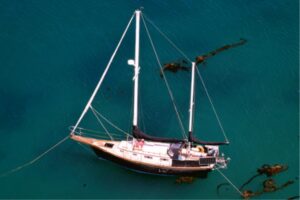
A monster wind wreaks havoc on a “safe” harbor.
Issue 130: Jan/Feb 2020
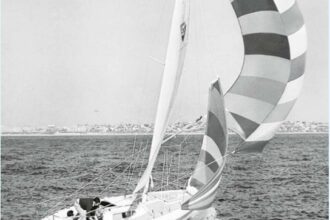
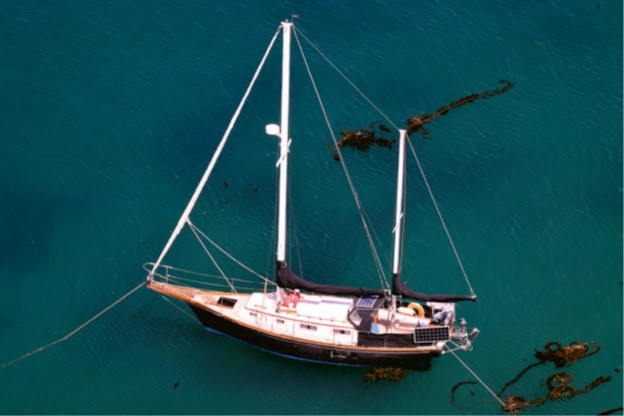
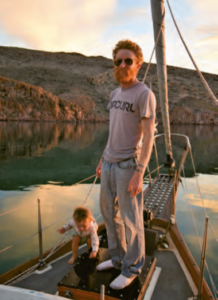
In March 2019, we were halfway up Mexico’s Baja California Peninsula, sailing on the Sea of Cortez side and looking for a spot to park Monsoon, our 1976 Fuji 32, for a couple days to buy some provisions so we could explore nearby islands. My wife, Yeen, and I zeroed in on Puerto Escondido, a short bus ride away from the markets of Loreto. We showed the guidebook to our son, Rowan, swinging from the fold-down table in the saloon. We pointed to a picture of Puerto Escondido and asked if he’d like to go there.
“No!”
Then I asked if he’d like a million dollars.
“No!”
I decided it best not to give his opinion great weight. Maybe sometime after his second birthday he’d earn his say.
Puerto Escondido is a large natural harbor full of mooring balls where each year hundreds of boats shelter from named and unnamed storms. After a quick stop at the dock to get water and check in, we chose a mooring. We used our own lines and tied them to the eye atop the ball, as we’ve done many times before.

The next day we opened the Windy app to see there was a Norther forecast for the end of the week. In this part of the world, a Norther is a system that blows more than 25 knots from the northern Sea of Cortez to the south, producing nasty seas over hundreds of miles of fetch. Having experienced the power and ferocity of Northers before, we were glad to be in a secure place to wait it out. But that meant our quick stopover was going to extend to a week. There were other winds in the forecast, before the Norther, but nothing too concerning. Nonetheless, I clipped a couple of massive stainless steel carabiners to the top of the mooring to prevent line chafe at that attachment point, then tied a half-inch safety line to the top of the mooring with a bowline that led loosely back to a cleat.
Two days later, returning after a visit to San Javier Mission, we crested a hill and got an expansive view of the Sea of Cortez and something we’d never seen before: a white sea. The wind was whipping the water to the point that white caps merged together to form an amorphous blanket of white. And this wind blew from an unusual direction. It wasn’t a Norther and it wasn’t a Chubasco (strong winds from the east). This was a monster come down from the mountains, funneled through the gap to the west. Yeen and I felt sick.
At the marina, it was hard to push the car doors open to get out. The dust in the air stung our eyes and blurred our vision. I made my way up to the second-floor marina office and saw the horror that was rocking the mooring field: 8-foot seas causing my boat and others to plunge and leap. Headsails unfurled and ripped apart. I borrowed binoculars from the harbormaster. Our home was straining against all the force, being whipped this way and that on her line.
Line? There should be three!
Focusing, I could see two lines in the water. All that kept our boat from being swept ashore was the safety line I’d tied to the top of the mooring ball. I stifled the urge to vomit. The home we’d spent six years fixing and upgrading, the home we’d paid off so that no bank could ever take her away from us, the home to which we’d returned from the hospital with our newborn—a vessel on which he would grow and see the world—our dream, our freedom, our life, now hanging by a 1⁄2-inch line tied to the top of a mooring ball.

I had to get out there, to avert disaster, somehow. Our oar-powered dinghy was out of the question. I begged the harbormaster to take me. He refused, too big a risk to place on one of his people. Risk? This wasn’t some dramatic movie, nobody was going to die, I just needed to get out to my boat!
He wouldn’t budge. I ran down to the cafe where other sailors stuck ashore watched the chaos and destruction, dumbfounded. I asked for help, but everyone avoided eye contact. I ran back upstairs to the office, and I found Todd from The Answer. He saw my desperation and empathized. He was a fellow cruiser, with a wife and kids aboard. He understood.
We rushed to his dinghy. It would be a wet ride, but he’d get me there, he promised. It didn’t seem that bad at first, but the further out, the bigger the waves grew. We made it to a bucking Monsoon, and I jumped aboard. Todd followed, struggling to secure his dinghy. I noticed the headsail furling line wasn’t tied off. I secured it and jumped down to get the keys to start the engine, hoping to power into the wind, relieve some pressure on the mooring line. As I started the engine, Todd finally managed to tie off his dinghy. I motored into the wind. We took a wave and plunged into the next one. The bow looked off.
“Did we just break loose?” I yelled. Todd looked forward.
“No.” If we had, he said, we’d be on top of the boat right behind us. But our bow kept turning…and here, looking back, is where things become blurry.
Chaos comes too fast.
I remember Todd saying, “Did we get aboard just in time? Just as the line broke?”
I remember that. Then I remember Todd falling overboard. We’re rolled by an 8-foot wave and a gust of wind that almost puts Monsoon on her beam ends. Everything falls. Todd’s hands are gripping the lifeline. I rev the engine to try and steer back into the wind. Over the roar of the wind and the roar of the motor, Todd somehow climbs back on board.
Then I watch my 130 genoa unfurl part way. Todd’s yelling: “Undo the jib sheets!” I can’t. I can’t leave the helm. The stopper knots are hard against the fairleads, and I can’t reach them. He’s yelling at me to release the jib sheets, but I can’t, Todd, I have to steer…
I can’t keep the bow into the wind. We get knocked down again. Todd falls in again. I have the engine pegged at 3,000 rpm. I see the spinning propeller in my head and think, “Oh God! I need to put the engine in neutral or I’m going to kill this man!”
Todd is somehow back aboard, again, and I’ve lost steering. The water hose that I’d left in the cockpit has tangled itself taut in the wheel and the windvane control lines.
I yell to Todd that we need to drop the anchor, now! He yells back: He doesn’t know how, and he has to fix his dinghy because it’s somehow making our situation worse. He yells again for me to undo the jib sheets. We take another wave and gust and Todd is back overboard.
Monsoon rights herself in all majesty. I’m breathing saltwater. My lungs burn. I’m going to kill Todd if I don’t again put the engine in neutral. I’m going to hit that boat if I don’t steer away. I’m going to run up on those jagged rocks if I don’t turn the other way. The wheel is part of the tangled mess and I can’t steer. I see the dinghy is gone, Todd is gone. I hope he’s with the dinghy.
Monsoon is getting closer to the rocky shore. I turn away and struggle to untangle the hose from the wheel. Steering regained, I try to gain momentum and steerage by doing a 360, full to port and maybe then I can keep the nose pointed into the wind. I overshoot and the wind takes my starboard side again, knocks me down again. I steer away from boats, there are too many close calls. I try the 360 again; I fail. Over and over. I’m not in control and I’m going to wreck ashore.
I feel like I’m not getting enough air. I think of my son swinging from the fold-down table giggling and laughing. I think too long about this, and Monsoon rounds up. I’m headed straight towards another boat. I turn hard to starboard to take his stern. But I have too much speed and not enough steerage. I ram Monsoon into this boat at full speed.
The 40-year-old, 5-foot teak bowsprit at one end of my home is broken and splintered. The sail folds, the rigging shakes and bends, and the 55-pound Mantus anchor bobs and bows. I watch it all white-knuckled at the wheel.
I look around for where to go. Not the rocks. I see bushes and steer for them.
Downwind sailing is always much quieter than upwind. My boat steers true, right for the mangroves. As I approach, I see the light brown of a muddy shoal. She hits fast, the engine still screaming at full throttle, but it is surprisingly gentle. She tips and pitches and grunts to a halt.
I run below, expecting to see water filling the boat. I lift floorboards in the saloon and forward, nothing.
Back on deck, the wind still rages. I have to get the headsail down. I release the halyard and it falls a few feet before hanging up on a massive bend in the foil. I struggle and struggle to get the sail down, attempting to straighten the forestay enough. I finally succeed and Monsoon immediately rolls up straight. I check the bilge again, dry.
On the radio, I broadcast my first Mayday. Someone responds quickly and concludes that mine is not a situation that requires a Mayday call, that I will be just fine.
I hung the mic back up and stood still for the first time, time slowing back down to a more normal speed, the chaotic movement abating. I looked around, took a deep breath, noted that my tongue was fat and dry and my lungs still begged for air. I fell to my knees and began to cry. My home was crushed, our dreams gone, and I almost cost another family their husband and father because I had to try and save a boat. I picked myself up to resume cleaning and organizing things on deck. Minutes later, the wind died, replaced with a stillness.
A little while later, other cruisers rallied to help pull Monsoon off the mud and to a dock. I approached my wife, head low, ashamed. I wanted her to know that we still had a home, but that I’d wrecked her pretty bad. The woman who grounds me and keeps me focused, my soul mate, said to me, “It’s just a broken arm, she’ll be fine, she can be fixed. We’ll continue on.” I choked and cried on her shoulder. Now, all we can do is move on, be prepared, and take each day as a gift.
The Takeaway
As with any profound event that changes you, you consider what could have been done differently, how you could have avoided seemingly benign situations that turned into chaos-driven nightmares. What insights have we gained and what will we take with us, knowing there might be a next time?
First and foremost, things happen. No one forecasted 70 knots of wind. No one was prepared. People who have lived in the mooring field for many years had not seen anything like it since something similar hit in 1998. Two other boats broke loose from their moorings that day, and fortunately they were able to power through.

That said, we could have been more prepared. We should have furled the headsail with multiple wraps of the sheets, which would have helped prevent it from coming undone, and we should have tied off the furling line. Now, even at a quiet anchorage we leave nothing lying out on deck or out of place; something as dumb as a hose created vast problems for me that day.
Using our own mooring lines and adding chafe guards and a safety line was smart; that third line held the boat long enough for me to get to her. My mistake was that I shortened the two main mooring lines after I had deployed them, and they had gotten wrapped up underneath the mooring ball and sucked into the hole at the bottom where the chain goes up into the ball. It seemed logical at the time, but because the lines were so short, the 8-foot waves that built in the mooring field pitched Monsoon hard enough that the forces were greater than two 2,500-pound stainless steel carabiners could hold. Had we been on the boat, we would have immediately lengthened the lines.
But we weren’t on the boat, which raises the inevitable “what if” of maybe we shouldn’t have left the boat that day. We knew there were going to be winds—a blow was forecast, though not nearly the level of what actually hit the harbor—but we were more concerned with the Norther coming afterwards.
Had we stayed aboard, we would have prepared our anchor, removing the finicky cap on the hawsepipe which always takes a couple of tries to clear. That maladjusted cap became a gauntlet amid the chaos that stopped me from deploying the anchor. The lesson? Fix what doesn’t work, no matter how seemingly small. That stupid little cap, had it come off quickly, could have prevented me from hitting another boat or running aground. Now, I check our gear regularly so I know it will work properly when I need it, especially in an emergency.
The jury’s out on whether I should have let the genoa fly free, perhaps enabling me to better power into the wind. I don’t know if I could have removed the stopper knots quickly enough without hitting another boat in the process. Likewise, could I have just shut down the engine and sailed around? That seems like a stretch, but maybe. Two things I did right at this point were managing to dodge about five boats and heading to the mangroves—one of two spots in that entire basin that had a clear mud bank and no jagged rocks.
Maybe we shouldn’t have stopped there at all. The outlying areas of Loreto and Danzante only saw 45 knots of wind. Only that basin experienced 70 knots of wind. This is due to a funneling effect the mountains in the west create. A friend told me, “Look at the place, it’s a giant hole in the ground. What do you think created that? Wind.” Now, I more closely examine a harbor’s geography when I arrive and consider the possible downsides to what seems like a secure anchorage.
Finally, and above all the most important takeaway, is this: You can fix fiberglass. You can fix wood. You can’t fix dead. What I imagined as a boisterous dinghy ride turned into a life-or-death scenario in which Todd risked his life to help. It was blind luck that nobody was hurt or killed. There’s no way to know, but if I hadn’t gone out to the boat, maybe the mooring line would have held. It snapped in the middle, a 1⁄2-inch-thick line, with no chafe. Maybe our added weight onboard, the dinghy flailing alongside, the effort of powering into the wind, any or all of these things caused it to snap. Or, maybe it would have snapped anyway, and Monsoon would have blown into other boats and the rocks and sunk. All I know is that if it comes down to someone’s life or my boat again, I will not risk someone’s life to save the boat.
Travis Weaver is a writer and a sailor who lives aboard and cruises with his wife, Yeen Yee, and their 2-year-old son, Rowan, aboard Monsoon, their 1976 Fuji 32.
Thank you to Sailrite Enterprises, Inc., for providing free access to back issues of Good Old Boat through intellectual property rights. Sailrite.com