Big Bobber marks the spot
Issue 86: Sept/Oct 2012
As your boat swings around in a tight or crowded anchorage, it’s helpful if you can see where your anchor is lying. An anchor buoy enables you to do that. It is also invaluable for recovering a fouled anchor, as it enables you to pull the flukes out backward from under an obstruction.
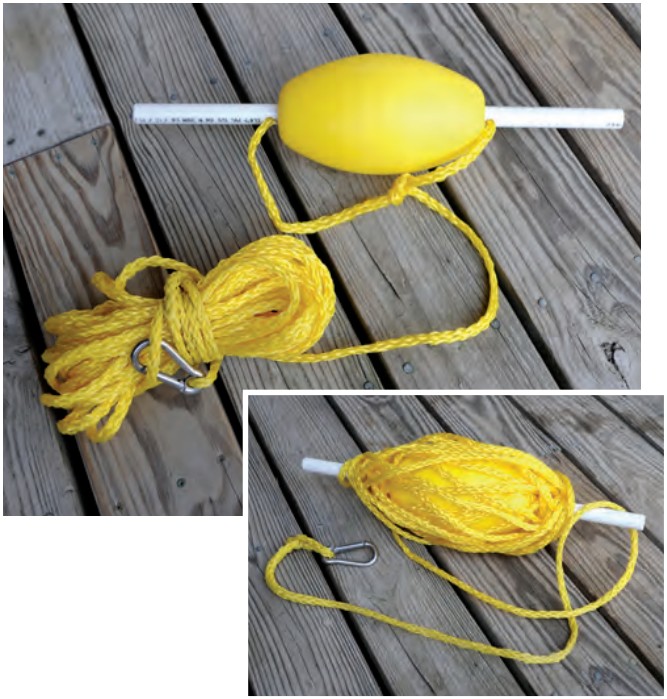
We call our anchor buoy our Big Bobber, because we store its 50 feet of polypropylene line on the buoy itself in the same way fishermen carry and store fishing line on small old-fashioned fishing bobbers. If you routinely anchor in deeper water, you might want to carry at least double that length. The polypropylene line floats, so it doesn’t sink the buoy it’s wrapped around.
The buoy itself is a common swimming-pool marker float with a hole through it to allow a line to pass through. We passed a length of 1/2-inch PVC pipe through the float and drilled two access holes in the pipe, one each side of the float. We threaded the 3⁄8-inch poly line though one hole and out the other and tied it with a bowline to the rest of the line, locking the float in the center portion of the PVC pipe. To store the line, we wrap it back and forth around the “horns” of the PVC pipe that extend from the float, ending with two overhand loops to secure it.
To use our Big Bobber, we first determine the depth of the water where we will set our anchor. We undo the securing loops and unwrap just enough line to allow the float to remain on the surface above the anchor when it sets. We secure the remaining line on the bobber with a couple of horn-cleat-style overhand loops. We tie the bitter end to the anchor crown in such a way that, when we pull on the line, it will pull the anchor out backward. When we deploy and set the anchor, we lower the bobber with it.
That yellow bobber serves as a visible marker directly above our anchor and is there to help us free it if needed. The bobber and poly line always stay together. We can adjust for a change in water depth just as one might adjust the depth of a baited hook when using an old-fashioned cork fishing bobber.
The cost of the components is less than $10. Fabrication time is about 15 minutes and requires nothing more than a way to cut PVC pipe and a drill to make the holes in the pipe.
Rob Hoffman began life as a Tennessee river rat who discovered sailing while in the U.S. Navy. A tinkerer, Rob refits boats and “builds stuff.” His most recent project was CanCan, a 28-foot aluminum Alubat. His current project is Ladyship, a Westerly Pageant 23.
Thank you to Sailrite Enterprises, Inc., for providing free access to back issues of Good Old Boat through intellectual property rights. Sailrite.com