The Coast Guard asks boaters to be careful observers
Issue 44: Sept/Oct 2005
ON SEPTEMBER 11, 2001, America was attacked from the air. Many terrorism experts feel it is only a matter of time before another attack occurs. Next time, the enemy may come by sea. Rivers, bridges, tunnels, ships, and ports are all inviting targets. With more than 95,000 miles of shoreline and 290,000 square miles of water, there are numerous routes of attack. In response to this potential threat, the U.S. Coast Guard, the branch of the military charged with protecting our maritime community, has developed the concept of Marine Domain Awareness (MDA). MDA has been defined as “the effective understanding of anything associated with the global maritime environment that could adversely impact the security, safety, economy, or environment of the United States.”
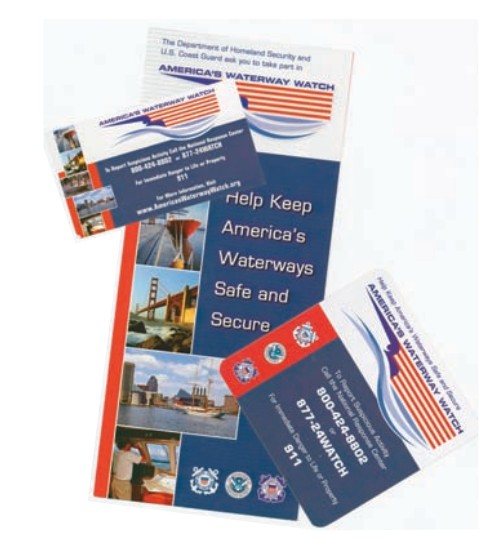
As part of MDA, on September 11, 2003, the Coast Guard and Coast Guard Auxiliary launched America’s Waterway Watch. The immense job of the Coast Guard prohibits it from being everywhere all the time. The objective of Waterway Watch is to enlist the boating community as additional eyes and ears of the Coast Guard. Waterway Watch is similar to the Coast Watch of World War II, during which citizen-volunteers mobilized to scan our shores for U-boats and saboteurs attempting to infiltrate the United States.
Recreational boaters, marina operators, fishermen, and waterfront concessionaires are knowledgeable and familiar with their home waters. They are first to notice when something “doesn’t add up.” Consider an example from the aviation community: immediately prior to September 11 an alleged terrorist, the so-called “20th highjacker,” was arrested in Minnesota when a flight school instructor felt something about one of his students just wasn’t right.
Waterway Watch does not require joining up, paying dues, or attending meetings. All one has to do is keep on the lookout for suspicious or unusual activities and report them to the Waterway Watch National Response Center at 877-24-WATCH. If time is critical, contact the Coast Guard on Channel 16 or call 911 immediately.
Lookout list
The Coast Guard and Coast Guard Auxiliary have developed a list of things to be on the lookout for:
- Persons who appear to be loitering near a boat or waterfront facility for no apparent reason
- People checking out or “casing” a boat
- Boats tied to or loitering near dams, bridges, or locks
- Unusual videotaping, photography, or questions about boats or marine facilities
- Boats with unusual or obviously inappropriate modifications
- Anything that strikes you as wrong: fishing in unusual areas, unusual diving activities, lights flashing between boats or between boats and shore at night
- Persons tossing and recovering items into and from the water
- Missing fences or lights in sensitive areas
- Persons buying or renting fishing/recreational vessels with cash for short-term, undefined uses
Be especially watchful around:
- Bridges
- Commercial areas: ports, fuel and cargo docks, cruise ships
- Industrial facilities: power plants, water intakes, locks, and dams
- Military bases
If you see suspicious activity, take notes on what you observe — the time, date, location, number of people and physical description, vehicles used, license plates, boat registration number. Then report your observations to the National Response Center. Do not challenge, question, or intervene in any way. Do not place yourself or your companions at risk. If you can take photos or videotape without exposing yourself to risk, try to do so.
Protect your boat
Other things you can do to assist the Coast Guard include: Secure and lock your boat when no one is aboard. Disable engines on stored boats or block trailered boats to make sure they are not easily moved. Display the Waterway Watch decal on your boat or waterside facility to remind yourself and others to watch for and report suspicious activity. Keep at least 100 yards from all military, cruise ship, or commercial shipping. Avoid all security zones or restricted areas. For information on restrictions in port areas, call 800-682-1796 or go to www.uscg.mil/safeports. For brochures, decals, and pocket cards on Waterway Watch, call 800-368-5647 or go to www.americaswaterwaywatch.org.
Thank you to Sailrite Enterprises, Inc., for providing free access to back issues of Good Old Boat through intellectual property rights. Sailrite.com