The Bristol 24: Relatively comfortable, stiff, and forgiving in extreme conditions
Issue 29 : Mar/Apr 2003
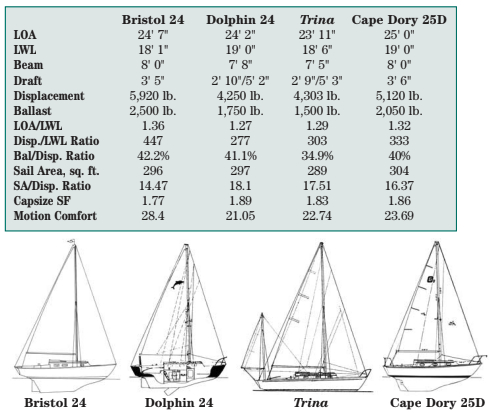
This review is a bit unusual because, for the first time, I’ve selected a custom wooden yacht for inclusion instead of a complete pack of Clorox-bottle boats. I fell in love with Bill Shaw’s yawl-rigged MORC racer, Trina, about 45 years ago, and I thought it would be interesting to see how she stacks up against some other cruisers in her size range. The reader may note the similarity between Trina and the Sparkman & Stephens Dolphin 24. I’m convinced that the Dolphin was influenced by Trina’s racing success. Indeed, Bill Shaw was still working for S&S in the early 1960s when I first met him.
The Paul Coble-designed Bristol 24 is the subject of this review, of course, and she is a husky little ship in her own right. She has by far the heaviest displacement of the group. This results in a high Motion Comfort Ratio, higher than some 28- to 30- footers, along with the best Capsize Screening Factor of this group as well. Her high ballast ratio is also very reassuring, and she should prove to be relatively comfortable, stiff, and forgiving in extreme conditions. The Bristol also has the shortest waterline. This will hinder her performance to a degree, although her long ends will pick up additional waterline length when she is heeled under sail. Given good condition and proper equipment, the Bristol would appear to be a small yacht that is well suited to sailing the deep-blue waters of this world.
Husky displacement
Unfortunately, the 24 is a bit light on sail area, given her husky displacement and wetted area, so a big 150-percent genoa will be necessary to get the best out of her in the lighter breezes and, even then, she will not be a sparkler. The Dolphin and Trina, much lighter, and with lower wetted surface by virtue of their keel/centerboard hulls, would have a definite edge in the zephyrs. The Cape Dory 25D, with her lighter displacement, fits somewhere in the middle, but she is also cut away more underwater so probably has a bit less wetted area than the Bristol. This should add up to slightly better light-weather performance, but Cape Dory owners have reported that a 150 genoa is still a necessity in light air.
The Bristol will do well in a stiff breeze where, given her displacement and heavy ballast, she should stand up to the weather and scoot right along. The Cape Dory 25D will not be far behind her, but I’d be very interested to see how the two keel/centerboarders fared. Trina has the lightest ballast and could be at a disadvantage compared to the two deep-keel boats.
It must be remembered that she has a fully framed and planked wooden hull, so her construction is, undoubtedly, heavier than that of the fiberglass boats. This reduces the amount of ballast she can carry, of course, but Trina is also narrower than the keel-boats, so she will have less form stability as well. Despite their racing heritage, I think the keel/centerboarders would have a job keeping up with the heavier and stiffer Bristol 24 in a blow.
In any case, none of these long-ended, short-waterline yachts is going to be competitive with contemporary light-displacement auxiliaries. Rather, they have their place as safe and solid coastal cruisers for family vacations and, just possibly, as mini trans-ocean voyagers for the more adventurous sailors among our readers.
Thank you to Sailrite Enterprises, Inc., for providing free access to back issues of Good Old Boat through intellectual property rights. Sailrite.com