… and not too far from home
Issue 3 : Nov/Dec 1998
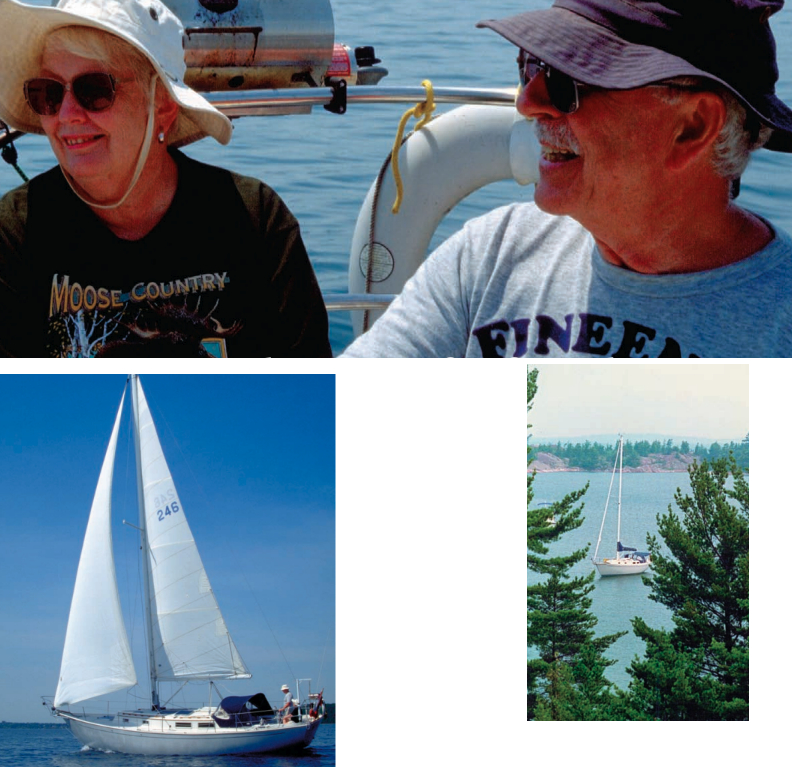
Ken and Pat O’Driscoll have lived abroad, seen the sights, sampled the foods, and tasted the wine in faraway places. So now, as they adjust to retirement living, they do not feel compelled to sail Fineen III, their Niagara 35, to distant ports. They say they are not finished exploring the many nooks and crannies of the paradise they call home.
Their paradise is the North Channel, a secluded part of Lake Huron offering natural beauty, clear water, pure air, and loons. It is the escape destination of many who sail lakes Michigan, Huron, and Superior, but because of its location, it is unavailable to weekend sailors and doesn’t get overcrowded as a result.
As the name suggests, Fineen III is the third in a line of sailboats for the O’Driscolls. The name underscores Ken’s Irish heritage. When he and Pat were considering marriage, Grandpa O’Driscoll sat Pat down and gave it to her straight: “You’re marrying into a family of pirates.” This was news to Ken, too, but Grandpa sang from memory the chantey tale of Fineen (pronounced Finney-in) the pirate:
What ho! For Fineen the Rover,
Fineen O’Driscoll the Free,
As straight as the masts of his galley
And as wild as the waves of the sea.
Pat married Ken anyway, and over the years the couple has learned many verses of Fineen’s escapades from other O’Driscolls and Fineen admirers. A trip to Baltimore, Ireland, confirmed the hard-to-believe stories of the early 17th century Irish clan chief. The sailing namesakes of all Fineens — I, II, and III — justified calling the vessels “he.”
Ken’s very first boat was not named Fineen, since he had yet to learn the tale of Fineen the Rover. It was a rowboat with a sail and one oar, which he bought in New York at age 12 for $2.50. And there was a Sunfish later in life that didn’t qualify for the moniker either.
The O’Driscolls first raised five children and enjoyed a series of foreign sabbaticals as a part of Ken’s job as a professor of chemical engineering doing research on polymer (plastics) chemistry. The sabbaticals took them to Japan, Germany, Sweden, England, and Australia for several months to a year at a time. And one sabbatical allowed for a trip down the Intracoastal Waterway to Florida, but that’s getting ahead of the story.
As they reached their 40s, with the children generally grown, Pat suggested that they attend the boat show in Toronto. She knew Ken had always enjoyed boating and realized that the timing was right for a new adventure. “We wanted something we could do outdoors together,” they both say.
It was 1974, and they saw an affordable 21-foot Sirius at the show and decided to buy it, they agree, “for no particular reason.” But the purchase was on the condition that the salesman come out sailing one day and introduce them to their new boat.
By this time the O’Driscolls had moved to Canada where Ken was teaching at the University of Waterloo. They had become landed immigrants on their way to eventual Canadian citizenship, and the Sirius factory was just 100 or so miles from home. So they visited the factory and set a new family precedent: visiting the locations where their boats were built. They had plans to check out three marinas on the way home from the factory visit. The first marina didn’t seem right for them, but the second was so right that they never visited the third. They got a slip in Wiarton, Ontario, on the east side of the Bruce Peninsula which separates Georgian Bay from Lake Huron.
One of the earliest adventures with the Sirius involved a sudden storm while they were within a half mile of the marina. It seemed to Pat at the time that the marina was unreachably far and that they’d be blown out of the bay and out to sea. Over the years their sailing skills improved, of course, along with their abilities to deal with storms and unexpected breakdowns, but their loyalty to the first Fineen eroded. “A 21-foot boat is not suited for cruising,” Pat says, and cruising was what they wanted to do.
Within two years they bought a used C&C 30 — another Canadian boat. Once again they visited the factory to learn about the boat they wanted. They spent some time climbing around in the 27- and 30-foot models and decided they liked the larger boat, since the overhead on the 27 was too low for Ken. But they preferred the price of the smaller boat and spent the rest of the summer looking for a used 30-footer priced below the cost of a new 27-footer.
When they found the right boat, a 1974 model, the five-year-old boat was beginning to show signs of neglect. The first owner had used the boat as a racer; the second as a party boat which never left the dock. As a result, they bought an anomaly: a used boat with brand-new anchor tackle.
The O’Driscolls cruised and raced Fineen II. The racing was done with other members of the marina. It taught them new sailing skills and provided for many fun post-race gatherings in the clubhouse as the finishes were calculated and winners declared.
The C&C was the boat they took down the ICW in 1983. That trip was very enjoyable, but it was the beginning of the end for Fineen II. “It was five months of camping out,” Pat says. “For example, we had installed pressure water, but had no dodger, refrigeration, heater, or shower.” (The low boom on many early C&Cs made protection from a dodger impossible.) Pat says, “Opening ports would have been a distinct advantage, since going south included some very hot weather. Cooking below was a challenge — how many fresh, cold shrimp can you eat?” On the positive side, she adds, “We have so many memories of that slow, relaxed trip south with sightseeing and many visits with friends and relatives. It took from mid-June until November to reach Florida. The images are like a movie in the mind: forever replayable, adventures included!”
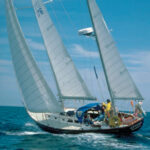
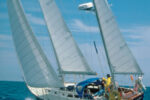
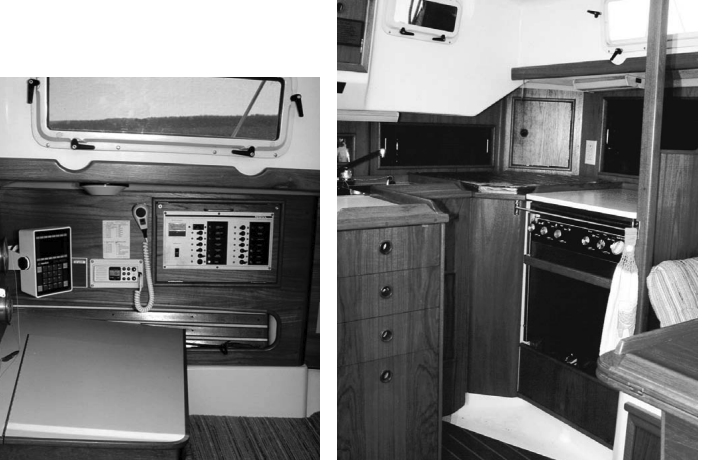
The new Niagara 35, built by Hinterhoeller and designed by Mark Ellis had much in common with the C&C they had sailed for seven years. Mark Ellis had worked for C&C earlier in his career, and Fineen III reflects a shared heritage. Ken is fond of saying that the Niagara 35 is just a larger C&C 30. However this boat has many amenities which move life aboard out of the “camping” category: a catalytic propane heater, a propane grill on the stern rail, a propane oven and three-burner stove, pressure water, a water heater, a dedicated nav station, a shower stall, enough bunks of reasonable size to make it possible for a couple to have a dedicated sleeping area without making the saloon do double duty as bedroom and dining room. (If there’s a hint of envy here, realize that Jerry and I “camp out” in our C&C 30, which we convert from sleeping to eating quarters and back each day. He says we’re going to add a modification soon, and it will change into a car as well and drive us home, but he’s still working on that invention.)
Pat points out the expanded galley with refrigeration, the generous ports which open for ventilation, and the thoughtful touch of a covered mast. This is a modification which any manufacturer could have done and which any boatowner bothered by a cold piece of extruded aluminum in the saloon can do easily. The Niagara masts, which are keel-stepped, come with a padded, insulated cover which is wrapped around the mast and fastened with Velcro … truly a revelation to anyone who has backed into a bare piece of aluminum early on a cold morning.
Instead of putting in hanging curtains, Pat created simple and effective window covers — oval in shape and exactly the size of the windows. These are fastened into place at night using small Velcro “dots.” She’s also working on a modification to keep the contents of the refrigerator cooler longer. She developed an insulated Styrofoam board covered with a “space blanket,” which they slide in place when they don’t need access to the contents of the refrigerator. But the board’s a bit bulky to store when they’re in the cooking mode, so Pat will replace the insulated board with a space blanket with batting quilted inside it. This can be rolled up and stored more easily.
Designer Mark Ellis said of this boat, “She is a cruising boat that made sense.” Ken and Pat placed their order for Fineen III in November 1988 and made several trips to the factory to watch her creation. They were particularly impressed with the craftsmanship and pride that the builders showed in the work they were doing, particularly their love for woodwork and fine finishes. The new boat was delivered in spring of 1989, and unfortunately the company went out of business about a year later. The last Niagara left the shop in 1990.
Fineen III was not raced. “Would you race your living room?” Pat asks. Since retiring, they’ve asked themselves whether another trip down the ICW might be on the horizon. “We thought about another trip down the waterway,” Ken says, “but we may have aged out of that. It was a lot of work. We were up at 6 a.m. every morning and moved an average of 35 miles per day when we moved. We’ve often thought of shipping the boat partway and spending a month or more in the Chesapeake, which we found contrasts nicely with the northern cruising areas that we are so familiar with and fond of.”
These days they enjoy the sociability of sailing — the people they meet on their longer trips and the people they enjoy seeing often at the Wiarton marina. Daysailing on Colpoy Bay (eight miles long) or 25- mile trips to nearby peninsula ports and anchorages provide spectacular views of the northern end of the Niagara Escarpment. The water is clear and deep. A week’s trip to Tobermory makes a memorable cruise. A trip to or around the islands at the mouth of Colpoy Bay and anchoring provides weekend escapes. They have usually enjoyed a three- or four-week vacation to the North Channel each summer and weekends in and around Georgian Bay. With retirement, they are looking forward to longer periods of time aboard, primarily in the North Channel.
This is a pattern that suits the area where they sail, they say, and it suits them, too. They like being able to take their time on weekends and longer trips, choosing weather for crossings and feeling unhurried by calendars and clocks. Ken says vacation starts when his watch comes off, and the white strap mark disappears from his wrist.
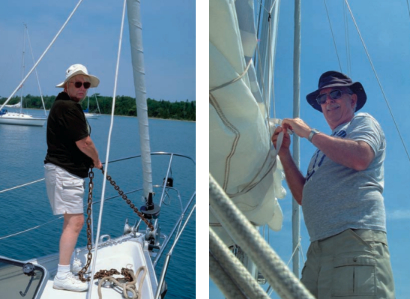
We spent one day sailing with Ken and Pat, watching them work together and marveling at how much can be accomplished conveniently from the cockpit of the Niagara 35. This is a well-found coastal cruiser, and Ken and Pat are experienced and competent coastal cruising sailors.
“It has been said,” Ken notes, “that sailing is either the world’s most restful or most challenging activity — sometimes both in the same hour. We’re working at making it the most relaxing activity,” he says, aided by Pat, who notes that it is sometimes challenging nonetheless.
Their years of sailing together have bonded the O’Driscolls into a formidable team, one which can handle the challenges while enjoying the relaxation. Fineen III is just right for the O’Driscolls and their retirement dreams.
Thank you to Sailrite Enterprises, Inc., for providing free access to back issues of Good Old Boat through intellectual property rights. Sailrite.com