Nautical tradition dictates where and how you fly your flags
Issue 4 : Jan/Feb 1999
A few years ago we had just cleared Canadian customs and were heading out of Bedwell Harbour in the Gulf Islands of British Columbia when we noticed a handsome 45- to 50-foot sloop sailing into the harbor, hard on the wind and making good time. She was obviously a Canadian yacht, judging from the large red and white maple leaf ensign on her stern staff. But as we passed, I looked back and there on her transom was her name and hailing port, “_____, Anchorage, Alaska.” I turned to Betty and shrugged, “Now why in the world would a U.S. yacht be flying a big Canadian flag on her stern?”
The mystery was solved later in the season. We had just tied up to the city docks in Victoria, B.C., when a 38-40 foot sloop pulled in, also flying a good sized Canadian flag. We took her lines and helped the owner get settled. The docks were jammed with visiting boats; we almost had to use a shoehorn to wedge the boat into a too-short space. The ensuing conversation went like this:
He: “Thanks for giving me a hand. It sure is crowded this weekend.”
Me: “You’re most welcome. Glad to help. Where are you from?”
He: “Tacoma, Washington.”
Me: “Then how come you’re flying a Canadian flag?”
He: “Oh that. My father said it’s courteous to fly a Canadian flag when visiting Canadian waters.”
Mystery solved! I’ll bet our Alaskan owner was also given similar advice. In this case, I enlightened the skipper so he would not be embarrassed during the rest of his Canadian cruise.
Another mystery, to us at least, is the size of many ensigns. I can’t believe that many boatowners are ashamed of their country, but it certainly appears that way when you see a boat with a miserably undersized, wimpy little flag hiding itself ignominiously amongst the life rings, man overboard pole, fishing rods, and dinghy. Seeing a comfortably large ensign makes me believe that the owners have a sense of pride in their vessel and in their country.
Just recently we saw a large oceangoing motor yacht, perhaps 120-130 feet long, anchored in Skagit Bay, and we knew right away she was British from the huge Red Ensign flying at her stern, long before the hailing port, London, England, was readable. Another grand sight that always gives us a thrill is seeing the Katahdin, a 1926 tug now converted to a yacht, breasting the waves with her eight-foot-long Stars and Stripes streaming proudly in the breeze, looking for all the world like the battle flag on a U.S. Navy warship. That’s showing pride in your country and pride in your vessel!
None of the following “rules” for flags are laid down by law, so you won’t be hauled into court if you break them, but they are laid down by nautical tradition. I suggest that you try to follow the traditions where possible, unless you really don’t care about the impression you and your boat make on the other sailors you meet on your cruises.
The ensign (or colors)
If you are going to fly your country’s colors — and you should — then the correct size is one inch of length on the fly (the long side) for each foot of boat length and, if in doubt, go one size larger. Bigger is definitely better in this case. The U.S. Yacht Ensign (the 13-star Betsy Ross flag with the fouled anchor in the union) can be flown in U.S. waters, if you prefer, but should not be flown in international or foreign waters, and that includes Canada. The 50-star ensign with its 13 stripes is the only correct flag outside of U.S. waters, although far too many boaters fly the yacht ensign when they head north.
The colors are taken down at sunset, of course, and not raised until 0800 the following morning. It is not necessary to fly your colors when at sea in international waters, but you should do so when sighting another vessel. Also, it is traditional that U.S. sailing yachts do not fly colors when racing.
Where to fly the ensign also seems to be a mystery to many. We have seen it flown at the bowstaff of power boats, from the spreaders of sloops, and on the mainsail leech of a ketch. The basics are actually quite simple.
On a motor yacht, the colors should be flown on the stern staff unless the vessel has a mast with a gaff. In that case the ensign is flown from the gaff, since that is the place of honor. Sportfishing boats that need to have a clear transom can fit a flagstaff on the bridge or fly their colors from the tuna tower.
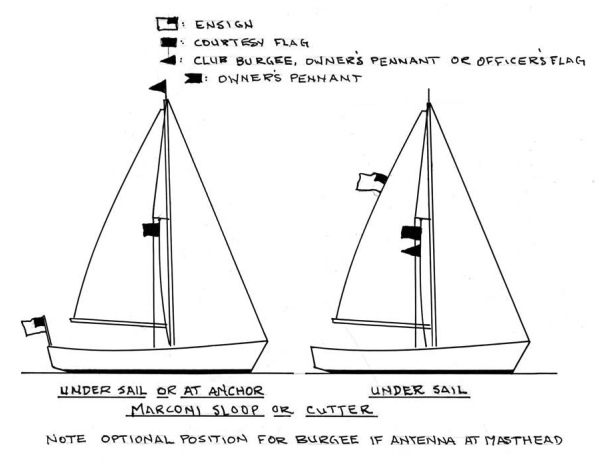
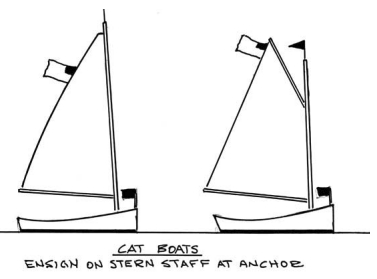
Sailing yachts have a few more options. The typical Marconi catboat, sloop, or cutter may fly the ensign from the stern staff or the mainsail leech, approximately two-thirds of the way up. The latter looks particularly smart in my opinion, and it is easy to do if you sew a couple of big stainless steel fishing line swivel snaps on the leech at the right spot. It is simple to snap the flag in place when you head out for a sail, and it never tangles. While we have seen many sloops with the ensign flying from the main backstay, it never looks correct. It is rarely rigged so it can be lowered at night and so it is usually faded, ragged, and far too small. Your good old boat deserves better.
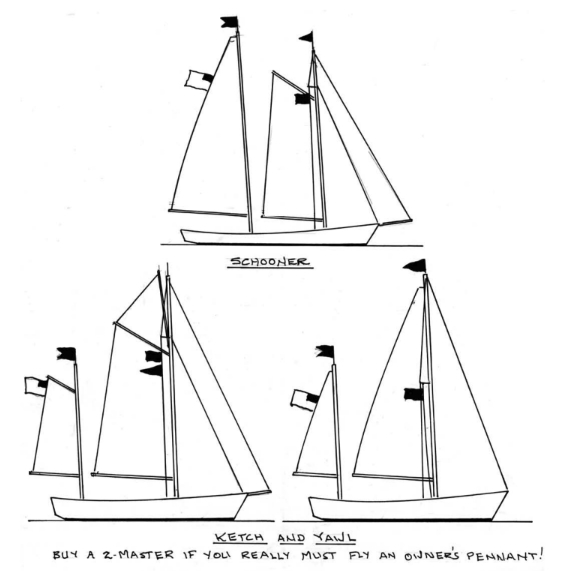
Gaff-rigged yachts should fly their colors from the gaff, in the position of honor, and two-masted gaff-rigged yachts fly the colors from the gaff of the aftermast. However, if the aftermast is Bermudan-rigged, as on many schooners, then the ensign should be flown from two-thirds up the mainsail leech.
When the sails are furled — at anchor or when made fast to a pier — the stern staff is the proper spot for the colors. On yachts with long boom overhangs, such as some gaff-rigged craft, schooners, and ketches, the staff can be off-center, always on the starboard side, to clear the sheets. This can be a problem on a double-ender so, on our 30-foot yawl, I arranged a flag halyard from the masthead to the boom end, and that worked nicely.
Yacht club burgee
The club burgee is traditionally flown from the bowstaff of mastless craft, such as runabouts; from the main masthead of sloops, cutters, yawls, and ketches; and from the foremast head of schooners. However, with all the antennas, windvanes, and similar impediments that decorate the mastheads of modern sailing yachts, it is virtually impossible to fly any flag up there without having it foul on something. As a result, most owners now fly their club burgee from a halyard on the starboard spreader.
Courtesy flag
When you are visiting a foreign country, it is courteous to fly the flag of that country (but not from the stern staff!). That flag should be about half the size of your U.S. ensign. On mastless craft, it is flown from the bowstaff. On yachts with spreaders, the courtesy flag is flown from the starboard spreader, even if the U.S. ensign is flown from a stern staff. This is one of the few times when it is proper to have a foreign flag flying above your country’s flag, as the stern staff is the place of honor.
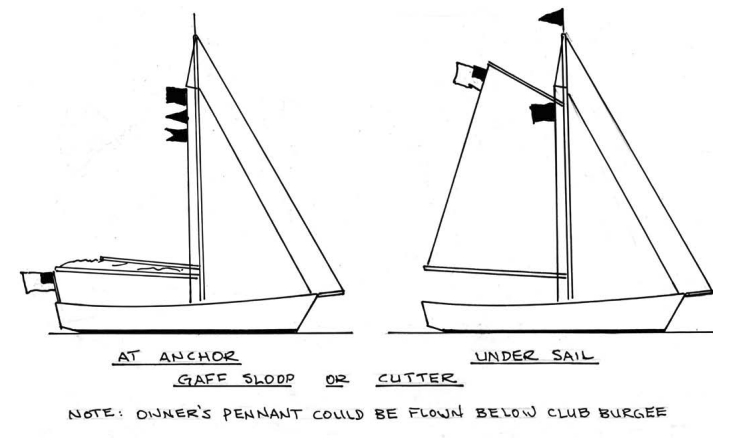
Most yachts have only one set of halyards on each spreader. So when you are in foreign waters, fly the courtesy flag above your club flag. If you do have two sets of halyards on your starboard spreader, then the courtesy flag would be flown separately from, and outboard of, the club flag.
There is one rather strange exception to the courtesy flag rules. According to Chapman’s Piloting, Seamanship and Small Boat Handling, the courtesy flag is flown from the foremast head of a schooner when the craft is operating in the Great Lakes, St. Lawrence River, or adjacent Canadian waters. Doesn’t that beat all? And I must admit that my experience fails me when it comes to catboats without shrouds or spreaders. In that case I would fly the courtesy flag from either the masthead or a bow staff and hope for the best.
Owner’s pennant
Now we are getting fancy! Still, since such a flag is not uncommon on larger yachts, it should be flown from the aftermasthead on two-masted vessels, both power and sail. If you have only one mast and still wish to fly an owner’s pennant, you will have to use your own judgment. From a halyard on the port spreader? Below your club burgee on the starboard spreader? It’s your choice.
Q flag
The International letter flag for Q, a solid yellow flag, is flown when you enter a foreign port and signals that the crew is healthy, and the vessel requests clearance. The Q flag is not necessary when entering Canada and some other countries, but check before you offend some pompous port official and sail into a sea of trouble.
Diver down flag
The international flag for diver down is the alpha flag, a swallow-tailed flag half white and half blue, with the white nearest the staff. In North America we see rectangular red flags with diagonal white stripes on them used as dive flags for some reason. Keep clear of a vessel displaying either flag. I gave up scuba diving years ago, but if I were diving today I’d hoist both flags to be on the safe side as there are a lot of nuts out there.
Miscellaneous flags
There are many other flags you can fly. The Union Jack (U.S., not British) is flown on a staff (the jack staff) at the bow, usually on larger vessels or naval craft, and only when anchored or made fast. Members of the U.S. Power Squadron or the U.S. Coast Guard Auxiliary will be aware of how and where to fly their particular flags, I’m sure. Others might include yacht club officers’ flags, an owner absent flag, and so on. If you simply must fly one of these, read Chapman.
If you want to look like a tried and true fool, you can always fly a Jolly Roger, a cocktail flag, or a battle ax. But please don’t invite me aboard if you do.
Above all else, fly your country’s colors high, and fly them proudly.
Thank you to Sailrite Enterprises, Inc., for providing free access to back issues of Good Old Boat through intellectual property rights. Sailrite.com