Issue 4 : Jan/Feb 1999
Last summer, I sold my aging 12-foot skiff to a farmer who had recently moved from the Pittsburgh area to Maine. When he answered my classified ad, he said he intended to use the boat as a tender for a Hunter 26 he had recently acquired. He and his young wife were just learning to sail, and he didn’t think he could afford regular use of the marina’s launch to and from their sailboat on a mooring.
At first, I thought the guy was crazy. Such a big tender for such a small boat seemed ill-advised at best. And for rank beginners at sailing to undertake rowing too? But when the wiry farmer arrived to look the skiff over, the picture became clearer. “Even when we cruise for a weekend,” he explained, “my wife wants to bring everything we might ever need along. So I need something that can carry a lot of junk.”
Moreover, the Hunter was moored in a fairly exposed anchorage. When a rough chop developed, the farmer figured he needed a sharp, high-bow skiff like mine to cut safely through the mess. He had rowed on lakes in Pennsylvania and didn’t think the coast would be much different. In the end, I had no guilt feelings. After he paid his $250, we loaded 150 pounds of skiff onto a couple of old bales of hay, and he drove off.
The farmer’s purchase was a perfect example of how to go about acquiring a tender for your good old boat. He sized up his needs, checked his budget, combed the classified ads for a couple of weeks, and made his choice. Being a neophyte, he had no hangups on what a tender “should be.” His criteria were more important than someone else’s opinion. So I’ve developed a checklist of how anyone might approach the same problem the Pittsburgh farmer faced.
Size, weight, capacity
As it was for the Pittsburgh farmer, determining the size, weight, and carrying capacity of your next tender is a personal choice. At a crowded yacht club dinghy dock, a 12-foot tender might be frowned upon. At your own dock, who cares? Likewise, if you intend to land on and push off lots of long sandy beaches, a 150-pound skiff could become more of an exercise in bodybuilding than you might like. And in places like Maine, sandy beaches are few and far between. Then is smaller the answer? Well, a wife and husband of 110 pounds and 150 pounds, respectively, wouldn’t need much of a tender for a brief row to shore now and then. Then again, if she gets pregnant and he considers cheesecake a member of the primary food group … well, you get the idea. Size your tender to your needs and expected needs very carefully.
Unfortunately, a tender’s carrying capacity is a difficult number to nail down. New tenders usually come with a recommended safe carrying capacity. Sometimes, it’s stamped right into the hull. But in most used tenders, the official carrying capacity has long since been forgotten. The U.S. Coast Guard has a complex and nearly incomprehensible formula for determining carrying capacity, and that’s usually where the hull-stamped number comes from. But, in the absence of the Coasties’ number, I’ve found the Subtract One Theorem works just as well: Ask the owner/seller how many adults he carried in the tender and subtract one. Multiply whatever’s left by 160 pounds, and you get a pretty good estimate of the safe carrying capacity of the tender.
Other significant considerations include the tender’s value as a maintenance platform. Most folks who maintain their own boats eventually do repair and touchup work after the vessel has been launched. A stable tender is a big help with these chores. And of course a tender’s towing characteristics and the ease with which you can stow it aboard the mother vessel are also worth considering.
To power, not to power
There are three basic ways to move a tender through the water: by engine, by oars, and by sail. Each has distinct advantages and drawbacks. Having used each of the three at one time or another, I’ve found that doing what everyone else in the harbor, yacht club, or flotilla is doing is not always the best approach.
For instance, in recent years the popularity of outboard-powered tenders has increased exponentially. I suspect the main reason for this trend is an aging, weary baby boomer population that has taken lessons from convenience-oriented charter fleets and certain advertiser-driven boating magazines. The conclusion? The internal combustion strategy must be the overwhelmingly wise choice. But before you invest $600 to $2,000 in an outboard, consider some of the less-attractive aspects of powered tenders.
Boat insurance companies are swamped every year with hundreds of claims for stolen tender outboards. Because these outboards are lightweight and easy to resell for a couple hundred bucks, thieves love these engines and regularly target them, particularly when they’re tied up at public docks near large metropolitan areas. Also, remember that before you head out into exposed waters, the tender’s outboard must be removed and secured somewhere on the mother vessel. Spare gasoline also must be stowed somewhere on the mother vessel. These are messy jobs at best, dangerous, if done improperly.
Of course, with a second engine to maintain, appropriate spare parts and tools must be carried. Although outboards have come a long way in reliability, the potential for annoying mechanical breakdowns in the middle of a cruise is doubled when you own two engines. And you still have to maintain a pair of oars for emergencies, while at the same time ruling out the possibility of converting the little darling quickly and easily to a sailing tender.
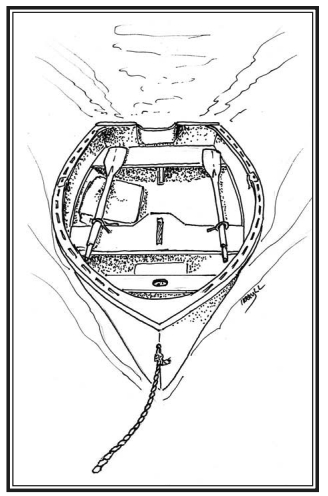
Oar-powered boats are, of course, simpler and cleaner. Still, some tenders are virtually unrowable in all but the most peaceful conditions. Inflatable dinghies, particularly the less expensive variety, are notorious for this. Moreover, some rigid, blunt-bowed, slab-sided dinghies cannot be rowed in a choppy anchorage. They take too much water over the bow and sides to be safe.
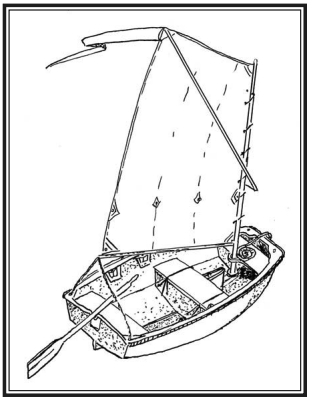
Sailing tenders are sweet when the wind blows at exactly the right speed, usually somewhere between 5 and 10 knots. The wind is rarely this cooperative during most of my cruises. Moreover, sailing tenders require maintenance of a rudder and centerboard, both of which have the uncanny ability to become very scarce when needed. And the centerboard well can be a nightmare if not sealed with a watertight insert while the dinghy is being towed. More than one sailing dinghy has been sunk because water forced its way up the centerboard well and filled the bilges before anyone noticed what was happening.
Inflatables, deflatables
Inflatable dinghies have come a long way since the days we called them “deflatables.” Improvements in air chamber design and materials, plus advanced fabric assembly techniques, now make it possible for some manufacturers to offer inflatables with a 10-year warranty — something that would have put most of them out of business 15 years ago. Most manufacturers, however, still settle for a five-year warranty which you must read carefully before you purchase. Some warranties include so many exclusions as to be nearly worthless.
Then there’s the decision between a solid floor and a fabric floor. In the old days, that was easy. Fabric floors slowed the boat to a crawl, offered a terrible standing or sitting platform, were impossible to bail out completely, and were prone to piercing and leaking. Solid wood, fiberglass, or aluminum floors solved most of these problems but created another big drawback: the elimination of easy stowage. Foldable floors addressed the stowage problem to some degree. But the inflatable that you could easily deflate, roll up, and stow almost anywhere became an ungainly pile of floorboards and fabric.
Inflatable manufacturers responded again, this time with a high pressure inflatable floor (HPIF), which has become popular in recent years. Essentially, the HPIF is a series of layers of bladders tightly stitched together which, when brought up to proper pressure, act very much like a rigid floor. Deflated, an HPIF rolls up easily. This all-fabric approach makes the HPIFs a little less expensive than their rigid counterparts and a little lighter. Performance through the water is about the same. Most HPIF owners caution that an electrically-driven air pump is essential for bringing the boat up to and maintaining proper pressure. When pressures are too low, the HPIF is no substitute for a rigid floor inflatable.
But can they be rowed? The answer is a simple yes and no. In absolute terms, you can row most inflatable tenders into a 12-knot breeze or a 2.5-knot current and expect to make some modest headway. However, if you like to row and expect to get somewhere in a 20-knot breeze or a 3.5-knot current, rowing an inflatable is an exercise in frustration. Even ardent inflatable advocates concede an outboard is used on the vast majority of these tenders because rowing is only a backup system at best.
And can they be sailed? Well, in California there’s at least one company that says “yes.” Tinker Marine of Alameda advertises an inflatable that includes rudder, daggerboard, and sail for sailors who are absolutely devoted to inflatables.
Prices for a basic inflatable up to 12 feet in length range from $700 to $4,500. That doesn’t include an outboard, but usually includes oars, a manual pump, and a patching kit.
Prams, dinghies, punts
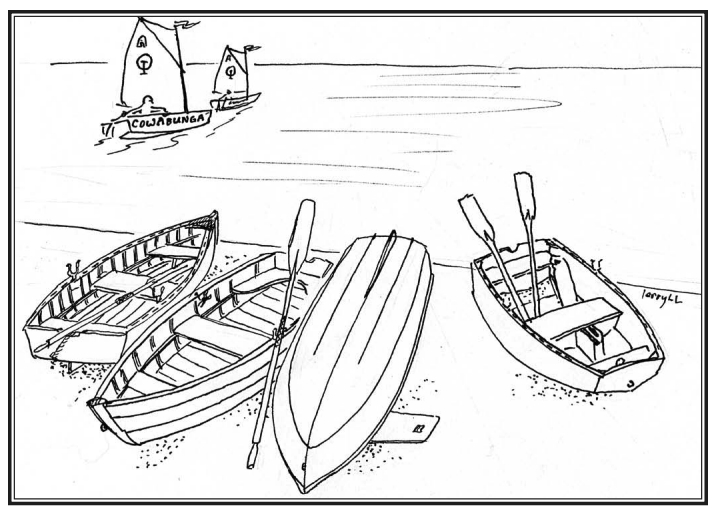
There are literally hundreds of designs for small tenders, which are known variously as prams, dinghies, and punts. Many of the designs can be built by just about anyone who can tell the difference between a spokeshave and a handplane. Most can easily be completed over the course of a winter’s worth of weekends, making them a project you can start in the fall and expect to have ready for the next sailing season. The cost of materials usually runs from $200 to $500.
However, if you are not a fairly well-accomplished do-it-yourselfer, stick with simple plans for a tender, preferably a flat-bottomed design that calls for the use of marine-grade plywood throughout. Sticking with a tender designed only to row will also simplify matters and keep the price between $100 and $200. The best plans and building instructions for such a do-it-yourself vessel can be found in the book Instant Boats by Harold H. Payson. First published in a hardbound version some 20 years ago, it is now available in paperback.
For those more adept at home handyman projects, there are several other aspects of tender construction to consider. First, if you are going to use epoxy or polyester resins on your chosen design, these materials must be used in a well-ventilated space. This generally excludes the basement of your house. If you opt to use a garage space, remember: some epoxies will work in sub-freezing temperatures, but most won’t. Nor do polyester resins appreciate cold weather. Heat of some sort will be essential.
Also, when considering sailing tender designs, be sure you contact a few sailors who have actually built and sailed these rigs. Some sail well but row poorly, and vice versa. And depending on how you answer the towing question (discussed below), any tender’s ability to be towed without a fuss may be critical. So get information from fellow sailors with real-life experience before you proceed.
Be tender to yourself
Off-the-shelf solid tenders — both fiberglass and otherwise — are a world unto themselves. Eight nationally known builders regularly advertise some 16 tenders that are built to be rowed, sailed, or powered by an outboard. Among the 16 possibilities are tenders that can be folded up when not in use, and even some allegedly unsinkable versions. Beyond the nationally known builders, there are also scores of local builders of solid tenders of all sorts.
In any case, when considering a solid tender, new or used, it is wise to steer clear of making your purchase until you’ve actually sat in the vessel in the water and checked out its behavior. Many solid tenders, particularly lightweight fiberglass versions, are far less stable than most boating people prefer. One’s sense of stability is unique, varying from person to person. So don’t depend on someone else’s assurances of how stable the tender in question is. Go to a boat show and try it yourself.
Workmanship in solid tenders runs the gamut from sloppy to finely fitted. Since most solid tenders are made of fiberglass, be on the lookout for bubbles underneath the glass mat webbing. Another common indication of shoddy workmanship is webbing that lays down unevenly or that hasn’t been fully saturated with polyester resin, leaving turned up ends of exposed glass fibers. Uneven painting with drips and sags on the vertical surfaces of the inside of the hull are also a sure sign of poor workmanship. Avoid tenders like this.
Kayaks, canoes, sailboards
In the last 10 years or so, off-beat tenders have become popular. Their advocates are devoted and numerous. But again, experience is the best teacher.
Kayaks, in particular, have become quite popular. The smaller versions are around eight or so feet in length and stow easily on a 35-foot sailboat. They are often lightweight enough to be literally carried around while on shore. Unlike a standard tender, you face the direction in which you’re paddling. The cost is competitive with off-the-shelf fiberglass tenders ($800 to $1,200) and most are as durable as any other traditional type of tender.
A kayak’s stability, however, can be a problem. Most sailors can adapt quite readily to paddling a kayak and keeping it stable in ordinary sea conditions. Rough conditions, however, challenge even expert kayakers, and neophytes would do well to stay away from choppy waters. Moreover, kayaks that are a handy size have limited stowage space and, unlike traditional tenders, they cannot be used as a floating maintenance platform.
Canoes solve the kayak’s stowage problems and offer a slightly better maintenance platform. They also allow you to paddle facing the direction you want to go. But stowing even a small 12-foot canoe on the deck of a 35-footer will be awkward at best. Towing a canoe is not a reasonable option and most are best used
within the confines of a calm harbor.
Sailboards are obviously limited to all but the most hot-blooded folks or to sailors who stay in tropical and sub-tropical cruising grounds. Stowage on a sailboard is limited to what you can carry in a backpack. Mastering the art of sailboarding is more difficult than mastering rowing, but most sailors can get the hang of it eventually. The boards stow easily on a 35-footer and offer a moderately useful platform for maintenance.
Boat overboard!
Throughout this discussion of tenders, there has been the underlying question of whether or not to tow the little boat behind your good old boat. How you answer this question will determine to a large extent what tender you buy or build.
Towing a tender is a quick and convenient way to bring the little devil along. But, depending on wind and sea conditions, and on the vessel’s design, a towed tender can be anything from a minor headache to downright dangerous. In fact, in a heavy following sea, I’ve had at least one tender swallowed whole by a sneaky breaking wave. Even headed to windward on a ordinary, choppy summer day, spray can fill the tender enough to require bailing, which is a tricky proposition while under way. And of course any dinghy you tow will — again, depending on its design — slow the towing boat’s progress by anything from a quarter to a full knot or more.
Bringing the dinghy aboard the mother vessel is the obvious solution. But this is easier said than done. Even deflatable dinghies are a hassle to get completely deflated, rolled up and tucked away somewhere convenient. (They also must be re-inflated which is also a time-and energy-consuming project when using the manual pump provided.) Solid tenders present even bigger problems. Lacking stern davits, the tender must be stowed upside down either just aft or just forward of the mast. But just getting an 85- to 150-pound tender aboard and in place is going to require some down-and-dirty muscle work even if you have a block and tackle to help.
Davits seem to be the answer here — until they catch an errant mainsheet or dock line. Davits also increase your good old boat’s overall length, allowing dockmasters to charge you for the extra footage. These problems can be solved by installing custom davits designed to swing inboard when not in use. But then you’re looking at spending around $2,000 for such a setup.
Thus the best answer to all this is the age-old sailor’s companion: compromise. As with just about everything else on just about every boat I’ve ever owned, a judicious compromise is the least expensive and most satisfying way to solve problems, big and small. Like the Pittsburgh farmer, know yourself and your needs well before you write that check.
Thank you to Sailrite Enterprises, Inc., for providing free access to back issues of Good Old Boat through intellectual property rights. Sailrite.com