Issue 4 : Jan/Feb 1999
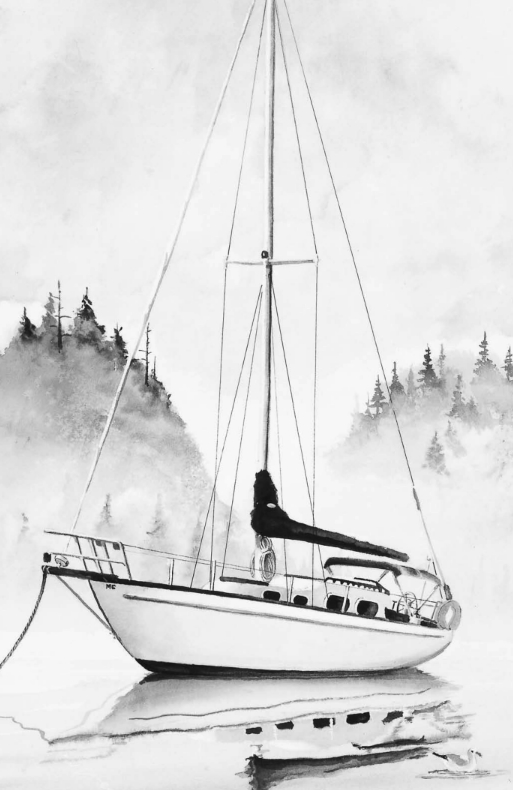
In years gone by I’d thought about building a boat. It had been a near-lifetime dream. In my Navy days I spent many an hour looking at the plans published in Rudder and reading Chappelle and other great writers. While stationed at Glenview Naval Air Station, not too far from Lake Michigan, I spent evenings with a fellow sailor, rigger Nelson Molson, drinking Harvey’s Bristol Cream sherry and talking about that bluewater trip we’d do after being discharged.
We even went so far as to buy an old 12-foot sailboat that we planned to restore and learn on. Boy, were we green. The boat was in such bad shape that we never sailed it. We didn’t even repair it, let alone restore it.
Right after my discharge, I followed a friend’s lead and applied for a job as a deckhand on Josephine III, a grand old sailboat moored at the Grosse Pointe Yacht Club. As I remember, it was owned by a big wheel in the automobile industry. Because I dawdled about instead of going down immediately to the Coast Guard office in Detroit to get my seaman’s papers, I didn’t get the job. No matter. I forwent the sailing experience and, at the urging of my intended wife, Hildegard, got an honest job with General Motors at the Research Laboratories, married shortly thereafter, and started to raise a family almost immediately.
In the mid-to-late ’60s, my friend Tom Schreiber bought a Cal 25 and asked me to crew. We spent some great years in the money in most races because of Tom’s excellence. By this time, the builder itch had long vanished. Fiberglass had replaced wood as the material of choice for boats. It was now a lot easier to buy a good boat than to build it, but I never thought of owning one. Well, we did have part ownership in a Grumman canoe with a sailing rig, but that hardly counts.
How the owner urge returned escapes recollection, but in 1979 Hildegard and I took courses at Annapolis Sailing School, chartered a Seaforth in Lake Erie for two weeks when we returned and decided we liked sailing. Late that year we bought a Columbia 8.3, named her La Yu, and spent much joyful time over several years sailing lakes St. Clair, Huron, and Erie.
When 1986 and my retirement rolled around, we decided to take the leap. After selling La Yu to Carl Schulte, who still owns and sails her regularly, we went to Florida, hired a local surveyor who didn’t know anything about sailboats, bought a 1964 Alberg 35 and shipped it back to Michigan. I didn’t plan on becoming a boat builder; I only planned to fix up the rough edges, test sail her on the Great Lakes, and then make our way to exotic places and Paradise.
Hildegard and I took a lot of time deciding on a name. One cannot treat naming as a trivial matter when the vessel is to be your home and transportation to see the world. With music such a strong part of our lives, we were pretty sure that the name would have to be on a musical line. You see a lot of Andantes, Adagios, Vivaces, and such on the water. We tried to think of something not so common. I suggested Polonaise — not only musical, but also a statement of our heritage. In a stroke of musical punning and historical brilliance, Hildegard came up with Astigafa.
Perfect! The boat came from the Beatles period; the name is an acronym for A Splendid Time Is Guaranteed For All — with an extra A thrown in for easy pronunciation. John Lennon sings the words at the end of the song “Being for the Benefit of Mr. Kite” from the Sgt. Pepper album. We certainly expected to have a splendid time on her in Paradise.
Actually, Marshall Crenshaw came up with that name for his first band and their first recording studio in Royal Oak. Since the name was legally registered, we probably should have asked his permission to use it. But Marshall had honed his trade in our basement, his band cracking the plaster, gouging the walls, shaking the putty out of the windows, loosening doorknob screws, and (infrequently) bringing the Berkeley police to knock on our door asking the guys to pipe down. We figured he owed us.
The boat arrived at North River Road Marina on the Clinton River. My good friend, ham radio buddy, and sailboat rigger extraordinary, Jon Kaplan, took a look at her as the semi pulled in and said, “Boy! You sure bought a piece of sh–, didn’t you?”
“Well,” I agreed, “I have to fix up a couple of things.”
“You’re gonna sail this around the world?”
My rejoinder of, “Maybe not all the way,” may have shown a slight lack of confidence by this point.
“Ya better stick around here for a while,” he concluded.
I had prepared a new nameplate for the transom to cover up the original Casta Diva, and went through the propitiation ceremony attendant to changing the name of a vessel. I offered a Christian prayer; I mumbled something to Allah and Buddha; I poured wine into the river for Neptune; I passed out cigars and offered the smoke to Aeolus; although the moon wasn’t up, I offered Druidic rumblings to her, telling her I’d play Donizetti’s Norma when I got home; I made offering to the four corners to ask Manitou’s blessing; and finally, following Chinese tradition, I lit a row of firecrackers to drive away evil spirits. I didn’t know how many to use but a dozen, to represent the Zodiac, seemed appropriate. I lined them up on a board under the transom and touched them off in turn with my cigar. The last firecracker didn’t go off.
“You’re f—ed now,” said Jon.
I knew he was a great rigger; I didn’t know he was a seer. In backing the boat out of the launch slip to turn it around so we could step the mast, I heard a loud clunk. The wheel spun out of my grip, and the boat circled backward, helpless in mid-river. After the rescue boat, for a pair of 20-dollar bills, towed me back to the slip, I determined that loose setscrews permitted the prop shaft to screw itself out of the coupling. I should have suspected that: when we did the sea trial in Fort Lauderdale, engine vibrations had thrown the coupler bolts. The loud clunk was the prop slamming into the rudder and jamming it against the stop. That was fortunate in a way. Had the prop not been in a rudder aperture, the whole shaft would have come out of the boat, and water would have poured in. More than one boat has sunk because of that.
Like it or not, I became a boatbuilder at that instant. With makeshift tools of an unbelievably crude nature, I got the shaft back into the coupler, secure enough for a short, cautious trip downriver to my home, hoping all the time that I wouldn’t have to use reverse. After going aground on a sandbar and maneuvering gingerly for about 10 minutes without using reverse, all to the delight of shore folk watching, I got off and got home.
Hildegard and I spent five years rebuilding the boat. We did some great summer sailing in her, hitting all the Great Lakes save Ontario, which we planned to sail on our way out. But the remaining nine months of each year were spent in blood, sweat, and tears. Between us, we acquired about five new scars, a few tens of stitches, a cracked rib, a couple of torn ligaments, an occasional utter hatred of each other and the boat, and, ultimately, respect for each other and the boat.
We had some good sailing times. Astigafa took us to all the Great Lakes, the St. Lawrence and Hudson rivers, through 64 locks, along the Atlantic coast to Chesapeake Bay and back. We accomplished part of the dream with some splendid moments.
We navigated through peasoup fog and rocks in Lake Superior to find a magnificent anchorage in the Agawa Islands. As we went through Quebec’s Chambly canal system, which takes you from the St. Lawrence River to Lake Champlain, we happily thought that we were in France. In Sandy Hook Bay, Hildegard harvested enough mussels for two meals and a couple of snacks. She had always wanted to do that. We had a really splendid time in Annapolis when our daughter visited us. We three stuffed ourselves at a raw bar on local clams, oysters, and crab.
Even some of the bad times had an element of goodness, if only because of a realized sense of accomplishment. Having to dive sans wet suit in 64-degree water to verify that we had indeed broken the rudder was not pleasant when going in nor staying under. Yet the exhilaration following the dive, and the pride in being able to fashion a jury rudder and get us safely to Annapolis made up for some of the misery.
However, in spite of five years’ cleanup work, the remnants of the fizzled firecracker stayed with us. I’ll not repeat the problem litany.
Because of all the work that it took to keep Astigafa going, and my own uneasiness, we didn’t get to the white sands, palm trees, and blue skies. It’s great out there, but it’s not Paradise.
Thank you to Sailrite Enterprises, Inc., for providing free access to back issues of Good Old Boat through intellectual property rights. Sailrite.com