Petite pole packs plenty pull
Issue 10 : Jan/Feb 2000
Whisker poles have come a long way since I sailed up the Pleasant River, in Addison, Maine, using a battered broomstick to hold out the jib of my leaky little flat-bottomed skiff. It was fun, but this equipment and technique had it limitations. That was in 1980, and since then a lot of thought has gone into whisker-pole technology and construction. Today, even the best-equipped good old boat can benefit from another look at whisker poles and their uses.
If you’ve never used a whisker pole, don’t be put off by a piece of equipment that seems designed for racers. You don’t have to be an America’s Cup champion to get the most out of your whisker pole. Cruisers can benefit tremendously from using them. And, even if you’re already hooked on your aging, non-adjustable wooden whisker pole, you should use it properly, know what size is right for your boat, and understand the options you have if it should ever come to grief.
Whisker-pole basics seem deceptively simple at first. Basically, the function of a whisker pole is to extend the clew of the jib to windward when you’re sailing off the wind. This prevents the jib from being blanketed by the main and helps shape the jib to get the most power out of it. Although a jib usually is not as efficient a downwind sail as a spinnaker, when it is projected outboard to windward, it can add a significant amount of boat speed.
While whisker poles are simple in concept, improvements have made them easier to use.
The basic set-up
The first indication that you need to set up your whisker pole is a slackening of the headsail sheet. In most boats, this occurs when you’re about 150 degrees off the wind. When the jib droops in the lee of the mainsail and the boat slows, it’s time to put the whisker pole to work.
Occasionally, I’ve found wind or sea conditions too rough to set up the whisker pole, even though the sheets and foresail are drooping. A whisker pole is basically a light-air device, useful primarily in winds of 18 knots or less. Stronger winds make whisker-pole work too dangerous. Also, even in light air, I’ve learned rough seas from an offshore storm make it wiser to postpone the use of a whisker pole. Except for times when a highly skilled crew is aboard, the whisker pole should be employed only when the foredeck is relatively stable and dry.
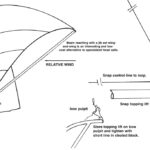
When you’re setting it up, first clip the whisker pole into the foresail clew or clew bowline. Then push the sail out to windward and attach the inboard end of the pole to the mast. The pole’s narrow end should always be outboard; the thicker end, inboard. On larger boats, a whisker-pole topping lift is also attached to the outboard end before the clew is pushed out to windward. On most good old boats, however, the topping lift is unnecessary.
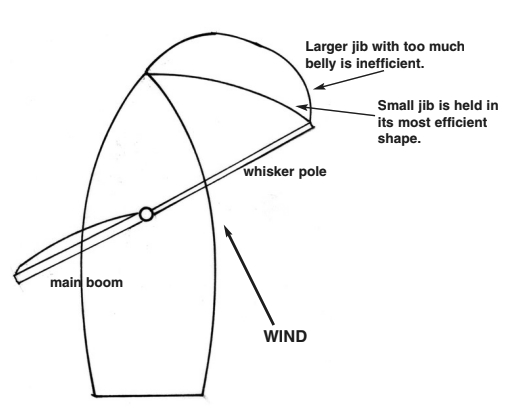
I’m not a spinnaker kind of guy. But using a whisker pole makes me think that somewhere in my subconscious lurks a spinnaker zealot. That’s because it’s always best to have the jib and whisker pole set on the side opposite to the main boom, just as a spinnaker pole is. This wing-and-wing setup offers the best results when the pole is trimmed so it lies essentially in the same plane as the boom, making it all look like a two-part spinnaker, as illustrated on the next page.
Although the jib sheets are used for most adjustments, a topping lift and a downhaul (usually a foreguy) will help keep the pole in a fixed position and help shape the foresail for best results. On bigger boats, a pole car affixed to the forward side of the mast will help keep the pole precisely perpendicular to the mast.
Once the pole is rigged, you immediately get good news from your speed-indicating instruments. Normally, I can add nearly one full knot of speed to my aging wooden sloop’s efforts. Although I still use an old-fashioned, fixed-length pole, I’ve been on boats with modern telescoping poles that often add more than a knot. For a long-distance cruise of, say, 300 miles, a whisker pole can get you to your destination a half day ahead of when you would have otherwise arrived. That may just get you into a safe harbor ahead of a nasty storm or at least in time to grab a cold one at the local sailors’ safe haven.
If you use a pole with an adjustable length, make sure its shortest length is at least one foot less than the distance from the forward side of the mast to the base of the headstay. If it isn’t, shifting the pole from one side of the boat to the other during a jibe will be messy at the very least. If you’re using an adjustable rig, the maximum length of the pole should be 100 percent of the length of the foot of the largest foresail you plan to use.
When jibing with a whisker pole, the maneuver is best done by taking the pole down completely, adjusting the boat’s course, and then reattaching the whisker pole on the new windward side. To take the pole down, simply reverse the procedure you used to put it up, detaching the foreguy first, then detaching the pole at the mast, taking off the topping lift, and so on. Be particularly careful taking down a pole that has come under increased load. In such a situation, the jib may try to yank the pole right out of your hands. To prevent that, the helmsman may have to bring the boat up a bit before turning off the wind.
To get the most out of the jib, be sure as much of it as possible is exposed to the wind. This is why some good old boats carried two whisker poles. One was for a large jib, the other for the small jib. Using an undersized pole is counterproductive.
Which pole and why
With the days of all-wooden whisker poles not that far behind us, I still believe they have a place on good old boats. For a boat less than 30 feet in length, a hefty, modified closet pole can make an inexpensive whisker pole. At a marine junkyard, you can always scrounge up appropriate fittings for each end of such a pole. For $30 or so, you can make a fixed-length whisker pole to practice with. Then you can decide whether something fancier, and more expensive, is worth it.
Once you’re ready to move to expensive ($200 to $1,000) manufactured aluminum whisker poles, proceed cautiously. Make sure the whisker pole you buy is strong enough to handle the largest headsail on your boat in conditions that you would expect to encounter with that headsail. You can get load limits from the pole manufacturer and your sailmaker. If your boat’s designer is still around, contact him. As a general rule, though: when in doubt, always choose a pole with a slightly larger diameter. Whisker poles get most of their strength from having larger tube diameters, not from small-diameter, heavily built tubes. So this is one case in which girth is good. Additionally, most adjustable poles have the maximum working length clearly labeled on the pole.
Whisker poles come in two basic varieties: fixed-length and telescoping. If you plan to sail with several jibs, you should consider a telescoping pole because you can adjust the length to get the most out of each sail. A telescoping pole consists of two tubes, one inside the other, and it will have one of three mechanisms to adjust the outer end of the pole: a pin lock, twist lock, or a line-controlled system.
The line-controlled system is probably the best because it allows you to adjust the pole when you are standing close to the mast. The other two adjustment systems require that you stand somewhere near the middle of the pole to make the adjustment. This may not be a problem in light air, but when the wind is blowing a little, it becomes a more precarious location.
Additionally, a line-controlled adjustment system allows you to make an infinite number of settings. In contrast, the pin-lock system allows incremental adjustments of 8 to 12 inches. The pin-lock system features a spring-loaded button that pops into a preset hole in the outer tube of the pole. Of course, the line-controlled poles are the most expensive type, followed by the pin locks, then the twist locks, and the fixed poles.
A twist-lock pole operates on a “jam” system that wedges the two sections of the pole together. Like the line-controlled pole, this feature allows the pole to be adjusted to any length. Both the pin-lock and twist-lock poles are harder to adjust under load than the line-controlled pole. Be particularly careful when using pin- or twist-lock whisker poles. There are points at which you can get you fingers jammed in the mechanisms. Always relieve compression loads as much as you can before making adjustments or taking the whisker pole down.
For best results
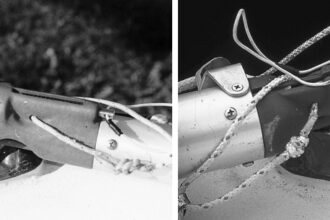
Most whisker-pole tips have some sort of spring-loaded locking mechanism at either end. Although you can still find a pole with a blunt-pointed end that is inserted either into the clew grommet on the headsail or into a clew ring of some sort, most of these are used aboard small racing boats. They are also used aboard boats like mine, where the owner is a cheapskate and doesn’t mind an old-fashioned mechanism that has no moving parts to break down.
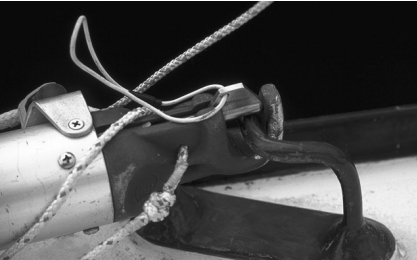
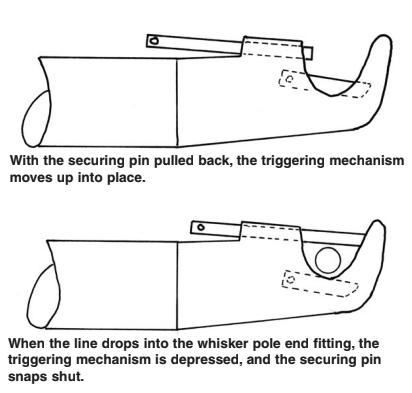
Still, most poles these days have spring-loaded locking fittings on either end that are either hand-actuated or “trigger” style. A hand-actuated mechanism requires that you pull a pin back and hold it there while you attach the pole end to a jibsheet or to a mast fitting. A trigger mechanism lets you pull the pin back and set it there. The fitting’s slot will remain open until it makes contact with a line or fitting, then the pin snaps shut.
The majority of whisker-pole end fittings used to be made from cast aluminum with stainless steel springs and pins. But the newer poles made by Hall Spars and Forespar have composite machined aluminum end fittings that are as strong as, and half the weight of, the older cast aluminum devices. Carbon fiber fittings and poles are available but make little sense on any boat other than a dedicated racer’s vessel.
For boats less than 35 feet in length, you may be able to use a large fixed pad-eye mounted on the forward side of the mast. However, for larger boats, a far better installation is a pole car mounted on a track attached to the mast. The more reliable pole cars use ball-bearing track systems.
Proper stowage of the whisker pole is also important. Many whisker poles are stored vertically on the mast. This has the advantage of placing it in service quickly, and the disadvantage of exposing it to salt crystal build-up which, if not cleaned regularly, can affect the pole’s performance. To make cleaning easier, store the whisker pole attached to the inboard side of the boat’s lifeline stanchions. Fittings to accomplish both of these stowage arrangements are readily available in most marine catalogs.
As noted, the bottom line for a new aluminum whisker pole can vary from just under $200 to well over $1,000, depending on your boat size, the pole’s construction, adjustment features, and so forth. Also, you should add another 20 percent or so for additional gear you’ll need to properly set up, control and stow the pole. Thus a whisker pole can be a major investment in your good old boat’s rig. But once made, it’s one relatively small pole that’s guaranteed to vault you into the ranks of faster boats.
Ken Textor has lived and worked aboard boats for 22 years. In addition to work he did for the former Small Boat Journal, he contributes to a number of sailing magazines and has written a book, Innocents Afloat: Close Encounters with Sailors, Boats and Places from Maine to Florida.
Thank you to Sailrite Enterprises, Inc., for providing free access to back issues of Good Old Boat through intellectual property rights. Sailrite.com