Rugged and classy
Issue 15 : Nov/Dec 2000
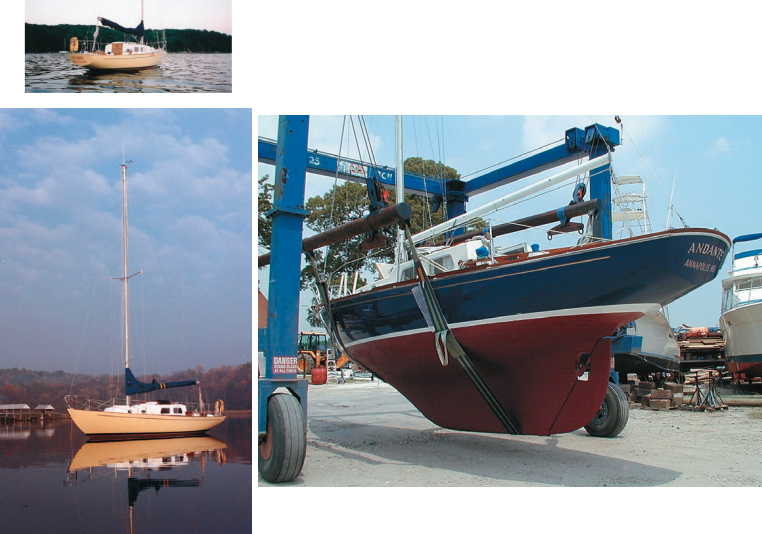
“Not many 30-footers, old or new, seem basically seaworthy and rugged as the Alberg 30.” That assessment comes from Practical Sailor, a publication which does not hand out compliments lightly.
The Alberg 30 is, in fact, a legend in its own time. There is a devoted following of fans and active class associations that foster keen interest and participation in this classy-looking sloop.
That ruggedness has encouraged many owners to make long ocean passages. Several Alberg 30s have even circumnavigated the world. “Prospective buyers should feel a warm confidence in her structural soundness,” the magazine added. One of the best-known circumnavigators is Jean du Sud, sailed by Yves Gelinas, who made an award-winning film of the trip.
The Alberg 30 story began in 1962, when a group of Folkboat owners at Toronto’s National Yacht Club went in search of a bigger boat. When they couldn’t find one that suited their taste, they asked Kurt Hansen of Whitby Boat Works to commission a design and build it for them.
Hansen went to Carl Alberg, a Swedish-born American, then one of the country’s best-known yacht designers. Hansen asked Alberg for a boat with a full-length keel, standing headroom, a decent galley, and a workable cockpit. It had to sleep four and be made of the new material, fiberglass.
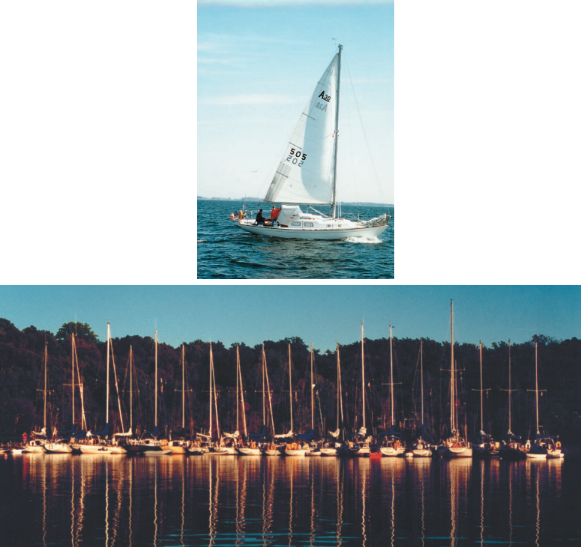
The seaworthy Scandinavian influence was evident in the beautiful sloop Alberg produced. She was like an enlarged Folkboat, with the same low freeboard and narrow beam, but with a counter stern. By coincidence, a group of sailors in Washington, D.C., was also ready to change from wood to fiberglass. They inspected the Alberg 30 at Whitby Boat Works, and left firm orders for 15. Another 12 were ordered for a group of sailors in Annapolis, Md., and so began one of the longest production runs ever. It lasted 25 years and produced more than 700 boats.
Today, the biggest concentrations of Alberg 30s are found in Chesapeake Bay (about 250) and Toronto (about 100), but the rest are scattered far and wide, and you could run into one almost anywhere.
Basic design
When Alberg designed this 30-footer he was 63 years old and still clearly influenced by wooden designs. By today’s standards her freeboard is low and her interior space cramped. Modern boats of the same length or displacement are bigger inside, brighter, and more airy. But much of this apparent “improvement” comes at the cost of seaworthiness. Excess beam is detrimental in rough water, and high topsides create wind resistance. The Alberg 30 has neither: she remains the essence of the old-fashioned, seaworthy cruiser whose emphasis is on seakindliness and safety rather than speed and extravagant accommodations bought at the cost of ultimate stability.
Her long keel, cut away at the forefoot, is ideal for heaving to or lying ahull in heavy weather, and if (as can happen to any boat, but more readily to a beamy one) she is turned upside down by a plunging breaker, her narrow beam will help her get back on her feet quickly. This is a forgiving hull that will look after a singlehanded passagemaker.
The ballast keel is cast iron, encapsulated in the fiberglass hull. Alberg wanted her to have a lead keel, and very early models proved to be too tender with cast iron, so more ballast was added to later models.
When she was first produced, the Alberg 30 was thought to be a reasonably fast boat. The design brief, after all, called for a cruiser that could be raced under the Cruising Club of America (CCA) measurement rule. Today, however, her average Performance Handicap Racing Fleet (PHRF) rating of 220 shows she is somewhat slower than her less seaworthy modern cousins, at least until the going gets tough. Luckily, all-out speed is not crucial in a boat that is raced as a one-design or cruised short-handed.
Her rudder is hung from the end of the keel and is controlled by a tiller or, on some boats, a wheel. On a boat of this size, a wheel is not a necessity, however, and adds to expense and maintenance costs.
Accommodations
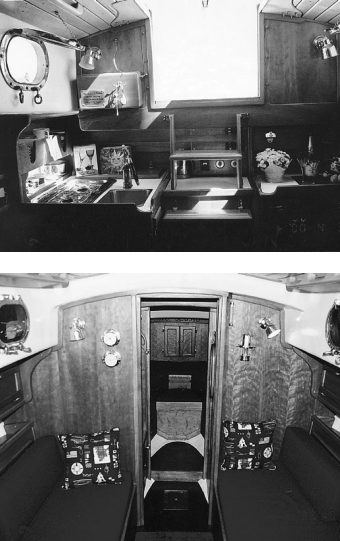
Up forward, in the “V” of the bow just aft of the chain locker, are two berths that will accept adults with reasonable comfort. Two more adults can sleep in rather more comfort on the transom berths in the main cabin. You’ll note that there are no staterooms with cuddly double berths on this sloop, which, like most boats of its era, was designed primarily with safe sailing in mind.
Between the two sleeping areas is the head — what the plans call a “toilet room.” It’s little wider than a toilet, but it does contain lockers and shelves for linen and clothes.
The galley is aft, where the cook can get some fresh air, and where drafts from the companionway can more easily blow out the flames of the cooker; but this particular galley is split into two areas, one on each side of the protruding companionway steps and the removable engine box.
There is no designated navigation station, and the large area where quarterberths were wisely not provided is given over to stowage, accessible from hinged cockpit-seat tops. That way, the sail wardrobe is more likely to be at hand in the cockpit where it’s needed than scattered, damp and bedraggled, all over the V-berth.
The engine installation is conventional, with access available at the forward end by removing the companionway steps. The original engines were gasoline-driven: the Graymarine 22 hp, and then the Atomic Four. Later models were fitted with diesels, starting with the Bukh 10-hp single, which proved to be a little short of power, and then upgrading to more powerful Volvos — the Penta MD7A and, in the very last boats made, the Volvo 2002.
The rig
Her aluminum-sparred rig harks back to the days when, perhaps rightly for a cruising boat, it was thought better to have a large, low-aspect mainsail and a small foretriangle. The theory was that a large mainsail, being attached along two edges, was easier to control than a large foresail, attached along only one edge and needing large winches to sheet it in.
Her mast, surprisingly for an ocean-capable boat, is stepped on deck, and its heavy downward thrust is conveyed to the hull by a large laminated beam running athwartships — a potential trouble spot. Alberg obviously designed it that way to avoid having the under-deck portion of the mast interfere with the already-cramped accommodations, but in hindsight it might have been better to change the accommodations to fit around a keel-stepped mast because deck- stepped masts almost always bring trouble in their wake.
Production-line changes
Around 1970, from hull #410 onward, changes were made to the Alberg 30. The hull-to-deck joint was improved, a seahood was added to waterproof the companionway slide in heavy weather, and — most dramatic of all — a fiberglass molded interior was fitted which cut headroom by an inch or two.
Known weaknesses
If you’re buying an Alberg 30, pay particular attention to:
- The thwartships beam that supports the deck-stepped mast. Check it for signs of delamination.
- The rudder fittings. On older boats, the heel fitting may have worn, resulting in too much play, and may need to be re-bushed.
- The rudder itself. On some of the first boats made, the rudders were not strong enough to withstand the forces imposed on them, and internal reinforcing parted from the fiberglass. Check for sloppiness by holding the rudder firmly while turning the wheel or tiller.
- The tiller head fitting. Check for cracks and undue wear.
- The forward lower shroud chainplates. Some, originally inadequately anchored, have been enlarged and reglassed. Check for signs of stress or movement.
- The gas tank. Original tanks were galvanized steel. Check for rusting.
- Wooden spreaders. Check for rot or splitting and replace if necessary.
- Mainsail roller furling. Replace it with jiffy reefing.
Owner’s opinion
Staley McDermet, of Salem, Mass., owned a 1968 Alberg 30 called Carapace for 10 years, using her for coastal cruising with his wife.
“She was a very strong boat,” he says. “I installed a fireplace and had to cut a hole through the deck for the flue. The piece I cut out was solid, about half an inch thick.”
The hull was solid GRP. “The only trouble with the hull was a small area above the waterline at the port quarter, very minute blistering. The only reason for it that I can think of was that where we moored it was rough, and the wind would blow against the tide a lot and the long overhang of the counter would stay wet. It was so minor it was hardly worth bothering about, and there was no sign of serious osmosis.”
McDermet is 6 feet tall, but was able to sleep comfortably in the forward V-berths. “The other two bunks in the main cabin were longer and even more comfortable,” he says.
He found Carapace easy to handle under sail. “She was tender to about 18 or 20 degrees of heel, then she suddenly stiffened up. It really had to be blowing hard to put the rail under.”
Under full mainsail and 150-percent genoa, his first action when the wind rose was to reef the mainsail. This happened at about 20 knots.
He had a 100-percent jib, but used it only about half a dozen times in 10 years. All his foresails had hanks. There was no roller furling.
Not closewinded
Carapace did not point terribly well. “Racing boats always seemed to point a few degrees higher than we did. Her best point of sailing was a close reach or a beam reach,” he recalls.
In heavy weather, when more modern boats were bouncing around badly, she would slice through the waves in relative comfort.
“I regarded her as very seaworthy. I was scared on occasion, but she never let us down.”
He never felt the cockpit was too big for heavy weather. “We got pooped once — got dumped on during an overnight sail. I heard the wave coming up behind me, but I wasn’t fast enough. It came over the stern and filled the cockpit about a third full. There was no problem, though. The water drained away rapidly through the two drains aft of the bridgedeck.”
Carapace was converted to wheel steering, and he never noticed any excessive weather helm or tendency to get out of control. “She was well-mannered even in the heaviest weather, easy to control.”
Her engine was the original Graymarine 22 hp, driving a two-bladed propeller. “It was plenty powerful enough — gave us full hull speed and was reliable. It was pretty accessible for maintenance, too. The companionway steps were removable and exposed the front end. I even replaced an oil seal once. There was a very handy access point through a port in the cockpit floor, as well, about 10 inches in diameter,” he says.
Good headroom
Headroom in the cabin was more than 6 feet. “But this was a 1968 model, and I believe in 1970 they installed a liner in the cabin that reduced headroom by about 2 inches,” he notes.
In the decade that he had Carapace, Staley experienced no problems with her mast or rigging and no problems with her solid bronze through-hull fittings.
He did, however, find that the rudder stock had worn excessively at the foot and rattled around in the heel fitting. “It wore down to about half its original thickness,” he says, “so I took it off and had it repaired.”
He also had to repair the beam carrying the thrust from the deck-stepped mast after he discovered it had cracked and separated into its individual wooden laminations.
When he put the 26-year-old Carapace on the market in 1994 her original gelcoat still looked good. “The biggest problem in selling her was the narrow beam — there’s not so much room down below as people have come to expect on modern boats. But we always sailed her with just two people — my wife and myself — and there was plenty of room for us.”
He eventually sold her for $15,500, taking into account that the new owner would have to spend between $500 and $1,000 on an engine overhaul.
It is apparent that Alberg 30s command higher prices in areas where owners’ associations are active. The original boats sold for about $10,000 brand-new, and the last ones, produced 25 years later, sold for about $34,000.
Conclusion
If you’re more concerned about ultimate stability and general seaworthiness than about large areas of accommodation, the Alberg 30 makes a fine oceangoing cruiser. She’ll carry two in comfort, and she’s easy to singlehand with a vane self-steering gear. While she’s no light-displacement speedster, there’s no reason why she shouldn’t make good daily runs during an ocean passage.
It would make sense to buy one of the older boats — hull numbers less than 410 — that were finished below with wood joiner work. The rather sterile interior fiberglass mold introduced later not only cuts down on headroom but may hamper the quick access you need to the inside of the hull if you strike a rock or spring a leak.
Use the money you save on the older model to improve the galley and improvise a chart table, hinged or folding if necessary.
Be prepared to have the engine overhauled or replaced, and check for the known weaknesses listed above. With reasonable maintenance, she should be good for another 25 years at least.
John Vigor is a professional journalist. The author of The Practical Mariner’s Book of Knowledge, The Boatowner’s Handbook, and The Seaworthy Offshore Sailboat, he has worked for major newspapers around the world and is a frequent contributor to leading sailing magazines. He has sailed for more than 40 years in boats 11 to 40 feet in length and logged some 15,000 miles of ocean voyaging. In 1987 he and his wife, June, and their 17-year-old-son sailed their 31-foot sloop from South Africa to the U.S. This series of boat reviews is based on articles from John’s book: Twenty Small Sailboats to Take You Anywhere.
Thank you to Sailrite Enterprises, Inc., for providing free access to back issues of Good Old Boat through intellectual property rights. Sailrite.com