Long hull, lovely overhangs
Issue 17 : Mar/Apr 2001
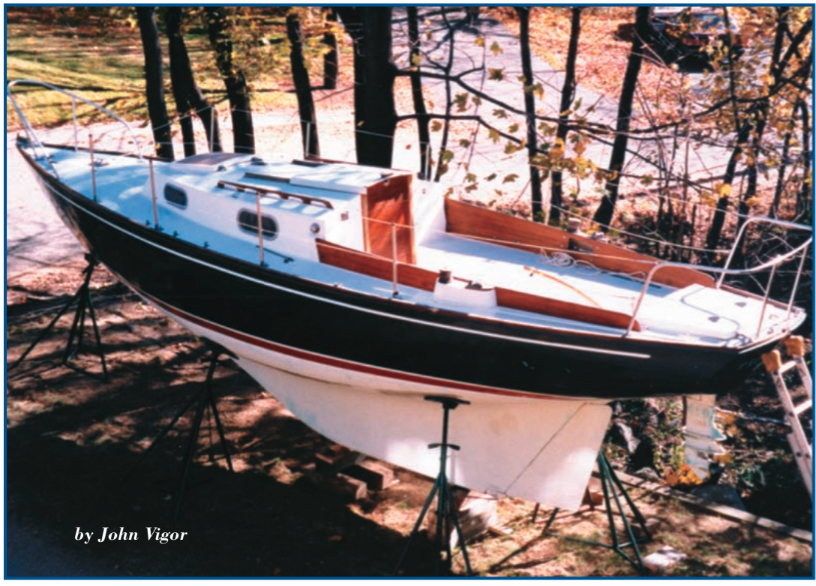
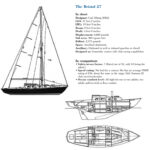
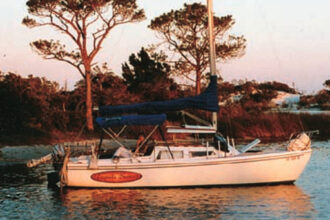
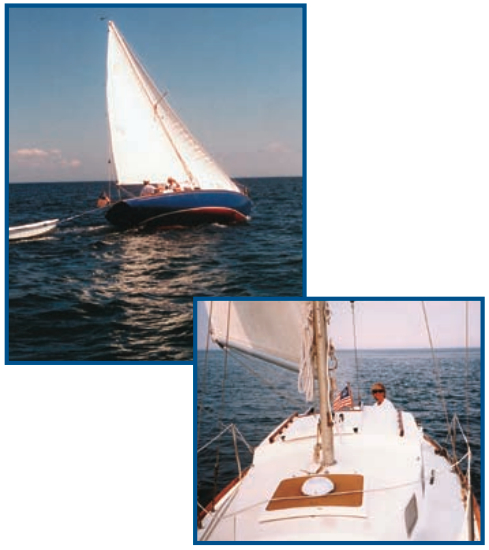
There are some people whose artistic sensibilities are offended by the size of the Bristol 27’s cabintop. They wonder how a designer with the flair and talent of Carl Alberg could have put such a lumpy top on such a sweet hull. The answer is very simple. He did it because the public wanted it. It provides what everybody wants, with the possible exception of the aesthetically oversensitive: standing headroom below.
While it’s true that a lower, more streamlined coachroof would have made this boat a spectacular looker, it could only have been done at the cost of comfort and bad backs. Bristol Yachts quite rightly figured that the great majority of the boating public is not sensitive to minor artistic transgressions, so they built it the way Alberg designed it. And in the end it proved to be a great success — more than 400 of these robust little cruisers were created between 1966 and 1978.
To tell the truth, you quickly get used to the look of that cabintop and tell yourself it’s not so bad after all. It begins to look “traditional,” like the rest of the boat, and in any case, as Francis Bacon assured us, “There is no excellent beauty that hath not some strangeness in the proportion.”
You can, if you want, deceive the eye with painted color schemes that will lessen the apparent height of the cabinsides, but few people have bothered.
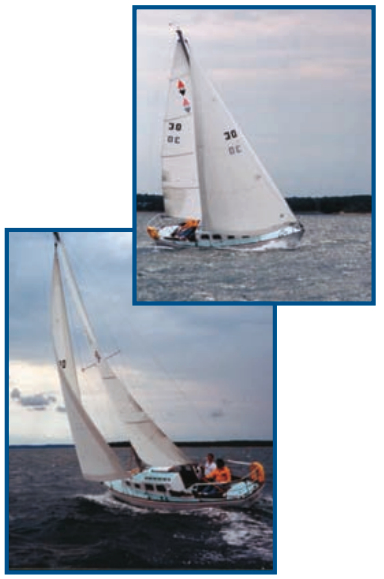
The Bristol 27 is a typical product of its era, the early days of fiberglass construction. She has a long, skinny hull with lovely overhangs. She’s made ruggedly to perform well in heavy weather, and her basic seaworthiness means she’s fit to cross oceans. And if you’re working on a tight budget, the price is right.
Basic design
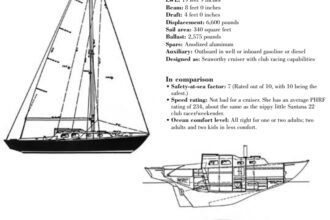
As was the fashion in the 1960s, the Bristol 27 has a traditional keel, well cut away forward for better maneuverability and safer tracking under a downwind rig.
Her ballast ratio of nearly 40 percent and the position of the encapsulated lead, much of it about 4 feet below the waterline, gives her a large positive range of stability. If she should be capsized by a plunging breaker in a bad storm, she’d bring herself upright again very quickly.
But her narrow beam (actually a factor that contributes to her seaworthiness) dictates that the righting moments of the keel and her form stability will not come into play until she has heeled over some 15 degrees or so.
This has led armchair critics to dub her “tender,” as if tender were a pejorative term. In fact, there is nothing dangerous or unseaworthy about initial tenderness, as long as it disappears at the right time, which it does on the Bristol 27.
After 15 or 20 degrees, she stiffens up and stubbornly refuses to heel any more, unlike some of today’s beamy boats, which seem to want to keep on rolling over forever.
The hull is solid fiberglass, laid up by hand, largely of woven roving, which was then the “strongest material available,” according to Bristol Yachts’ sales brochure.
The deck, cockpit, and that cabintop were integrally molded and mechanically bonded to the hull molding. Her graceful counter stern provides buoyancy and good stowage space in a lazarette behind the tiller.
The large efficient rudder hangs off the aft end of the keel, where it is well protected from floating debris and crab-pot lines.
Her 6-foot 2-inch-long self-bailing cockpit is well above the waterline and is provided with 1 1⁄2-inch drains. Early boats were provided with a solid bridgedeck at the forward end of the cockpit to prevent water from cascading below if a large wave filled it. For some reason, this bridgedeck disappeared on later models and a low sill was substituted — not a good idea on an ocean-going boat. You can achieve the same effect, of course, by keeping the lower dropboard in place in the companionway opening, but human nature being what it is, it’s safer to have a permanent barrier between the accommodations and a cockpit full of water.
The standard boat came with a well for an outboard motor in the aft lazarette, and an inboard engine beneath the companionway was an option. When they found that most buyers went for the option, Bristol Yachts filled in the well and turned the space over to stowage. While outboard engines work well in calm water, they hardly work at all on this type of boat in choppy seas (when you really need their help) because the propeller is out of the water so much of the time.
The inboard engine most commonly fitted at first was the popular 30-hp Universal Atomic 4 — far too powerful for the job, but good and compact. Other owners opted for a reliable diesel, the Westerbeke Pilot 10.
Three models of the Bristol 27 were produced: the Standard, the Dinette, and the Weekender. The first two were cruising designs, fit for deepsea work, but the third was, as its name implies, a sort of picnicking, daysailing, short-term-camping type of boat with an 8-foot cockpit and a consequent shortage of space below. You could make the Weekender fit for sea, but it would hardly be worth the money and effort, considering how cramped the accommodations would be.
The Bristol 27 is a design fit for heavy weather. She should heave to well and lie ahull in comparative safety.
Accommodations
The Standard model is thoroughly traditional below, with 6-foot 6-inch V-berths up forward and a 20-gallon water tank below them, together with a seat/locker and stowage cubbyholes. Overhead there is an opening hatch for light and ventilation.
Next comes a small, but private, head and a linen locker to port. To starboard, opposite the head, there’s the usual wardrobe and shelf.
The main saloon comprises two 6-foot 4-inch transom berths, one either side of the central gangway, and a galley in two halves, either side of the companionway steps. A two-burner alcohol stove lies to port, alongside a generously-sized stainless steel sink placed inboard for good drainage. A large icebox that drains overboard lies to starboard.
Headroom is 5 feet 10 inches beneath the overhead liner in the main cabin — courtesy of the prominent cabintop. There is unlimited headroom if you stand at the foot of the companionway steps with the sliding hatch open. Four fixed ports admit light to the living area and, while they are not excessively large, it wouldn’t be a bad idea to make plywood or acrylic storm covers for them that could be fixed in place in really bad weather.
The more popular Dinette model is provided with a table as standard equipment. The dinette seats four on three sides, and converts into a double bed. The galley then gets its act together in one piece along the starboard side, and a quarterberth begins where the galley ends. Otherwise, the accommodation plan is the same as that of the Standard model.
The rig
Here we have yet another deck-stepped mast, but this time the downward thrust is taken by a substantial bulkhead separating the forward cabin from the head compartment.
As was usual in her heyday, the Bristol 27 has a relatively large mainsail and smaller foresails than are now common. She is a masthead sloop with anodized aluminum spars. The original boats were supplied with roller-reefing on the main boom, which by now should have been converted to jiffy reefing for improved speed and better sail shape.
Wire halyards with Dacron tails were originally supplied for the mainsail and foresail. These, too, should have been replaced by now by low-stretch Dacron halyards. With any luck, the masthead sheaves will have been changed, too, to accommodate the greater diameter of the line.
This is a good cruising rig, though that big mainsail will call for fairly frequent reefing. A third row of reef points, in lieu of a dedicated storm trysail, would be an excellent addition.
Singlehanding her should be easy, with tiller, mainsheet, and jib-sheet winches all within easy reach.
Performance
The original Bristol Yachts brochure claimed the 27 was fast. But then, they also claimed she was roomy below. You can draw your own conclusions.
At the same time, she’s no dog. She has that average sort of performance that makes her pass everything in sight when you’re concentrating really hard, and fall behind when your attention wanders seriously.
She carries slight weather helm, which is fine. Weather helm is a good thing in small doses. It helps suck a boat to windward on the beat, and it means she’ll round up and wait for you if you fall overboard. But if you find yourself with the tiller up under your chin in a breeze, it’s time to reef the mainsail followed by a smaller jib or some rolls in the furling genoa.
Owners like to refer to the Bristol 27 as “nimble,” meaning that she has her wits about her, even if she’s not equipped with afterburners, and that she tacks and jibes quickly and precisely.
In short, there’s nothing wrong with her performance, and if you give her a chance to show you what she can do on an ocean passage, she might surprise you.
Under power, it’s a question of what engine you’re carrying. Any outboard is likely to be unsatisfactory in choppy seas. Any inboard is likely to be fine if it’s 10 horsepower or more. And being so nimble and sailing as well as she does, you could easily persuade her to sail around the world without an engine. Many other boats have done it in the past, and many are still doing it. That extra space, coupled with the lack of a fuel tank, propeller, and all the through-hull holes and paraphernalia associated with an engine, could be a blessing.
Known weaknesses
Here are some points to ponder if you’re thinking of buying an old Bristol 27 for long-distance voyaging:
- Ignore the scaremongers who tell you she’s too tender. Indeed, she does exhibit initial tenderness, but it’s not a bad thing, as we mentioned earlier. It’s a safety feature that some of today’s beamy coastal cruisers badly need.
- Don’t choose an outboard engine model.
- There have been reports of leaks in the hull-deck joint. Probably the caulking is getting old and tired. Get out the hose and squirt the joint from the outside. Check inside with a flashlight for leaks. Mark the places and then get out the caulking gun.
- Get rid of the main boom roller reefing system and install slab reefing. It’s faster, and better for the sail.
- There’s not much through ventilation. A Dorade box or two in the right places would help a lot, especially in the tropics.
Owner’s opinion
For four years, Christopher Gross, of Centerport, Long Island, New York, sailed a Standard Bristol 27 on Long Island Sound, where a strong north-easterly or southwesterly sets up a short, nasty chop.
She was a 1966 model that he sailed with his wife, Barbara, and two children, and although he now sails a Ranger 33, he still has a fondness for the old Bristol that nursed him and his family through a storm or two.
She was tender, he recalls, but never seemed to heel more than 30 degrees. He learned to reef the mainsail promptly when the wind rose, and it made “all the difference” in the way she handled. As the wind piped up, she would start to experience heavy weather helm, but one reef in the main made her handy and docile again. “She came with roller reefing on the main,” Gross recalls, “but it didn’t work well because the boltrope kept fouling the gooseneck. When I got a new mainsail, I had two reef points put in it and used jiffy reefing. It was much easier.”
One day, in the North Fork, the Grosses got caught in a northeaster. “We were fully exposed, and the seas built amazingly fast,” he said. “We double-reefed the main and kept up the working jib on a broad reach for a while, then we turned downwind to run for shelter.
“There were huge waves towering over the transom. Our wooden pram dinghy was surfing down the waves and threatening to ram the transom. It was survival sailing. We made sure the kids were wearing lifejackets. The jib got wrapped around the forestay and ripped, but the boat handled OK, and we gradually worked her into protected water, where she was fine.”
The one time she didn’t handle so well was in a 30-knot southwesterly blowing on the nose. “We were going into waves about 6 feet high and of very short duration. We were pounding and hobbyhorsing. As soon as we’d get going she’d be stopped dead by another wave and fall off. We couldn’t make any progress to windward.”
Eventually, Christopher was forced to turn on the motor. He was hesitant at first, because his power came from a 9.9-hp longshaft Evinrude outboard housed in a well under the aft lazarette. “I was afraid the propeller would keep coming out of the water,” he said, “and in fact it did. But even so, it did the trick.” He was able to forge ahead and find shelter.
On the whole, he found the Bristol 27 reasonably fast and comfortable — “Actually quite quick on a beam reach” — except when she was pounding into short head seas. “We and the kids took her all over the Sound, as far as Bristol, Rhode Island, and she sailed and handled very nicely. Although she was quick to heel, she felt stable. You never felt you were in any kind of danger.”
This boat had no hull/deck leaks, nor did she experience any mast-compression problem. “She was seaworthy and well-constructed. There was really thick glass where I put a knotmeter in,” Christopher says.
The cockpit, he felt, would be a bit large for safety offshore, and would need to be partially filled in. And although his 27 had a bridge deck to prevent a cockpit full of water flooding down below, she also had a deck-opening ice box. It was meant to be convenient for grabbing an iced drink while you were on deck, “but it needs to be fixed closed or glassed over for sea work,” Christopher notes. “Additional cockpit drains would also be a good idea. And also, you’d need to carry more drinking water — the standard tank was very small.” Finally, if you’re planning to cross an ocean in a Bristol 27, go for the inboard engine, not the outboard, he advises.
His boat had a wooden rudder that used to shrink when she was hauled out for the winter. “It developed big gaps between the boards, and it looked horrible, so I caulked it up. Then, when she got back in the water again the wood swelled up and all the caulking came out. I learned not to do that again.”
Christopher says that some later-model Bristol 27s had higher cabintops than his. “That’s because they started using iron ballast instead of lead, and had to raise the cabin sole to accommodate the greater volume of iron. So they also had to raise the cabintop to maintain the standing headroom.”
He says the ballast was iron filings. “If it got wet it rusted, expanded, and made a real mess.” One person he knew vacuumed out the iron filings and had a proper lead keel made to fit in the hull.
So watch out for iron ballast. It doesn’t necessarily disqualify a Bristol 27 from sea service, but if you can find a boat with a lead keel and a lower profile, you’ll probably be happier.
Conclusion
She’s cramped down below, but she’s ruggedly built and likely to be around for a long time. There’s nothing very fancy about the Bristol 27, but when it comes to value for money she’s in the top league. She sold originally for about $13,000. By 1976 the price had risen to more than $18,000. You should be able to find a mid-1960s model for about $12,000 to $15,000 depending on condition. Not a bad price for an ocean-going yacht.
This and other reviews are reprinted from John Vigor’s book, Twenty Small Sailboats to Take You Anywhere.
Thank you to Sailrite Enterprises, Inc., for providing free access to back issues of Good Old Boat through intellectual property rights. Sailrite.com