Boats designed by John Cherubini, a naval architect with a genius for blending function and form
Issue 17 : Mar/Apr 2001
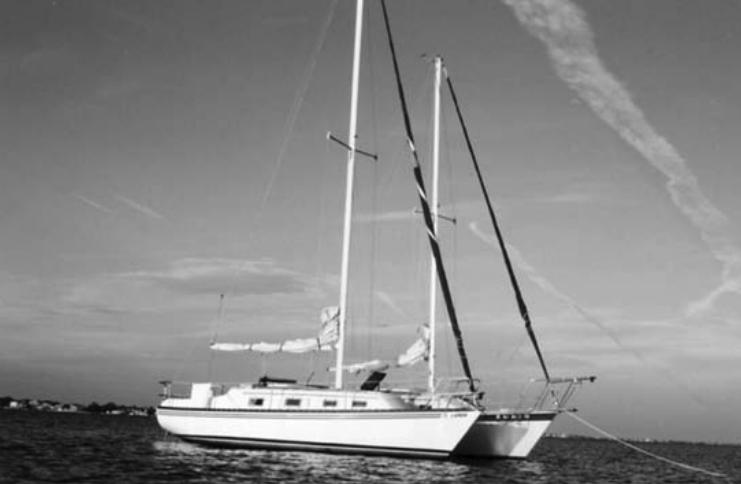
When sailors hear the name Hunter these days, the first thing that comes to mind is radical new designs. Visions of ultra-luxurious cabins, downswept transoms with swim platforms, B&R rigs (an intricate system of shrouds, double diamonds, and aft-swept spreaders devised by Lars Bergstrom and Sven Ridder) and, of course, the renowned arch, are just a few of the things Warren Luhrs and his team of Hunter designers are known for. But as a lover of good old boats who has owned more than one older Hunter, I decided to take a closer look at the Hunters of the 1970s and early 1980s.
It all started in 1973, when newly formed Hunter Yachts, a division of Silverton, led by Warren Luhrs, began building sailboats. Warren came from a family of sailors and boatbuilders, and he was familiar with the territory. Perhaps Warren saw the success of the Pearsons and Frank Butler’s Catalina 22, and felt that the first oil embargo (and the resulting energy-conscious public) signaled a growing market for a small, affordable family cruiser.
Warren turned to Robert Seidelmann to design his first boat. Robert and his friend, John Cherubini, were known as “river rats” because they spent much of their leisure time racing sailboats on the Delaware River near Philadelphia. These two middle-aged sailing buddies teamed up to design the boat that was to become the beginning of the Hunter success story. The result of this first project was a 25-foot sloop that, besides meeting Warren’s objective, turned out to be an excellent performer, winning most of the official races during its first year.
After seeing the success of this project, Robert Seidelmann started a company of his own in the mid-1970s and built several coastal cruisers, from 25 feet to 37 feet in length. When you study these boats, you can see some similarities to the early Hunters. But Robert Seidelmann’s boats are another story.
John Cherubini, a former World War II bomber pilot and aeronautical engineer for Boeing, became the designer for Hunter Marine for the next nine years. John came from a long line of sailors, artists, and musicians. Together with his engineering knowledge, he applied his artistic talents and became known as a great marine architect with a genius for blending function and form. John also designed two boats for the family business in New Jersey, which was called the Cherubini Boat Company at the time and is now known as Independence Cherubini. These two ketches, first a 44-footer and later a 48, were John and his brother Frit’s attempt to build the perfect yacht. I recently had the opportunity to inspect one of these newly completed boats and was stunned by the beauty of this magnificent example of a Cherubini-designed boat (see Good Old Boat, May 2000, for more on these boats). In addition to the beautiful classic lines, the excellent craftsmanship and finish work must be seen to be appreciated. The Cherubini family is still building John’s designs as well as Independence Trawlers.
Brand loyal
As an “aside,” in the midst of writing this article, we sold our 1980 Hunter 27. We had discovered her while searching for another Catalina. Like many sailors, I was rather “brand loyal” back then and only had eyes for Catalinas. My wife, Cheryl, on the other hand had no such blinders and knew when she saw something she liked. Our Hunter 27 was a wonderful boat for us, and we will remember her and the cruising we did with her fondly.
With the sale of the 27 we decided to give the sailing thing a rest and try powerboating. After six months with a 23-foot, 260-hp cuddy cabin, we said, “Enough of that, let’s go back to sailing!”
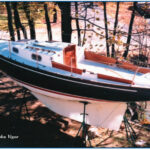
While spending a lazy weekend at our favorite marina in Ocean Gate, New Jersey (Ocean Gate Yacht Basin), I found myself wandering around looking at all the sailboats. I came upon an interesting looking boat on stands. It appeared to be an old Hunter 33, but it was unlike any I had seen before. It turned out to be a 1977 model, one of the early versions I was not familiar with. The registration sticker had been expired for three years (indicating the owner had not sailed the boat for some time), so I contacted the owner and inquired about whether the boat was for sale. It was not, but he agreed to consider an offer if I was so inclined. I was, and two weeks later we were sailors again, this time the proud owners of a Hunter 33. In need of some tender loving care after several years of neglect, this boat is a work in progress. In the first season that we owned her, we found her to be a treat to sail (much faster than I expected) and quite comfy as our new weekend retreat.
In looking back at the evolution of Hunter sailboats, it appears that some time after the 1975 model year, John Cherubini redesigned the 25 with many cruiser-friendly upgrades, and the resulting boat looked more like the rest of the Cherubini Hunters. Following the success of the 25, the next boat from Hunter Marine was the Hunter 30.
Attempting to duplicate the success of the 25, the criterion again was to design a boat that would be fast, but also have a comfortable, spacious cabin and, as always, be affordable. Like the 25, the 30 was also quite successful, despite fierce competition from the Catalina 30. I believe it was the only Cherubini offered with a centerboard. Incidentally, the original 30’s interior was designed by John’s son, John Cherubini II.
A “masterpiece”
The 30 was immediately followed by the 27, which was originally offered with a tiller and later with a wheel, a T-shaped cockpit, a teak-and-holly cabin sole, and opening ports. In 1977, the 33 was introduced, looking a little like the original “Seidelmann” 25 with a sleek, tapered forward cabintop. Hunter Marine called this boat a “masterpiece from the drawing board of John Cherubini.”
In 1979, the 33 joined the rest of the fleet with the typical raised cabintop and 10 opening portlights, but the hull and interior design remained the same. The 33 was followed in 1978 by the 37-foot cutter, the boat I consider to be the queen of the fleet.
Although John designed much of the Hunter 54 hull, the 36 was considered the last of the Cherubini Hunters and was introduced in 1980. The 36 was a little unusual in that there was no quarterberth. Not many seem to have been sold. Perhaps this was the reason.
Regarding the 54, the original was a very light, custom-built racer that John designed for Warren Luhrs to race. It turned out to be another masterpiece and was displayed at the Hunter exhibit at Annapolis in 1977. It had a structural tube frame inside, like a drag-racing car. People came aboard and saw all the tubes and said, “Oh, this must be for racing,” since it didn’t have a yachtlike interior. There was no engine, no toilet, no deck hatches, and no through-hulls (the sink pumped up into the tiny cockpit). A tiller at the end of the midships cockpit was connected by a cable to the outboard rudder about 14 feet behind the cockpit. The original did not have a sugar scoop transom. I am told there were only four winches. When people asked what all the tubing was for John told them, “To hold the boat together.” Then they’d ask what the fiberglass was for and he’d say with a wink, “To keep the water out.” The boat design was later radically altered by the Hunter design team to make a production model, which is why purists don’t consider it a true Cherubini.
Some may credit Hunter’s early success with high-volume manufacturing techniques, along with standardizing the design and allowing for few options. Hunter’s idea was to fully equip its boats and take advantage of high sales volumes to sell loaded boats at bargain prices. Other comparable boat manufacturers were offering bare boats and charging relatively high prices for optional (but essential) equipment such as sails, bow pulpits, lifelines, and so on. The only option Hunter offered was a choice in keel configuration — deep or shoal.
Cruising emphasis
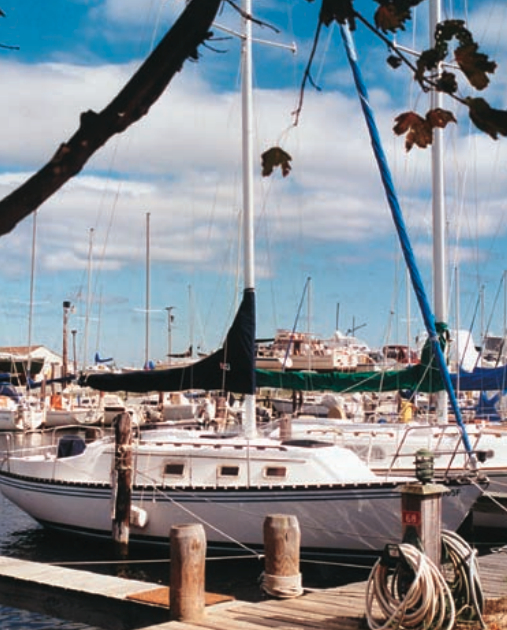
When comparing the Cherubini Hunters to other similar vintage production boats, you’ll notice an emphasis on cruiser/big boat attributes. Features such as spacious cabins (at the expense of somewhat smaller cockpits), diesel auxiliaries, wheel steering, enclosed heads, teak-and-holly soles, opening screened portlights, and solid wooden doors (no cheap plastic curtains) were standard equipment on most of the Cherubini Hunters, not to mention things that should be standard, like lifelines and sails.
Some of the common flaws in these boats can be found by reading through the extensive list of owner reviews that is located on the Unofficial Hunter Owners’ Web site (also known as HOW). Typical complaints include poor-quality portlights, underpowered auxiliaries, and excessive weather helm. Occasionally, the quality of workmanship on the interior woodwork (joinery) and finish on the hidden glasswork (tabbing) comes under fire.
I have found the Gray portlights to be as good as one can expect from plastic (which is not very good). The rubber O-ring seals will leak with age if not replaced, and the plastic lenses can take only so much ultraviolet before they become brittle. With a little maintenance, they will do the job and I, for one, will certainly be willing to do a little maintenance in return for having portlights that will open.
The auxiliary in my boat happened to be the little bulletproof 8-hp Renault diesel. I found, like most owners, this little engine keeps going and going . . . or should I say chugging and chugging. (It reminds me of the African Queen!) This engine has no thermostat and no oil pump; it is simplicity itself. The addition of an aftermarket three-bladed propeller made the performance of my little engine acceptable. Perhaps this would be a solution for others who believe their auxiliary to be a little anemic. Most of the other Cherubini Hunters came with one of the venerable Yanmars that are still one of the most popular diesels used in production boats today. Many of the reviews indicate that insufficient power with these engines can also be remedied by changing to a different propeller.
Friendly weather helm
Weather helm can be the best friend of a novice sailor. Safety-conscious cruisers will also appreciate a boat’s tendency to round up into the wind when hit with a strong puff, but for those who want to bury the rail on a regular basis and take their boats to the edge, the Cherubini Hunter might not be the best boat. That’s not to say these boats are slow. John Cherubini enjoyed a good race and designed most of his boats to move. Many owners have found that, even when loaded with cruiser goodies and supplies, these boats can be very competitive.
When it comes to workmanship, I have found that there are some folks who can appreciate quality woodwork and will be critical of the joinery (as I was). Others just appreciate the solid wood doors and teak-and-holly soles and don’t seem to mind if some of the joints in their cabin trim don’t line up perfectly. For the perfectionist out there, this is a good place to make improvements if you enjoy working with wood. I also found some of the glasswork that was hidden from view looked a little sloppy and the bonds to be of questionable strength — for example, where bulkheads and floor “joists” are tabbed and bonded to the hull. I have not heard or seen anything to suggest that this has caused a significant structural weakness or problem though, and it is a flaw that is easily remedied.
Even among those who complain the most, when asked if they would buy their Cherubini Hunter again if the hands of time could be turned back, the overwhelming response is, “Yes.” Those who are familiar with the Cherubini Hunters have found them to be very affordable, quick, and strong boats with attractive, classic lines that lean toward the coastal cruiser rather than the racer . . . truly a line of good old boats.
Don designs, builds, and flies giant-scale radio-controlled model airplanes and has a private pilot license. He says flying got expensive, so he bought a Sunfish, then an O’Day 17, then a Catalina 22, then a couple of Cherubini Hunters (a 27 and the current 33). It appears to the dispassionate ones among us that this sailing hobby is going the way of the airplane one, but the individual with the habit is always the last to know.
Thank you to Sailrite Enterprises, Inc., for providing free access to back issues of Good Old Boat through intellectual property rights. Sailrite.com