What happens when metals corrode, first of two parts – stainless steel corrosion details
Issue 19 : Jul/Aug 2001
All boats have metal fasteners and fittings, and usually some kind of metal is used for the really tough jobs on board, such as handling heavy loads while being immersed in salt water. If a metal fitting fails, be it the rudder post, a chainplate, or a seacock, the results are usually serious. For that reason, all boatowners should make it their business to know something about how metals behave in marine environments.
Moisture, salt, and heat
Corrosion is a complicated subject, and it would seem simpler to forget the details and just use a material that has a good reputation for corrosion resistance, such as a marine grade of stainless steel. Tempting as that is, it will set you up for trouble down the road. For example, Type 302 stainless steel, which performs reasonably well as boat rigging, isn’t a good choice for chainplates. Type 316 stainless, which might be acceptable for a chainplate on the Great Lakes, still isn’t a great choice for chainplates in the tropics; boats in the tropics should really use bronze. Getting confused? Avoiding problems isn’t hard if you start at the beginning with an understanding of why and how metals are corroding in the first place.
Imagine a piece of bare steel — say a newly sharpened wood chisel. In the desert you could leave it lying around for weeks and come back to find little or no rust. Bring it aboard a boat, and it’s likely to be rusty in a day or two. Chuck it in a bucket of salt water, and it’ll rust almost before your eyes.
Why the different rates of rusting? Because of changes in the environment: the more moisture and salt present, the faster the rate of corrosion. The rate of corrosion in metals is also dependent on temperature. Cool, dry environments will have the lowest rate of corrosion, while the worst place for corrosion is the tropics, where warm temperatures and high humidity work together to accelerate the process.
Why metals corrode
Most metallic elements are found naturally in the form of an oxide, sulfide, or carbonate. To make the metals we commonly use (such as iron, copper, and steel), these elements are refined, a process that separates the metal and the oxide. Refining metallic elements consumes lots of energy, and the metals that result are in a high-energy state, one that they constantly seek to escape through the process of corrosion. These metals are considered reactive, in that they will readily form reactions with substances in the surrounding environment. Exceptions to this rule are “noble” metals such as gold and platinum, which don’t require refining, and are naturally stable and non-reactive.
Metal corrosion involves a transfer of particles from the metal to the surrounding environment. Metals — and all other substances — are composed of atoms, which have a nucleus surrounded by a number of electrons; the latter are much like planets in orbit around the sun. As long as the electrons stay in their orbit around the nucleus, the metal will be in a stable condition and won’t corrode. Corrosion takes place when metal atoms lose electrons. Electrons don’t simply drop out of orbit, but are wooed by positively charged particles in the surrounding environment (electrons themselves have a negative charge). When these positively charged particles (called positive ions) come calling, they draw electrons away from the metal atoms. That leaves the original atom short of electrons (meaning it is now a positively charged particle). The positive metal ion that’s left behind follows the electron’s lead and jumps ship itself, and corrosion has begun.
Electrochemical corrosion
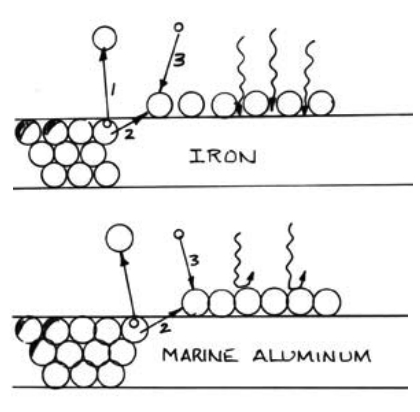
The process that we’re describing is called “electrochemical corrosion,” as it involves both chemical and electrical reactions. Electrochemical corrosion is a fact of life with just about all metals, but they don’t all corrode at the same rate. Those that corrode slowly — such as silicon bronze, marine-grade aluminum, and stainless steel — do so because they protect themselves from the relentless loss of electrons by forming a special coating. The coating is called an oxide film and is a combination of an element within the metal (the positive metal ion described above) and an oxygen ion from either the air or water. Mild steel and iron also produce an oxide coating when they corrode — the brown, scaly stuff we call rust — but the coating for these metals is permeable to oxygen and water and doesn’t stop corrosion. Metals with an effective oxide film still slowly corrode, but the process may take many decades rather than days or months.
In order for electrochemical corrosion to occur, metals must be in the presence of an electrolyte, which is a fluid that enables the transfer of ions between one or more metals and any corrosive agents (such as oxygen, salt, acid, and so on). The most prevalent electrolyte for most marine sailors is sea water, which contains an abundance of dissolved salts and is thus loaded with positive ions looking for an electron. Freshwater sailors are better off, as the electrolyte in which they sail has far fewer positive ions, due to the lack of salts. But corrosion is not limited to those metals that are immersed in the ocean or another water body; all metals are affected to some degree by atmospheric corrosion.
Atmospheric corrosion also relies on an electrolyte, but it is a very thin film, all but invisible, that forms on metallic surfaces once a critical level of relative humidity is reached. What constitutes a critical level varies with the metal and the level of atmospheric pollution. Corrosion is more rapid in the presence of pollution. In the absence of pollution, atmospheric corrosion of iron begins when relative humidity reaches about 60 percent. If there are large amounts of salt or pollutants present, atmospheric corrosion can be both rapid and severe, and it actually accounts for most of the corrosion experienced worldwide.
Oxidation and reduction
The reactions taking place when a metal corrodes are termed “oxidation” and “reduction” reactions. Oxidation is what happens when a metal atom loses an electron and becomes a metal ion. Reduction occurs when a substance gains an electron; if the electron escaping from the metal atom is attracted to a hydrogen atom, then the hydrogen has been reduced. These processes always act in combination; oxidation cannot take place without reduction. The principle of oxidation and reduction underlies all basic corrosion, and controlling corrosion in a single metal (whether in air or water) is primarily a matter of slowing or eliminating these reactions. This can be achieved through protective coatings (such as zinc or paint on steel), by alloying various elements (combining iron and chromium in stainless steel), or by reducing contact with reduction agents (that’s what we do when hosing the salt off of metal fittings after a sail).
Galvanic corrosion
Galvanic corrosion is a special type of electrochemical corrosion that occurs primarily between two different metals. When immersed in sea water, every metal shows a different level of stability, or tendency to lose electrons. This can be measured as an electrical current, which is just a flow of electrons. The galvanic series lists many common metals and alloys in order of their corrosion potential when immersed in sea water.
Generally speaking, the “nobler” a metal is (that is, the closer to the bottom of the table on Page 23), the more slowly it will corrode. But, more importantly from the perspective of galvanic corrosion, metals that are close together in the series will produce less of a reaction than those that are far apart. When galvanic corrosion occurs, the more noble metal is typically protected from corrosion, or at least corrodes at a slower rate than it normally would, while the metal that is less noble corrodes more rapidly.
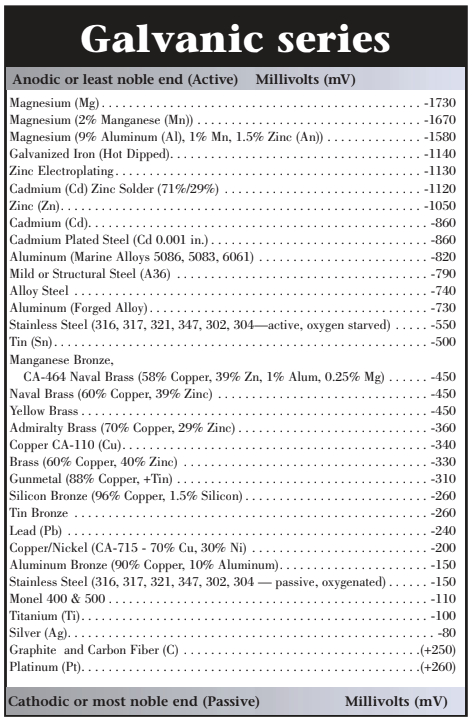
Galvanic corrosion won’t take place unless the two metals are in direct electrical contact (as they would be if they’re bolted together) and are immersed in an electrolyte, such as salt water.
It’s possible to take advantage of galvanic corrosion to protect metals. That’s what we do when we attach zincs to the bottom of the hull or the prop shaft during a haulout. Zinc corrodes more readily than most commonly used metals. Place the zinc in direct contact with the metal you want to protect (by bolting it to the prop shaft, for example), and the process of galvanic corrosion will take care of the rest: the zinc will corrode, but in so doing will protect the prop shaft from corrosion.
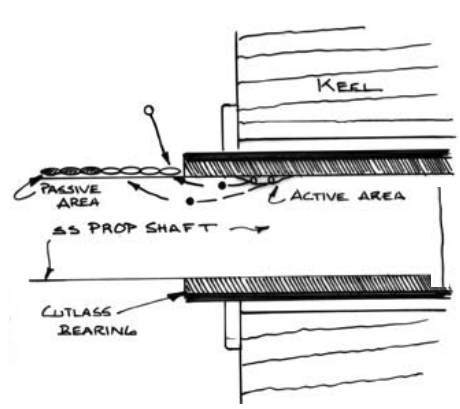
Galvanic corrosion can take place in a single metal if there’s a difference in the corrosion potential in two different places on its surface. Such differences can arise in various ways, including simply from imperfections in the metal itself. This is a common cause of problems with stainless steel. If one area of a fitting is protected by an oxide film it will be “passive” with a low corrosion potential (note that passive stainless is near the bottom of the galvanic series). Another area of the same fitting that lacks an oxide coating will have a much higher corrosion potential (the metal here is “active” and is near the top of the table). Being part of the same fitting, the two areas are linked electrically; when immersed in salt water, the area that’s passive will be protected, but at the expense of rapid corrosion of the active area.
Problems can also arise with some alloys if one of the constituents is attacked, while the other is not. This happens with brass (made from zinc and copper). When used underwater (such as on a rudder fitting, or a fastener), the brass will “de-zincify;” the zinc corrodes out of the fitting, leaving behind the corrosion-resistant (but much weaker) copper.
With these principles in mind, let’s look in detail at how corrosion affects stainless steel, the metal most commonly used on boats these days.
Stainless steel
The term “stainless steel” is applied to many steel alloys, but only a few that contain chromium and nickel in varying amounts are intended or suitable for marine use. The chromium in marine stainless steel reacts with oxygen to form an oxide film that is tough and protects the underlying metal from corrosion. If enough chromium is used (12 percent or more), then corrosion resistance will be quite good.
Problems with stainless steel arise primarily when the oxide film is either worn away or prevented from forming. This exposes the metal to corrosive elements in the environment. Unfortunately for us, the chloride found in salt water is one of the worst around. What kind of corrosion takes place depends on the type of stainless and how it’s used.
Types of stainless steels
In the United States, stainless steel is commonly graded according to an American Iron and Steel Institute (AISI) system whereby each type is given a number. Common marine grades occur within the AISI 300 series. They can be distinguished from non-marine grades because marine grades are not normally magnetic, although fittings made from 304 will often show a slight degree of magnetism. But it’s very hard to tell if a fitting is made with 304 or 316, and the difference is important. (See sidebar on Page 26.)
General corrosion of stainless
Widespread corrosion takes place when there’s an overall breakdown of the passive film that usually forms. This causes the entire surface to have a sponge-like appearance. The rate of attack varies but goes up dramatically as temperature increases. Some sources indicate a doubling in basic corrosion with an 18 ̊F rise in temperature of either the corrosive agent (say salt water) or the metal part. This doesn’t bode well for boats in the tropics and helps explain the high rate of corrosion often experienced with stainless steel exhaust manifolds. In general, though, fittings made from marine grades of stainless steel won’t suffer from rapid general corrosion.
Pitting
Pitting takes place when the oxide film is broken only in a few places, instead of over the entire surface, and is a simple example of galvanic corrosion. Because passive stainless is far more noble than active stainless, the areas without a protective film are attacked (they function as an anode), while the rest of the material is protected (acting as a cathode). The large difference in relative area speeds the corrosion and causes the pits to grow. Pitting is common on poorly finished hardware which may have impurities left on the surface that make for a less-than-perfect protective oxide film. It also takes place under O-rings and seals or where stern bearings contact shafts because these can all act to wear away the protective film.
Tests show that 304 stainless steel is relatively unaffected by pitting corrosion in marine environments if temperatures are about 68 ̊F or below; 316 will be relatively immune up to about 86 ̊F, while 318 shows good resistance up to 150 ̊F. That indicates that those of you living up north may get away with using 304, but tropical sailors should avoid it; even 316 is likely to show some pitting in warm climates.
Weld decay
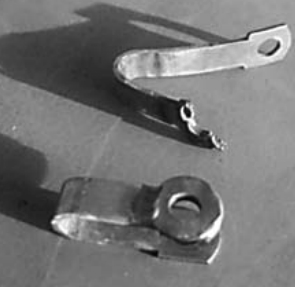
When most marine stainless steels are welded, carbon moves out of the immediate area of the weld while the metal is molten and combines with chrome in the adjoining areas to form chromium carbide. This in turn starves these areas of the chrome they need for corrosion protection. Put the welded part in or near sea water, and the result is galvanic action. The chrome-rich areas are protected, while the chrome-poor areas are attacked. There is normally no sign of trouble (perhaps only a bit of light-brown staining), but weakness develops along the weld, which can lead to sudden failure. The best way to combat weld decay is by using a low-carbon stainless steel (such as 304L or 316L) for any welded fittings.
Crevice corrosion
Crevice corrosion can take place whenever oxygen doesn’t reach the surface of the stainless steel. It is especially common in the presence of salt water, because chlorides are ready and waiting to attack the surface of the stainless steel as soon as the protective layer is disturbed. Once that happens, pits form, and the lack of oxygen prevents the protective layer from reforming. Under the right (or rather the wrong) conditions, crevice corrosion can destroy metal very quickly, and it does so in places that can’t be seen without taking fittings apart or removing fasteners. Examples of where crevice corrosion is likely to occur include wet wood (above and below the waterline), wet fiberglass, and any underwater fittings, such as fastenings for seacocks, struts, and shaft logs.
Crevice corrosion in sea water starts at temperatures around 20 to 30 ̊F below those at which pitting occurs. That rules out the use of 304 under the water in all marine environments and makes 316 an unwise choice except in very cold waters. Type 318 should be free of problems below about 120 ̊F.
Stress corrosion
Stainless steel under tensile stress (any fitting that’s under tension, such as chainplates and rigging tangs) is especially susceptible to pitting and stress cracking. The biggest contributor to stress corrosion is chloride, which is always present in the marine environment.
Passivated and polished
The passive, protective surface layer on stainless steel is never static (or permanent). The layer is affected by the environment and slowly erodes. That’s not a problem if there’s oxygen present, allowing it to re-form. But if there isn’t, one of the various types of corrosion we’ve discussed will likely result. You may hear of companies offering “passivated” stainless, and that would seem a good solution, but unfortunately such coatings are likewise not permanent. Stainless is made passive by immersing it in an acid bath, which removes the oxide film and provides an ideal surface for a new layer to form; this happens as soon as the stainless steel is exposed to oxygen.
Although it was once thought that the acid treatment acted to thicken the subsequent passive film (making the steel more corrosion resistant), it’s now known that it has little long-term effect, and that the film will form at the same thickness when exposed to the environment without being treated. The acid can act to remove small bits of iron and other impurities on the surface of the stainless steel, though, and the metal will certainly look better initially. Another technique that improves the appearance of stainless is polishing. In contrast to passivation, polishing can help reduce the chance of future corrosion, as it eliminates roughness that might otherwise lead to pitting or crevice corrosion.
Preventing problems
Duplex stainless steels, such as 318, appear to be largely free of many of the corrosion problems that plague 304 and, to a lesser degree, 316. They are very expensive, however, and not easily distinguished except by the manufacturer; you’re also unlikely to find any fittings made from duplex stainless, except possibly propeller shafts. As a result, play it safe and stick to the following rules:
- Don’t use stainless steel in any location where it will be constantly in contact with salt water, especially in areas where water is trapped or not moving (and may become oxygen-starved). This means stainless steel shouldn’t be used for underwater fastenings or fittings, exhaust manifolds, and structural items such as frames, floors, and the like.
- Avoid using stainless where it will be in contact with substances such as wood that might be saturated with salt water.
- Don’t use stainless for highly stressed fittings, especially if these are often immersed (a bobstay fitting at the waterline would be a good example).
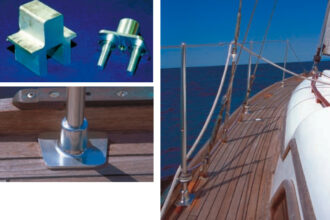
- Places where stainless steel will work are rigging fittings, rails, stanchions, winches, and shackles. Even then, be sure to buy 316, and keep a close eye on the fitting.
- Make sure that any stainless fitting is well polished, as this may help prevent corrosion. There’s no need for a mirror finish, but it should be smooth and even.
Types of stainless steels
Type 302: This grade of stainless steel is also called 18-8, because it’s made with 18 percent chromium and 8 percent nickel. Many fasteners are made from this alloy, but it’s not suitable for most marine use, except perhaps on boats used in fresh water or in a boat’s interior. It is often used for the manufacture of rigging wire.
Type 304: The most common marine grade, and the minimum that should be used in the marine environment, type 304 is suitable for non-critical deck and interior fittings on boats in salt water and for more general use on boats used only in fresh water. It is also commonly used for rigging wire.
Type 316: Containing 2 to 3 percent molybdenum for higher corrosion resistance than 304, type 316 won’t readily develop a rust film and is very resistant to pitting in salt air. The material of choice for any important stainless steel deck and rigging fittings.
Type 304-L and 316-L: Extra-low-carbon versions used for welded fabrications to prevent problems with “weld-decay” that can lead to sudden and catastrophic failure in welded fittings. Types 304-L and 316-L should be used for any welded parts, even if these are to be used below decks.
Type 318: A duplex stainless steel, 318 has significantly better corrosion resistance and higher strength than 316. It is expensive and often difficult to obtain.
Types 316 and 316-L offer much better resistance to corrosion than 304 and 304-L and should be used in their place whenever possible. But even 316 is not suitable for use as a fastener in any situation where water may be present but oxygen may not be readily available. (See discussion on crevice corrosion). Type 316 is sometimes used for seacocks in aluminum hulls, but they must be well insulated from the hull. Type 316 is also used for propeller shafts, but it must be protected with zinc anodes, and problems with pitting corrosion may still occur; Aquamet or similar alloys may be a better bet.
In Part II, in the September issue, Mark will discuss corrosion in aluminum and copper alloys and review their use in various types of boating equipment.
Since 1993, Mark has been sailing Nomad, a 35-foot Cheoy Lee Lion, with Kim des-Rochers. They’re currently in New Zealand. International Marine will be publishing his book, called Tropical Cruising Handbook. Mark studied yacht design and has a Website.
Thank you to Sailrite Enterprises, Inc., for providing free access to back issues of Good Old Boat through intellectual property rights. Sailrite.com