Issue 27: Nov/Dec 2002
The relative merits and demerits of the two main methods of self-steering — electronic and windvane — are often debated. Both have their merits, but we seem to have forgotten the good old practice of lashing the helm.
Fixing the tiller in one position is a technique for keeping the boat near enough on course in areas where it is safe to do so for short periods of time while we go below to do a little chartwork or brew some tea. Provided you keep a proper lookout by popping your head out of the hatch at very frequent intervals, this is a useful facility. You may continue to use it, if the boat is still on course, while you sit on deck to eat the sandwich or drink the brew, to rest your tiller arm or keep your hands covered and warm. If the boat is doing all right, you simply let her get on with it.
With most modern or reasonably modern boats, lashing the helm is not a serious alternative to an autopilot or vane gear, but some older, particularly long-keeled, boats have the ability to steer themselves for longer periods. My own boat, which falls somewhere between the two extremes, will steer herself from a close reach to a beat with her helm free and the sails balanced, but for sailing between a close reach and a broad reach she needs to have her helm lashed. It’s a matter of dynamic equilibrium.
The critical elements are that the helm should be capable of being secured or released quickly and easily, and that the positioning should be precise and easily adjusted.
Traditionally, many yachts were fitted with pegboards, timber rails with rows of holes bored in them that were located beneath the tiller. The wooden pegs, which resembled belaying pins, could be set into the appropriate holes, and the tiller was secured between them. This worked after a fashion but usually needed some refinement for purposes of adjustment. One could bet that the peg holes would never be in quite the right place.
Fine adjustment
One method of overcoming this was to fit pegs with a differing diameter in their upper section or cam-shaped pegs that could be rotated in the hole for fine adjustment.
A similar problem occurs when the helm is fixed with a simple lashing or with a line with knots in it passing over the tiller; the facility of fine adjustment is usually wanting. One often sees the system of a cleat, usually a jamb cleat, or another line-pinching device on the tiller with a line crossing the tiller athwartships. This works, but in my experience it has to be set up very painstakingly to avoid excessive slack in the line.
One can forget the traditional methods and resort to a track and slide that can be locked in infinitely variable positions, but I have used a less expensive system successfully for years.
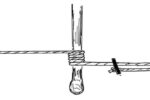
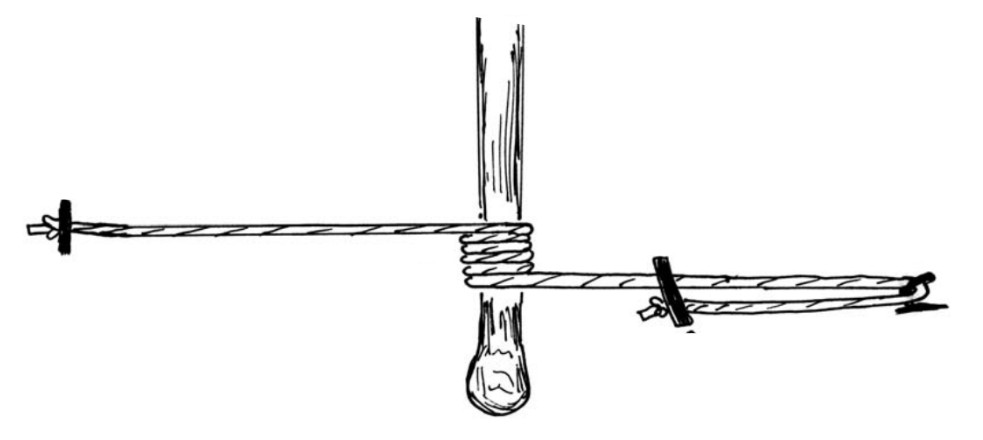
In my system, a single line is permanently attached to the deck, coaming, or other convenient point beside the tiller. To deploy the line, it is brought athwartships over the tiller then wound around the tiller for a few parallel turns before continuing athwartships to a similar point on the opposite side of the tiller, where it is secured to a jamb cleat or run through a hook and secured to itself so that it can be drawn taut. In that case, a tent-guy tensioner or a rolling hitch will do the job of the jamb cleat. A hook is used so the line can be removed. Alternatively, an eye can be used provided the line is long enough when slackened to hang below the tiller.
The system works because the friction of the few turns around the tiller grips it effectively, and very fine adjustments can be achieved by rotating the turns of the line in much the same way as one adjusts the throttle on the twist-grip of an outboard motor. Not only does this permit very precise adjustment but it also allows the initial setting of the helm to be a quick, rough estimate followed by easy fine-tuning.
As soon as the system is no longer required, the line is slackened and all the turns are slid off the end of the tiller. Where a tensioner or rolling hitch is used, it may be convenient to leave the line permanently shipped at both sides, crossing the cockpit below the tiller, so long as it does not interfere with helming and there can be sufficient slack to form the loops around the end of the tiller when deployed.
If properly set up, the whole device can be collapsed in seconds and conventional tiller steering resumed.
Thank you to Sailrite Enterprises, Inc., for providing free access to back issues of Good Old Boat through intellectual property rights. Sailrite.com