Issue 20 : Sept/Oct 2001
One thing for sure about being aboard a boat is that the weather is never the same for very long. There are times when you don’t need hatch doors at all, times when heavy-duty doors don’t seem strong enough, times when it’s warm and balmy but you need screens to keep the bugs out, and times when it’s pouring rain or chilly outside and you want to close up without feeling like you’re in a cave.
After many years of cruising, we have come up with a solution to the hatch-door problem that has proved practical for us. We have created three sets of interchangeable cabin doors to meet all weather conditions.
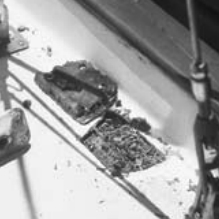
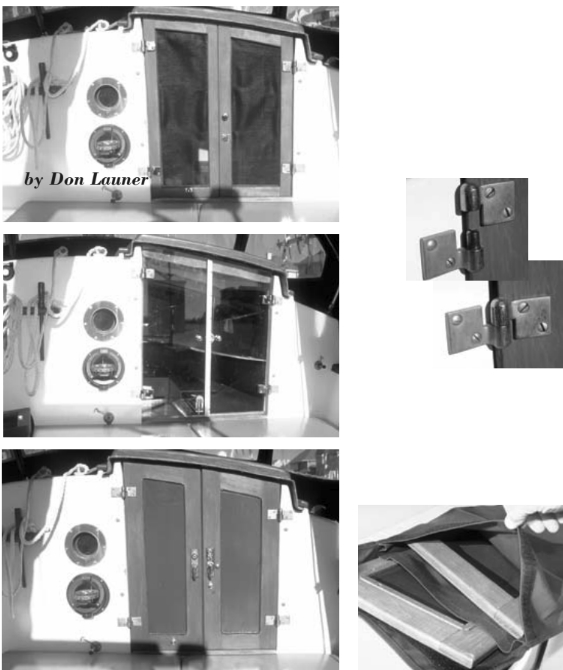
Our hatch doors are on lift-off hinges, and the hinges on all three pairs of doors are compatible, so that in a matter of seconds one pair of doors can be replaced by another. Since there are as many dimensions for drop-on hinges as there are manufacturers, to make the hinges interchangeable, sticking with the same manufacturer is a must.
Our main hatch doors are made of heavy 1 1⁄2-inch teak, with a built-in lock and dead-bolt. These strong doors are the ones we use when we’re out in rough seas and for security when leaving our boat unattended.
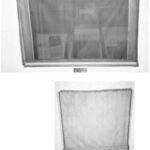
For hot summer days when bugs are annoying, we have a pair of screens with teak frames that we drop in place. Even though all 11 of our bronze ports open and have screens and our forward hatch can open in either direction and has a screen, the added airflow with screened hatch doors makes a big difference. These screens have the added advantages of letting in light and providing a view.
Once, while in a transient slip in Cape May, we had several days of cold, windy rain pelting our cabin from the stern. We used our third pair of hatch doors to keep us dry and cozy inside while allowing for light in the cabin. This third pair of hatch doors is made of 1⁄4-inch clear acrylic. Although they have the drop-on hinges of the other doors, they have no frames. They’re wonderful for keeping out the rain and cold while maintaining the feel of an open hatch. We find they’re also handy on sunny days during the off-seasons when they create a nice greenhouse effect.
Our two sets of unused doors are stored in slip-covers made of Sunbrella. This rugged material protects the doors from scratches and keeps them together. Our two unused sets of doors are usually kept on a quarterberth unless our granddaughters are sailing with us. Then we keep them in the lazarette — the hatch doors, that is, not the granddaughters.
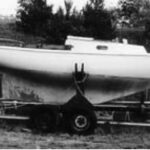
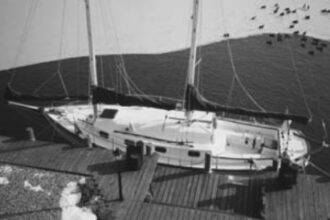
Don Launer is an inveterate do-it-yourselfer. He built his own home from scratch. “I bought 28,000 bricks, a cement mixer, and a book on how to lay bricks,” he says. In 1980 he also built his own Ted Brewer-designed schooner from a bare fiberglass hull, right out of the mold. (Look for a granddaughter photo in an upcoming issue. You’ll understand why the hatch doors are occasionally relegated to the lazarette.)
Thank you to Sailrite Enterprises, Inc., for providing free access to back issues of Good Old Boat through intellectual property rights. Sailrite.com