Professionally restored Corinthian delights her owner
Issue 20 : Sept/Oct 2001
The founders of the Cruising Club of America bridged the gap between cruising and racing with a brilliant design rule. In the process, they created scores of aesthetically simple and comfortable family boats that were also successful competitors, dominating American yacht racing for decades.
As a youngster, I spent summers around traditional boats and learned to value everything about them. By the time I was ready for a boat of my own, designer Carl Alberg was interpreting the CCA rule for my generation. No surprise that my first serious boat was an Alberg. No surprise that my present boat is another Alberg. Those early lessons in aesthetics and simplicity set the focus and scope of a keel-up restoration.
I live on a lake, enjoy smaller boats, treasure simplicity, respect good design, value structural fiberglass, appreciate wood, and respond to the feel of a full keel, and I had already learned to appreciate Alberg’s Corinthian two decades earlier. I knew firsthand what a joy this boat could be. So when faced with the prospect of rescuing a rather forlorn Corinthian, I did not hesitate for long.
In 1964 Carl Alberg completed his design #40, the 19-foot 6-inch by 14-foot 6-inch by 6-foot 6-inch by 2-foot 9- inch Corinthian, which appeared in the design section of Yachting the following year — no small feat for a small boat. Freed from the usual builder’s demands for headroom, the graceful lines of the Corinthian are pure Alberg. His elegant compound curves convey far more than mere form; they convey feeling, spirit, and movement itself. And, in a very special way, they also constitute serious art. With her balanced overhangs, graceful sheer, sleek profile, and full-keeled wineglass hull, the Corinthian is an elegant little sloop. Although she might be considered narrow or heavy by some standards today, her yachtlike handling befits a gentle boat from a gentle era.
A professional job
Professionally restoring a famous old boat raises interest; professionally restoring a small, 30-year-old production boat just raises eyebrows. Small seems to be counter-cultural. An American fixation with ever-larger homes, cars, and boats makes spending serious money on anything small appear suspect. Earlier I, too, had fallen into the trade-up trap, but experience gained during a few misspent years in powerboats taught me one major lesson: as complexity increases, enjoyment decreases.
I returned to sail and to that basic tenet: a simpler boat with good aesthetics is the favored tack to real enjoyment. Sailing dinghies, canoes, and kayaks, which need neither crew nor bowthruster to leave the dock, share the lake with me. They are reminders that small is not just beautiful; small is simply enjoyable.
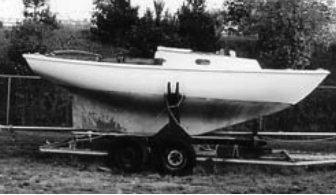
Sailstar of Bristol built my project boat in 1966. On a cold fall day 33 years later, I found her uncovered on a shaky wooden trailer in a Portland, Maine, back yard. The validity of my concept was more than challenged by the gruesome reality: years of neglect, poorly concealed by far too much high-gloss paint.
At first I just felt sympathy. Then I began to see that even her sad condition could not completely hide her good bones, her aristocratic bearing. She deserved restoration. As soon as transportation had been arranged, the tattered little sloop with a bilge full of ice was back in her native Rhode Island. There, the good folks at Bristol Marine would do a serious evaluation. If everything went well, she would be reborn in spring as the Daystar.
Begin again
The evaluation was alarmingly simple: just start over. They say if you assemble a car using new parts, you do end up with a new car, but at 10 times the cost. Now I get it. That said, facing my three-score year and probably my last restoration opportunity, we did just that. The only unaltered piece of the original boat still aboard is her tiller. Everything else was completely reworked or crafted new to match the original.
We began with basics and then ran the gamut. Separating the hull and deck, we replaced the balsa deck coring and re-fiberglassed. We removed and patched the through-hull fittings of the old head and installed a new garboard drain. We built three bulkheads and added foam flotation before refastening the hull and deck with screws and sealant. Since she would carry only main and jib, we discarded winches and genoa track. We gelcoated all visible interior areas, including the bilge. We added a new teak cockpit grating and cabin sole, new mahogany seats, cockpit coaming, companionway doors, all new wiring and fixtures, new portlights, new stainless-steel deck hardware, a new mast-support beam and chainplates, a new mast tabernacle, new rigging, new sails, and new boom tent.
Alberg designed an engine well deep in the cockpit where the motor would not mar the aesthetics. A quiet Nissan four-stroke, with exhaust through the prop, utilizes the well nicely. A rubber flap inside the well prevents backwash from wakes. At the aft end of the cockpit we added a bulkhead to close off an awkward looking open area around the well and installed a cockpit storage drawer. Below, in place of the head, we created a secure spot for an AGM battery, a small electric panel, and another storage drawer. We rebuilt the berths with mahogany trim and navy-blue cushions.
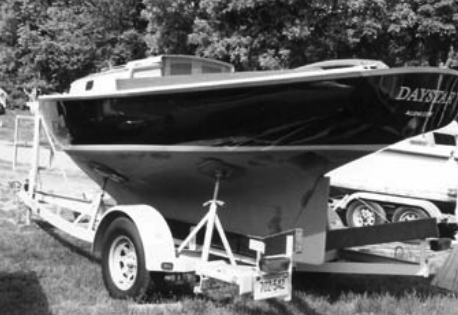
On the deck we added a traditional mahogany eyebrow to the cabin trunk, replaced a vinyl rubrail with mahogany, and used Awlgrip for all paintwork. We replaced the nonskid in the original pattern, coated the deck, cabintrunk, mast, and boom in white, and finished the mahogany in high gloss. We did her topsides in flag blue, lettered her name in gold and white, painted the bottom red, and added a white boot-top. Even in the relatively dim light of the workshed, the effect was awesome.
Cinderella
The center of attention in the bright sunshine of a late May afternoon, Daystar was the prettiest boat in the Bristol yard. People who remembered seeing her when she first arrived were amazed. She was a real-life Cinderella story. “What a shame Carl didn’t live to see this,” was the heartfelt comment from someone who had known the designer. I recalled a moment years ago when I was walking past my first Corinthian, Ragtime. At least 10 years old by then, she could still provide that powerful rush of owner pride. Ragtime did then; Daystar does now. To achieve that rush of pride, the restoration must be as good as the initial design. Bristol president and naval architect, Andy Tyska knows that. His team worked as skillfully on little Daystar as on any of the million-dollar yachts only inches away.
Daystar exceeded expectations in her first Connecticut season. She mastered the fluky summer breezes on Candlewood Lake, tacking smartly in 2-knot zephyrs. She proved her mettle in the steep chop of approaching storms where, with spray flying well aft, she was as solid as a 40-footer.
In the generous winds of autumn, she became an absolute demon. Long rail-down tacks under hillsides of blazing color were spectacular. In the crisp fall air, her welcoming wooden cockpit became the center of a warm and wonderful world. Even stretched until Thanksgiving, the season seemed too short.
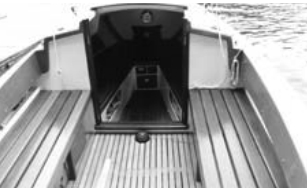
Daystar saw some minor changes in the off-season. We recut her traditional boom tent to create a more functional and attractive cockpit cover. We added a matching mainsail cover and a furler. Comfortably settled into her second Connecticut season at age 35, Alberg’s lovingly restored little gem is a quintessential CCA pocket yacht. The way I see it, the restoration saved an old boat from the chainsaw, while creating one of the finest small sloops in the country.
Inevitably at the end of a project of this magnitude, the final task is to answer those pointed questions. Was the restoration worth the considerable expense? Absolutely. Could I ever recover the cost? Probably not. Is that important? Not at all. Every time I see her at my dock, or charge down the lake on a reach, or motor quietly around a cove at dusk, I know deep inside that little Daystar will always be quite simply . . . beyond price.
Frank has been sailing since his school days, competitively in college but just for pleasure now. After years on Long Island Sound, he now sails Candlewood Lake in Connecticut.
Thank you to Sailrite Enterprises, Inc., for providing free access to back issues of Good Old Boat through intellectual property rights. Sailrite.com