Issue 22 : Jan/Feb 2002
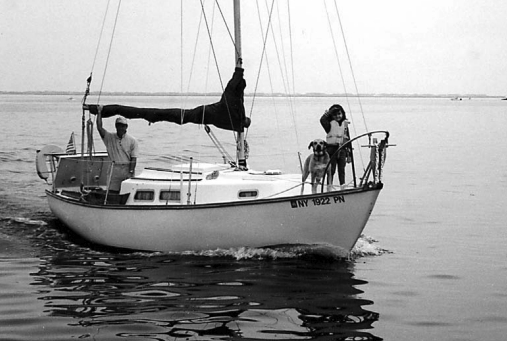
I reluctantly accepted the fact that I couldn’t keep her. It was like my first sports car, which I had vowed to keep forever in a barn until I was old, retired, and ready to play again. There was no barn for the boat, just as there was no barn for the car. And even if there had been, boats are meant to sail. Keeping her dry would be like keeping my dog chained to a tree. In the rain. No, I told myself, it wouldn’t be right.
I had a “new” boat now, bigger, faster, and — I deluded myself — ready to take me anywhere. The ad was placed in the paper and as an added bonus (very cutting-edge at the time) it appeared on the Web site of the publisher.
Sea Sprite, a Cape Dory 25, had come to be mine at least a decade before I had a right to expect such good fortune. She, a victim of hard times, and I, with little money in the bank but the serendipity to read the paper on a lucky day. I had brought her back to life slowly, and she had repaid me in ways I’m still learning to understand and appreciate. Shared times with my daughter. Mireille at the bow in her little yellow life jacket, proudly holding steady with her hand on the forestay; me at the tiller, proudly looking at her. Time with my dad. Helping me tie the cover fast in preparation for cold winters. And time alone. Time sitting on the rail, sails perfectly set, with the autopilot taking us down the bay, dreaming of nothing but water on the horizon.
When the call came about the advertisement I was surprised. It came from 1,500 miles away, and the paper hadn’t even been published yet. The gentleman told me that he was calling on behalf of his parents who were keeping warm in Florida but wanted to get back into sailing. His father noticed the ad on the Internet. We exchanged details about the boat and agreed to meet later in the week.
I overcame the considerable reservations I had about actually selling my boat when he told me about his parents. They were both well into their eighties. They had owned sailboats most of their lives and had lived on a few, their travels covering thousands of miles. They had sold their last boat years ago, having listened to their children and to “reason” about the dangers of old folks on pitching boats in stormy seas. But something beyond reason prevailed. They yearned to sail again and decided to look for a boat on which they could spend their summers back north.
I’m not sure their son agreed with their logic, but after describing my boat to his father he came back and offered to pay the asking price. I spent some time on the telephone with his dad and, over the course of the next two months, quite a bit more. I heard him speaking to his wife, the excitement evident in both of them. The boat would be kept near their summer house, a two-day sail from my back yard. Arrangements were made and, after reassuring them yet again that all was ready, we agreed on a date when they would set sail.
I woke up early, made sure that everything was proper, and washed the deck down one last time. It was a picture-perfect day, the early May sun shining brightly and the breeze beginning to fill in from the southwest. I stood on my dock and looked at her again, proud of how she looked and happy for her new life. I felt guilty about my new boat and troubled about having made the decision to buy it.
These thoughts were interrupted by Harold and Ferne, walking up the garden toward me, arms loaded with gear. It was great to meet them face-to-face, though I felt we knew each other pretty well by then. Ferne gave me a copy of a cookbook she had written during their years of cruising the Caribbean. She asked for the name of my new boat and dedicated the book to pleasant voyages aboard.
I thought perhaps we would share some coffee, and they would go back home. But reality and time moved forward. Gear and provisions were stowed in the tiny cabin, and we went over the systems and discussed how things worked. It was time for me to leave for work so my offer of a short sail together was made in spirit only. Harold and Ferne assured me that they were fine and anxious to get on their way; there were miles to be covered. We said our good-byes for the fifth time, and I cast the lines onto “their” deck.
I should have turned and gone to work, but I couldn’t leave the dock. I watched the boat make its way out into the bay, its mainsail slowly drawing wind. The genoa unfurled and began luffing in the gentle breeze. It was the first time I actually saw her sail. From land. From someplace other than on board. She was beautiful. Harold turned her east, the little ship getting small and smaller as it became late and later for me to get to work.
I realized that it wasn’t simply nostalgia that kept my feet planted on the dock. Her jib was still luffing. She was on a beam reach, mainsail pulling nicely, her jib sheets slack. She would be around the point soon. I wanted to see her one last time, in her glory, like a picture on a postcard. As I turned around to head for the house, I saw her jib fill with wind, her mast taking her rail closer to the water. A final thank you and a final good-bye.
An emergency physician professionally, Kai grew up racing dinghies and Hobie Cats in New York. He holds a USCG 50-ton masters license. He and wife, Mary Ryan, cruise Long Island and southern New England on Étoile Filante, a Tartan 34, with Mireille, now 11, (pictured at left on the bow in the life jacket just as Kai remembers her) and Kyle, 5. The Tartan has been to Bermuda with previous owners. Kai wants to take her back.
Thank you to Sailrite Enterprises, Inc., for providing free access to back issues of Good Old Boat through intellectual property rights. Sailrite.com