These relics of nautical history still have practical modern uses
Issue 22 : Jan/Feb 2002
As sailors, sometimes our most basic feelings come to the surface when we go aboard an old boat. Whether it be a small craft or a tall ship, there is a strange wonder, nostalgia, and enchantment as we walk the deck and gaze in awe at the archaic rigging that rises above us.
Although much of the ancient mariner’s art has been nearly lost in today’s world of Tupperware boats, there are some things that have not changed. With the exception of a few self-supporting carbon-fiber masts and some masts found on very small boats, nearly all sailboat masts are supported by “standing rigging.” This standing rigging, in turn, is attached to the hull of the boat or ship through the use of tension adjusters — the essential links that enable the sailor to adjust the complex rig.
Nearly all tension adjusters on modern boats are turnbuckles or, as the British call them, rigging screws. But these turnbuckles are actually a fairly modern development whose use began in the 1860s. Before that time, sailboats had, for more than 2,000 years, employed a much different method for adjusting tension on the shrouds. That device was the deadeye.
Disk-like pieces of hardwood with three (sometimes four) holes in each, deadeyes were the predecessors of today’s turnbuckles. They are seldom found on today’s recreational small craft, although a few exist on old boats and character boats whose owners like to preserve tradition . . . a handful of sailing purists, such as Chris and Laurie Bauer, profiled in the September 2001 issue of Good Old Boat.
Standard equipment
Today, however, about the only time we see deadeyes is when visiting tall ships. Surprisingly though, deadeyes are still being used as standard equipment in those parts of the world, such as in the West Indies, parts of South America, and Portugal, where working sail survives commercially.
Before Columbus discovered the New World, deadeyes were made from oak, elm, or locust. Bronze and iron were also used on rare occasions. But in the tropical Americas explorers found an evergreen tree whose wood was even more ideal for making deadeyes. Its wood was hard and durable, could take great compression forces, and was highly resistant to splitting. This tree’s sap was also considered to have extra-ordinary medicinal powers. The tree was given the Latin name for “wood of life,” lignum vitae. Lignum vitae is the heaviest and hardest of all woods, so hard and heavy that it doesn’t float. It became the wood of choice for constructing deadeyes. The resin of this wood also provided wonderful lubrication, which was a great help in preventing abrasion of the tensioning ropes.
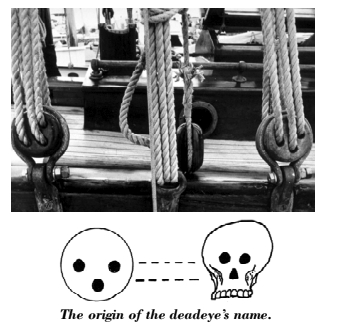
Deadeyes are actually very similar to multiple-part block and tackles, however deadeyes have no sheaves and, once adjusted, the resultant friction of the sheaveless deadeye becomes an asset. As with a block and tackle, there is an upper and lower deadeye for each shroud. The upper deadeyes have a groove around their circumference for the steel cable or rope shroud. On the lower deadeyes this groove is for the strap or cable that fastens the lower deadeye to the hull or chainplate. Although some deadeyes are pear-shaped, most are round, which makes it easier to create the outside shroud and chainplate grooves on a lathe (which in olden times was turned by hand).
Primary tools
Making a deadeye was a fairly simple process, even with the archaic tools of the time. The saw, adz, and auger were the primary tools. The required diameter and thickness of the deadeye was the first consideration. For the old square-riggers, deadeyes were about 8 inches in diameter and about 5 inches thick, but for recreational boats in the 30- to 35-foot range, a 2-inch thick, 3- inch diameter deadeye is about right. Deadeyes for boats of 35 to 40 feet are just slightly larger: 3 1⁄2 inches in diameter and 2 1⁄4 inches thick.
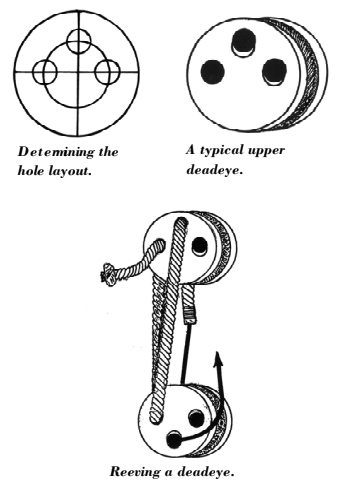
The process begins by selecting a plank of the desired thickness. Then two concentric circles are drawn. The outside circle is the diameter of the deadeye, and the inside concentric circle is half the diameter of the deadeye. A bisecting line is then drawn across the deadeye, with another bisecting line perpendicular to it (see sketch above). The three holes for the tensioning rope, or lanyard, are drilled at three intersections of the inside circle and these bisecting lines. All except one of these rope holes will have slight chamfers on both sides to eliminate the sharp edges that could abrade the rope, which, for centuries, was made of hemp. One hole, in the top deadeye, does not have a chamfer on one side. That hole is for the knot at the bitter end of the rope lanyard, where a chamfer might urge the knot to slip through.
Once the deadeyes have been constructed, filed, and sanded, the rigging begins. The bottom deadeye is fastened to the chain-plate with a strap, cable, or rope. The operation of securing the top deadeye to the shroud is known as “turning in.” The cable or rope shroud is turned around the outside groove in the upper deadeye and seized.
Threading lanyard
The next operation is “reeving.” This involves threading the lanyard through the holes in the deadeye, much as you would rig a block and tackle. A stopper knot is placed at one end of the rope lanyard, and the lanyard is threaded through the upper deadeye hole that has no chamfer. Tallow or wax is rubbed into the deadeye holes to facilitate the final tensioning, and the rope is threaded through the remaining holes.
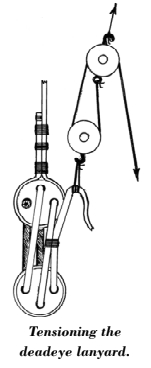
Now the lanyard can be tensioned “full due,” with the aid of a suitable tackle fastened to the shroud being tensioned or to another fixed point aloft (see sketch at left). When the shroud has been tensioned to the desired point, the lanyard is temporarily seized to hold it in place, and the block and tackle are removed. The free end of the lanyard is then fastened to the shroud with a cow-hitch or lanyard hitch, then run down and seized to the last reeved lanyard below the top deadeye.
Old-time deadeyes, which used natural fiber ropes such as hemp, had to be maintained about once a year, usually by coating them with black tar, but even with this preventive maintenance the lanyards seldom lasted more than seven or eight years. With today’s synthetic fiber lines, the black tar program is no longer necessary, and the lanyards last much longer.
You’re not interested in replacing your stainless steel turnbuckles with deadeyes? Even if you just want to make an interesting room-divider or a pair of bookends, the construction of a deadeye brings a reminder of the mariner’s art and boats of yesteryear. With today’s power tools, an authentic deadeye can be turned out in a surprisingly short time. Making a deadeye is a satisfying winter project that can bring us in touch with those skills of our ancestors — those skills that enabled them to cross oceans and circumnavigate the world in ships whose survival was dependent on such simple equipment as the deadeye.
Don Launer has held a USCG captain’s license for more than 20 years. He built his two-masted schooner, Delphinus, from a bare hull and sails it on the East Coast from his home on Barnegat Bay in New Jersey. He’s a frequent contributor to boating magazines, has had a regular boating column in a New Jersey newspaper, was field editor for Waterway Guide, and is the author of the book, A Cruising Guide to New Jersey Waters.
Thank you to Sailrite Enterprises, Inc., for providing free access to back issues of Good Old Boat through intellectual property rights. Sailrite.com