TV series helps builders, gets people on the water
Issue 22 : Jan/Feb 2002
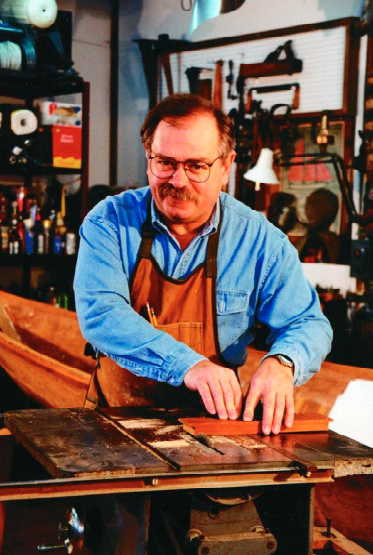
David Dean likes messing about in boats. He likes working with wood, building boats in particular, about as much as he likes being on the water in them. Almost as soon as we meet, he says, “Boating should be an inclusive sort of thing. Yachting seems exclusive.” Since 1996, Dave has been on a quest to bring boating to the people through the power of television.
His cable television show, The Boat Shop, is all about messing about in boats. Tune in, and it will be just you and Dave working together on a boat project while he shares some of his boatbuilding secrets and a bit of commonsense philosophy. “Seek results, not perfection,” he tells you. “Remember this is a workboat, not a piano.” He shrugs off a small imperfection in the project and advises you to do the same with your own boat. His warmth is genuine. His woodworking skill is obvious. And his goal is simple, “It’s not important how you get out on the water, just that you do,” he advises.
The letters Dave receives from viewers often tell him, “I’m an older guy. I’ve had a set of plans for years. But I never realized, until I watched your show, how easy it is to build a boat.” Setting free this creative force in others is one of Dave’s greatest joys.
Dave wasn’t born with a vision of some day producing and starring in his own series of television shows. First a series of happy (and some painfully unhappy) coincidences led him to a point of increased introspection while sharpening his perspective of what he could accomplish with the skills he had.
Learning skills
At 53, he looks back fondly at boatyard jobs where he spent time learning skills from “the old guys.” In fact, he says, “That’s the only place you can find these skills. You pick up a little bit from each person you meet.”
A Michigan boy who grew up in boats at the summer cottage, Dave says he struggled in school but understood geometry without ever opening a book. He was accepted at Harvard but went to Georgetown instead. Mostly he enjoyed his involvement on the freshman sailing team and in summer stock theater. “I should have gone to Julliard instead,” he says ruefully. After he’d played for a year, no one was too surprised when he was kicked out of school.
In the mid-’70s, Dave was married and running a boatyard in Traverse City, Mich., building large Atkins designs. Then he was diagnosed with cancer while still in his 20s. This heavy blow to a young man with his life still unfolding caused him to rethink everything, as he puts it. Families are often brought closer together by a health crisis of major proportions, but just as often they are broken up by the stress. Dave’s young marriage suffered, and a divorce followed.
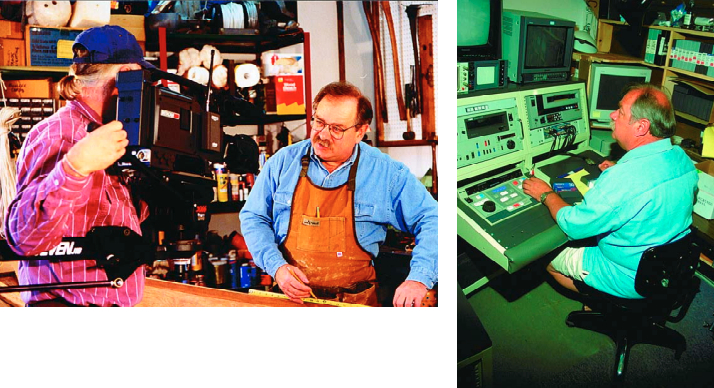
While he was searching for clear answers to nebulous questions, Dave was invited to run a video camera doing investigative work for a lawyer friend. Video technology was still evolving. Dave grew with it. Then another friend asked him to put those skills to use for him. This friend was producing a television series called The Michigan Boater. Dave says his involvement on the show brought more how-to projects to the viewers, and viewership picked up. Mail started flowing in. The project came to an end when funding ran out, but Dave’s eyes had been opened by the experience.
Bought equipment
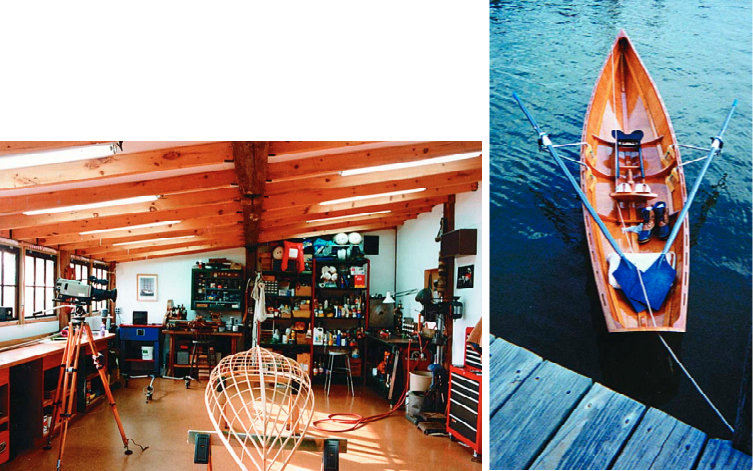
This was his defining moment. “I came up with the money to buy my friend’s video equipment,” he recalls. “I turned my barn into a studio. And I launched my own show in 1996.” Of course, it is easier now to tell it in retrospect than it was to do it the first time around without a road map.
Dave was (and still is) living in an old farmhouse in Suttons Bay, a beautiful small coastal community on Michigan’s pinkie finger (if you visualize the mainland of this state as a left hand). The farm has a real barn full of treasures Dave has collected: old cars and motorcycles, boats, tools, and the usual assortment of rodents (these were not really “collected” as such, rather they are “volunteers”).
The barn and Dave’s lovely old red 1959 Willys Overland pickup truck create the opening scenes of The Boat Shop and take viewers back in time to Dave’s reality: a place where time really has stood still.
And there he is cutting out another small boat surrounded by clamps, spokeshaves, sanding blocks, chisels, and epoxy cans. While shaving a rudder, he looks you in the eye and says, “One thing I’ve learned while working around the boatyard is that you need a clock that runs at half speed. Everything takes twice as long as you thought it would.”
Sage advice delivered one-on-one to you, the viewer. What you are unaware of is the production crew, the extra lights, the shot setups, the editing suite in the next room, and the struggle to find sponsors to fund a program costing upward of $750,000 for 13 segments (a year is broken into quarters, each consisting of a series of 13 segments).
Impossible dream
How many boaters have searched for a way to spend time messing about in boats while simultaneously being gainfully employed? At first glance, Dave Dean has achieved the impossible dream. But a closer look reveals the intricacies of television programming. Dave now knows more than you were ever afraid to ask about Nielsen ratings, networks, uplinks and downlinks, clearances, exchanges, and syndications.
In a nutshell, The Boat Shop was carried by a local Michigan PBS station in 1996. Soon it was also being carried on stations in New Jersey, Miami, New Orleans, and Houston . . . “It was popping up all over,” Dave says. He was able to tell this from the mail he was receiving. Formal Nielsen ratings presented an impossibly high-buck way of getting the same information, he explains.
There had been no promotion, yet The Boat Shop was available for viewing in 30 to 40 million households. “People started seeing it. The buzz started growing,” Dave recalls. Two years later he was “lashed up with American Public Television as a syndicator,” and he had made a big investment in newer camera and editing equipment.
Dave Dean, a small town dreamer and lover of boats, had gone big time. During the 1999- 2000 season, his show reached 70 million households.
While the previous segments he produced are still running in some regions around the country and in Canada, Dave is currently creating a new series of 13 segments and seeking sponsorship for these shows.
Each half-hour show includes a part on building a small boat, a piece about boats on the water (or in museums or at boat shows), and something about tools and techniques (sharpening, dovetailing, scarfing, problem-solving). And each show is sprinkled with Dave’s truisms: “There’s no mystery in boating. It’s as elemental as crossing a stream on a log.” (This from a man who once held a USCG 6-pack license.)
Dave’s there in his shop with you not so much as an expert, but rather as a brother or uncle . . . the guy next door who just happens to have an old red barn, a classic jalopy, and a love of messing about in boats.
He’s in the shop, warm and personable, building projects you can do, too, and encouraging you to take them out and float them . . . sail or paddle them . . . enjoy them. Dave Dean draws you in. The satisfaction of working in wood along with the simple beauty and harmony of a small craft you can make yourself will keep you there. Not bad for a self-described “guy in Suttons Bay with a dream.”
Thank you to Sailrite Enterprises, Inc., for providing free access to back issues of Good Old Boat through intellectual property rights. Sailrite.com