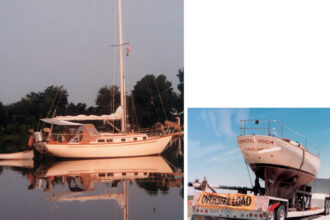
Sam Crocker’s traditionally styled fiberglass 23-footer is still much sought-after
Issue 22 : Jan/Feb 2002
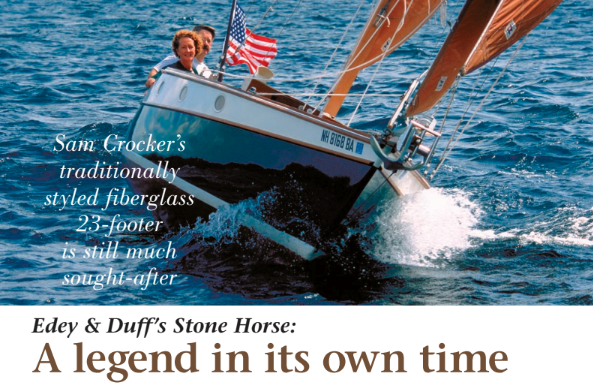
Of the 150 Stone Horses built since 1971, only hull #2 is missing. The builders, Edey & Duff, Ltd., of Mattapoisett, Mass., know where the rest are, says Edey & Duff sales manager, David Davignon.
No wonder. Owners today seem to be just as convinced of the little sloop’s perfection as were Mait Edey and Peter Duff when they formed Edey & Duff in the late 1960s to build a fiberglass version of Sam Crocker’s 1931 design.
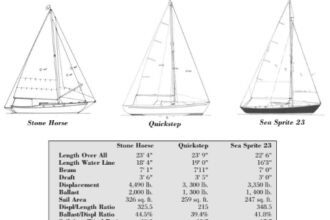
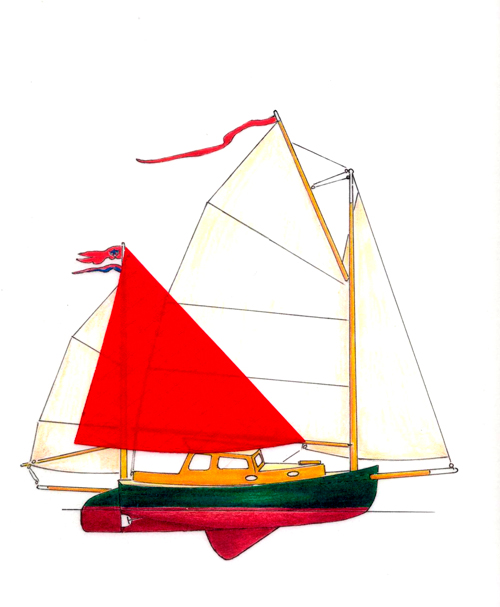
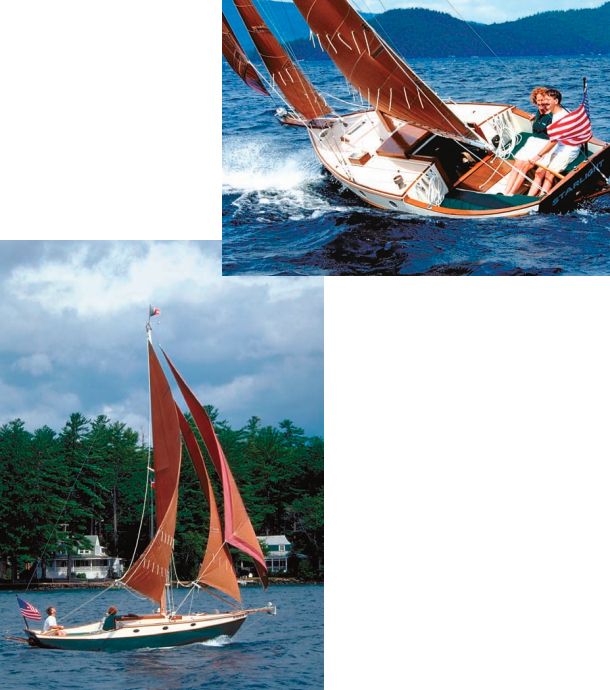
Stone Horse owners appreciate more than the classic beauty of the 23-foot boat’s small-workboat look. The composite hulls seem to be nigh indestructible. The shallow full keel yields steady tracking and full hull support should (heaven forbid) grounding occur. The double headsail and 339-square-foot sailplan with generous mainsail, staysail, and bowsprit-mounted roller-furling jib, with lines led back to the cockpit, make it possible for even a singlehander to sail her in a variety of conditions without sacrificing a pleasing pace.
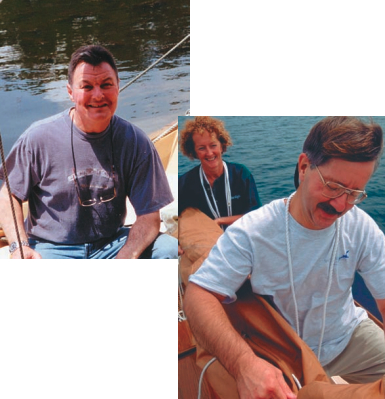
Even hull #1, built in Peter Duff’s living room and herb garden, is still riding gloriously in wind and waves off the Massachusetts coast. The current owner, Bill McBrine, of Malden, Mass., tells of sailing hull #1 to her home port of Winthrop, Mass., from Mattapoisett in 1999 through 12-foot seas in a gale that he believes peaked at 60 knots. The sails were beaten up in the 13-hour ordeal, but the 28-year-old wooden tiller didn’t break . . . until the next week.
Suffered indignity
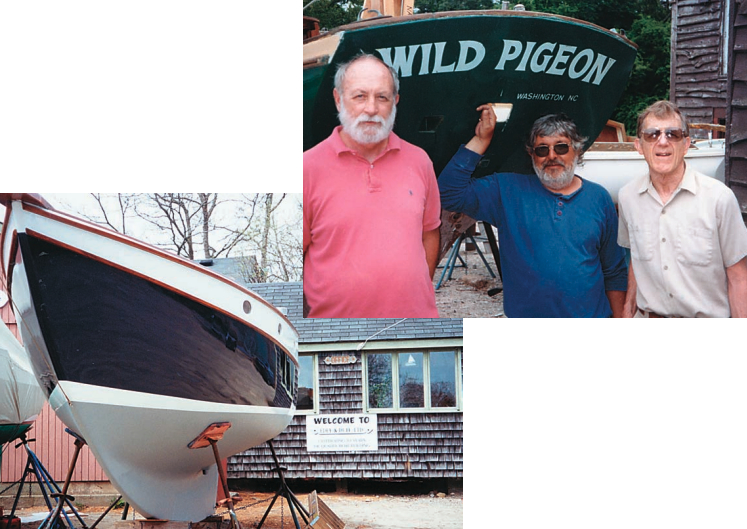
And this after Bill had rescued Naomh Sean (meaning St. Sean) from a watery sleep of 10 years in a North Carolina backwater. It must be said that the only reason Naomh Sean (then Wild Pigeon) had suffered that indignity was that her previous owner had died in the midst of planning to sail the Stone Horse from North Carolina to Wisconsin. Left to a son-in-law who was not a sailor, Wild Pigeon languished at her slip until the son-in-law decided the family should sell the boat.
Although Wild Pigeon had been neglected for so many years, Bill believes the family was anxious to be sure the next owner would take good care of her. He remembers being quizzed about his family and how he planned to use Wild Pigeon — behavior that perplexed him, considering the amount of green slime that had developed over the Stone Horse in its decade of decline.
Bill was not deterred by the green slime. He knew he wanted a Stone Horse. He could tell the hull was sound. He figured a little elbow grease would solve the cosmetic problems. He was spared at least some of the labor of bringing his new boat back to shipshape. When Edey & Duff learned he had found hull #1, they offered to clean and repaint the boat in time for the yard’s 30th anniversary celebration in July of that year. They also replaced the running rigging so when Bill and fellow sailor, Jim McCaffrey, were caught in the 13-hour sleigh ride through Massachusetts Bay on their way home from the Mattapoisett celebration, the Stone Horse was flying on a spotless bottom and with new sheets.
Wasn’t fun
Bill is really proud of Naomh Sean’s excellent performance in that terrible gale, but he recalls, “It wasn’t fun.” He has calculated that the footwell in the working-style cockpit could hold 150 gallons of water. He figures that he and Jim each bailed at least that much when not at the helm.
But Naomh Sean on that day demonstrated to Bill that the Stone Horse fulfilled Edey & Duff’s third essential characteristic for a cruising sailboat: seaworthiness. “Seaworthiness really means just keeping the sea on the outside of your boat,” wrote Edey & Duff in 1970 in their treatise, The Stone Horse: a Superior Small Cruiser, a work initially written by Mait Edey and then enlarged by Peter Duff.
“A lot of factors contribute to making a boat seaworthy,” they wrote. “She must be strong. A weak hull, deck, the place where they join, steering gear, or rig, is inexcusable, but not unusual! . . . She must be buoyant, unless you’re willing to live with a submarine . . . ”
The footwell might have been sloshing during that storm, but Bill and Jim lived to tell the tale. Now with a third crew member, Albert Marley, they happily sail Naomh Sean out of the Pleasant Park Yacht Club in Winthrop, Mass., in all weather — recently cruising the bay on a late October daysail in winds piping to 35 knots. Bill owns the boat, but Jim and Albert have been good friends ever since Bill — who grew up with ice hockey and contact sports — discovered sailing. Bill’s wife, Margaret, also sails with him, but she limits her excursions to fair weather sailing.
Main attractions
For Stone Horse owners Tim and Linda Bates, of Wolfeboro, N.H., the boat’s traditional look, with its sleek raised deck and a sheerline sweeping back to a two-foot freeboard at the nearly eight-foot-long cockpit, is one of its main attractions.
Tim grew up in Marblehead where his father had a boatyard. He says he could row a boat before he could ride a bike. After he left Boston University in 1972 with a B.A. degree in English, Tim headed back to boats and worked at the Graves yard in Marblehead until he realized that as long as he worked on boats he wouldn’t be able to afford one.
He moved on to marine insurance and worked in the field for years before circumstances persuaded him that the law would be his profession. Specializing in municipal law, Tim established a practice that fascinates him and, best of all, leaves some time for sailing. During these career transitions, Tim was satisfying his sailing urge by borrowing his brother’s Marshall Cat Sandpiper.
Linda, a science teacher and school administrator, was new to sailing when she met Tim. She grew up in Medford, Mass., with powerboats and fishing. The water is a comfortable world to her. Sailing was a new discovery. She enjoyed sailing the 16-foot Sandpiper so when the two started looking for their own boat, the 23-foot Stone Horse seemed a logical next step.
“I’m a traditionalist,” Tim says. “I was brought up in a family connected with the ocean and yachting — a conservative environment. I think I understand the aesthetics as well as the mechanics. The notion of an ugly boat is anathema to me. So when Linda and I decided to get a small sailboat, I naturally inclined toward a more traditional design. The boat had to be aesthetically pleasing.”
Seemed right
Tim’s father had known the Crockers through his marine connections so, during family conversations about available boats, the Stone Horse was singled out. The couple watched sailboat ads for a while. When they spotted a Stone Horse that seemed the right age, price, and location, they called Dave Davignon, who brokered the purchase of their Starlight, formerly Peaconnett. For the past two years they have happily sailed Starlight on Lake Winnipesaukee in New Hampshire. They live a five-minute walk from Corinthian Yacht Club where Starlight is moored.
“It’s a beautiful looking boat,” Tim says. “An aesthetically pleasing boat is likely to sail well. With the Stone Horse, that has certainly been our experience. We’ve even been pleased with her performance in light air. The boat has 2,000 pounds of lead in the keel, and you might not think it would sail well in light air but we’ve kept up with bigger boats in light air — to their surprise! And she tacks great. It’s just a beautiful boat!”
Tim and Linda Bates and Bill McBrine echo most of Edey & Duff’s criteria for the essential characteristics of a cruising sailboat, listed in their Stone Horse treatise:
- She must be easy to handle. . . . She should be directionally stable, yet have authoritative rudder control and a small turning circle.
- She must be comfortable . . . A cruising boat should have easy, graceful motion, and be dry . . .
- She must be seaworthy . . . fast . . . beautiful . . .
Still in print
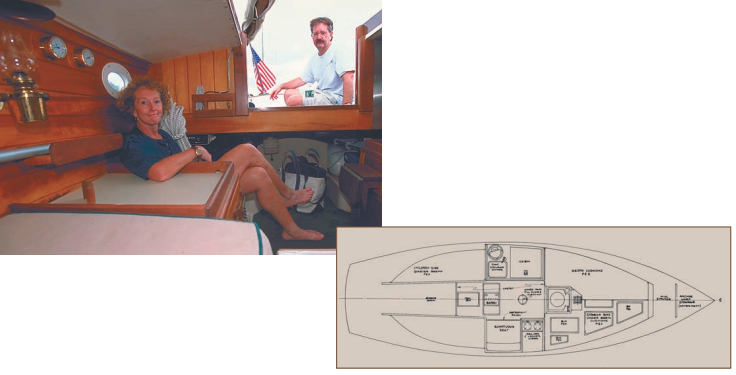
Tim and Linda and Bill are thoroughly familiar with The Stone Horse, a Superior Small Cruiser. Bill says he thinks he’s read it at least a thousand times. There must be thousands of other readers of the work out there in the world. Although only 150 Stone Horses have been built, Dave Davignon says 50,000 copies of the booklet have been sold at $5, and it’s still in print. Although Edey & Duff were addressing the Stone Horse in particular, in lucid prose they address other cruising and boating issues as well. It’s impossible to board a Stone Horse without thinking of their cogent explanation of the rationales behind the boat’s design, construction, and appointments.
Despite the incredible distribution of what is essentially a marketing piece, the Edey & Duff yard hasn’t built a new Stone Horse in four years, Dave says, primarily because the cost of a new one would be so much greater than the purchase price for a used one. In October, Edey & Duff, which is usually the broker for used sales, advertised five Stone Horses, all built in the 1970s, for prices ranging from $14,500 to $19,995.
“They’re pricey but worth it,” Tim Bates says.
As with hull #1, the Bates’ 1984-built Stone Horse needed only cosmetic work when they bought it. Tim and Linda have repainted the boat, choosing to paint the wood spars because the brightwork finish had not been well kept up. They redid the teak with Cetol. They also replaced the running rigging and backstay, but they continue to sail with the original tanbark Harding sails.
Tan next time
Bill replaced the sails on Naomh Sean with white Neil Pryde sails, mostly because he plays hockey with the local Neil Pryde salesman. He’s happy with the sails but is thinking perhaps he’ll go to Hood’s tan Egyptian cloth next time around. He had the sailmaker put the number 1 on his main, he says with a big grin.
Neither owner has replaced the auxiliary inboard, although Bill had some problems with the hoses on Naomh Sean’s BMW 7-hp single-cylinder. He and his crew replaced the hoses and solved the problem.
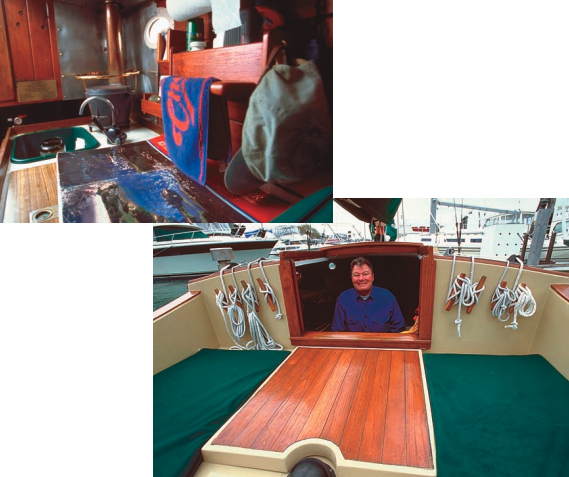
At Pleasant Park, a powerboat club, Bill says his 7-hp engine is a source of great amusement. He’s delighted to lift the cockpit hatch covering, showing the easy open access to the engine that all Stone Horse owners enjoy (see photo on Page 8). The engine also can easily be reached from either of the tiny quarter berths or from the cabin.
“They call it my coffee grinder,” Bill says, as he replaces the cockpit cover and flips the switch so visitors can appreciate the purr of the little engine.
According to Edey & Duff, the model for the first E&D Stone Horse — Mait Edey’s 1938 wooden Stone Horse — had no auxiliary power, but the company decided to offer two engine alternatives with the composite version: a 7-hp, single-cylinder BMW or a 10-hp, two-cylinder Westerbeke. They note that three owners chose to have outboards and like them, but Edey & Duff comment, “We don’t like the blasted things.”
Six owners
Naomh Sean evidently had a Westerbeke originally. Bill doesn’t know when the switch to a BMW occurred. He believes the boat has had as many as six different owners, judging from the file kept on the boat at the Edey & Duff offices.
Most Stone Horse owners use the little cruising boat for short trips or daysailing, but Dave tells stories about Stone Horses cruising to Alaska and Hawaii and up and down the East Coast. And at least one Stone Horse owner is a liveaboard.
Edey & Duff gives an award for the most interesting adventure at its biannual parties in January and July. This year the company has asked Stone Horse owners to write anecdotes about their Stone Horse adventures and send them in, says Bill, who probably has 365 adventures just from the past year. His pleasure in the boat so delights him that he has given Edey & Duff an award for their work on the boat and general all-around help. “They are the best boatyard on the coast,” he says.
Of course there’s no headroom in the boat, but the bunks are comfortable and there is plenty of storage space for one or two people. One of the treasures left to Bill by the former owner, indicating his serious cruising intent, is a set of homemade harnesses and bronze rings at strategic points on the boat to which to tether the harnesses. Bill hasn’t used the harnesses but he has stayed aboard overnight on occasion.
Complex regulations
Tim and Linda overnighted once at the private boathouse of Linda’s family on Alton Bay, but they generally daysail. The overnighting regulations are formidably complex on Lake Winnipesaukee, Tim says. Still, they enjoy their day and evening sails. In the summer they can come home from work, walk down to the yacht club, and sail away for long summer evenings surrounded by gentle New Hampshire hills.
They agree that the sailing on Winnipesaukee is best during the week and in the fall when the popular lake is not inundated with summer and weekend visitors, but even in the summer a sail in their steady Starlight is renewing.
The Stone Horse is equipped for coastal cruising. The head issue is solved with a Porta Potti. The boat has an 11-gallon water tank with hand-operated pump, a non-draining sink, and a non-draining icebox. The little sink can be lifted out. The icebox has a pump to bail out melt or condensation water.
The boats also can be equipped with a little cast-iron cabin heater. The heater that came with hull #1 was gone when Bill acquired his boat, but Dave Davignon found one of the originals for him (see photo at left). Bill has even installed a little rug — the original boats were equipped with a bit of carpet — easy to shake out and much nicer for bare feet, Edey & Duff remark in the Stone Horse treatise.
Molded seats
The two seats in the cabin were molded for the purpose with the backs slightly slanted for true comfort and set so that long legs can stretch out. One seat — called “the Throne” — fits over the Porta Potti. The other — called the “Sumptuous Seat” — is on the starboard side facing the sink.
“It’s really comfortable in the cabin,” Bill remarks, during a lunch break from his job with the Massachusetts Department of Revenue, Bureau of Special Investigations. He reminisces about the crew’s good times and conversations while they relaxed in the cabin and cockpit between bouts with Massachusetts Bay high winds.
“I could sit here all day,” he says, at ease in the Sumptuous Seat. “This boat has brought a lot of happiness to the people I sail with.”
Gail has been a freelance writer and photographer – primarily in the boating field – for 22 years and has been published in most of the major boating magazines. She is the founder of a stock photo company, North Country Photos.
Thank you to Sailrite Enterprises, Inc., for providing free access to back issues of Good Old Boat through intellectual property rights. Sailrite.com