Make them last longer and perform better
Issue 23 : Mar/Apr 2002
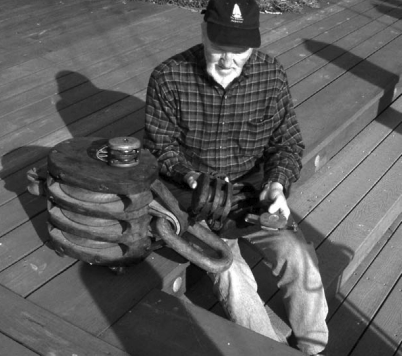
Blocks, or to use the landlubber’s term, pulleys, are as indispensable to the operation of a sailboat as an engine is to a powerboat. They can provide a mechanical advantage or a change in direction of the pull on the fall. Blocks have been used since sailors first hoisted sail, but in the last century the materials used and the internal parts used to reduce friction have seen a major breakthrough into high-tech. Although blocks made of wood were the first to be used and persisted for two millennia, they are seldom seen on today’s recreational sailboats.
Galvanized blocks
In our great-grandparents’ day most recreational sailboats used blocks and deck hardware of galvanized iron or steel. They were a practical, strong, reasonably long-lasting, and inexpensive way to set up the running rigging on a sailboat. Today, however, galvanized fittings are seen only on traditional workboats or as dock hardware. Galvanized blocks use a zinc coating to protect the underlying iron or steel from corrosion. Various processes are used to apply the coating to the iron. Of all these methods, hot-dip galvanizing, where the iron is immersed in molten zinc, is the most effective, providing a zinc coating of about .003 inch. Less preferable is electroplating, which results in a coating about half as thick. Usually the sheaves (pronounced “shivs”) of old blocks were also galvanized and rotated directly on the shaft. Maintenance, in those long-ago times, consisted of an occasional drop of oil.
Bronze blocks
A huge leap forward came when bronze blocks were introduced. Bronze blocks were used on the highest quality yachts from the Civil War to the middle of the 20th century. As late as the 1950s and 1960s, 12-Meter boats competing for the America’s Cup used bronze blocks and hardware. But even in the mid 1900s, bronze blocks usually lacked bearings for their bronze sheaves. Legendary Nathanael Herreshoff made cast-bronze blocks in six sizes and two styles. For decades his were considered to be top-of-the-line. Bronze was universally considered to be the best material you could use, and bronze blocks were used on the finest yachts built for the richest men in the world during this period.
Although bronze was largely replaced by aluminum and stainless steel after the mid-1900s, bronze is now making a strong comeback on production and custom yachts. This is partly due to the introduction of modern materials as bearings. Bronze has the ability to last almost indefinitely in the marine environment and has several advantages over other materials such as stainless steel, which is subject to crevice corrosion and rust, or aluminum, which has galvanic surface-corrosion problems.
Although the shell of bronze blocks lasts indefinitely, the major problem with early bronze blocks was the plain bronze bearings that wore out and were not easily replaced. This problem has now been largely eliminated, and modern bronze-shell blocks make use of roller bearings that reduce the friction to almost zero — and there are some bronze blocks with easily replaceable axles, bearings, and sheaves. Roller bearings for top-of the-line bronze blocks are often made from such modern plastics as Delrin or the better and more expensive plastic, Torlon. Bearings made from these modern materials have proven to be highly reliable over the last 30 years and can handle loads equaling the strength of the blocks themselves.
The durability of bronze in the marine environment is indisputable. Bronze artifacts that have lain on the bottom of the sea for more than 2,000 years show little deterioration. The major problem for the sailor who would like to purchase bronze hardware today is one of quality. A lot of the marine products now being sold as bronze are really brass with a high zinc and lead content, often cast overseas from scrap metal. This brass alloy is attractive to the manufacturer. It melts at a low temperature and machines like butter. This speeds up the manufacturing process, doesn’t wear down the tools, and improves the profit margin. It’s not a bad product for a pair of candlesticks, but it’s a terrible one for important fittings in the marine environment.
These brass fittings have a low tensile strength, which decreases even more as dezincification begins and the zinc in the alloy turns into acetic zinc oxide. The resultant white powder attacks wood, causing it to rot. (If you’ve every noticed wood-rot around your “bronze” fittings, chances are these fittings aren’t really bronze.)
But if consumers are not metallurgists, how are they to tell? Although you would hope to rely on the big-name manufacturers who distribute “bronze” products, unfortunately many are more profit-oriented than customer-oriented, and their “bronze” is really brass. Consumers could ask whether zinc is used in the manufacturers’ alloy, but chances are they couldn’t get a straight answer — even if the distributor knew.
This is too bad, since real bronze blocks are maintenance-free (with the occasional addition of a drop of oil or Teflon spray). You have to sand and varnish wood-shell blocks, and stainless-steel blocks tend to bleed rust and are subject to corrosion, but a true bronze block can last the life of the owner — or even the owner’s children and grandchildren.
One bronze manufacturer is Roger Winiarski of Bristol Bronze (Good Old Boat, May 2000). “There is no zinc in my alloys. I use silicon bronze for the majority of my castings, and springs are phosphor bronze,” Roger says. Bristol Bronze has blocks with bronze sheaves and free-turning bronze axles. The sheaves and axles on these blocks can be replaced by removing the separately cast cheek pieces — this might have to be done 20 to 40 years after the block is put in service. Through an agreement with Harken, Bristol Bronze can now supply blocks with Harken sheaves that have Torlon roller bearings. Sheaves with Torlon bearings remain free-turning even under heavy loads and are superior to Delrin bearings, which can be chewed up by abrasives, change shape under load, and get brittle when exposed to ultraviolet rays. Bristol Bronze has introduced a bronze alloy that has a greater tensile strength than conventional 304 stainless steel, for those who need it in high-load applications.
Routine maintenance on bronze blocks consists of simply rinsing them out occasionally to flush away abrasives and adding an occasional drop of oil such as 3-in-1. Teflon spray may also be used and has the advantage that there is no oil to stain sails or wood. And Teflon doesn’t attract dust. Aerosol spray cans of Teflon are available with small plastic tubes that can direct the spray directly into the bearings of the block.
As nearly perfect as bronze blocks are, there is one caveat: they shouldn’t be used in direct contact with aluminum, due to their relationships on the galvanic table.
Stainless-steel blocks
For decades stainless-steel blocks have been the blocks of choice for most sailors and are nearly the exclusive block material in most recreational boating stores and catalogs. Most of these blocks are made by stamping out the pattern from stainless-steel sheet metal. Stainless steel has many advantages. It is strong, easily available, and good for direct attachment to aluminum. However, the name “stainless” may be a misnomer. Stainless steel is made from iron, and iron rusts. It is also subject to crevice corrosion; wherever there is a hairline crevice or crack or when the stainless steel is deprived of oxygen, rust will form (the rust we find on our topsides or sails is an example). Crevice corrosion occurs when stainless steel is deprived of the one thing that makes it stainless — oxygen. Stainless steel is also subject to failure when welded. This failure is called weld-decay, carbide-precipitation, or weld-migration, and the insidious condition usually progresses with little indication of a problem, until there is a sudden failure of that part.
Why do some of those stainless-steel fittings we bought 25 years ago still look bright and shiny while the ones we bought last year are showing rust stains? A couple of decades ago, stainless steel was treated with a procedure called passivation. In this process the stainless steel was immersed in an acid bath and the iron on the surface was eliminated, leaving bright and shiny nickel and chrome. In recent years, however, EPA rules on the disposal of these acid baths have made the process too expensive — except for parts being made for NASA or the medical industry.
Most stainless-steel blocks use metal for the high-load components and plastic for the block cheeks. These plastic cheeks serve only to keep the line running smoothly on the sheave. Although some small, low-load stainless-steel blocks have sheaves that rotate directly on the axle, most mid-range and big-boat blocks now use roller bearings made of modern, high-tech materials such as Delrin or Torlon. The one small problem with these miracle plastics is that if heavy loads are left on the blocks for extended periods of time the bearings can temporarily deform slightly. Normally the bearings will return to their proper shape after being rotated, but there may be an initial resistance to rolling. Although big-boat-block bearings are generally resistant to this deformation, as a rule of thumb it’s not advisable to leave strains on any hardware when the boat is not being used.
Most manufacturers of stainless-steel blocks who use Delrin or Torlon roller bearings recommend that no oil products be used to lubricate the bearings, since this can attract dirt and cause abrasion. The suggested lubrication is periodically flushing the bearings with water or detergent and water. Then a dry lubricant, such as a silicone or Teflon spray, or a proprietary product, such as Harken’s “McLube,” may be used.
Often, as stainless-steel blocks age and are exposed to the sun, their black plastic cheeks begin to turn a gray color. This doesn’t affect their strength, and the discoloration may be removed with a fine abrasive. If an abrasive is used on these cheeks for cosmetic purposes, be sure to thoroughly flush out and re-lubricate the bearings after working on the block.
Wooden blocks
Many traditionally-rigged older sailboats and even some newer boats, use wooden blocks (or to be more accurate, wooden-cheek blocks). Although these blocks may appear to be old and out of date, they have several advantages over many of their modern counterparts. Not only are they beautiful and strong, but wooden blocks are designed to be easily disassembled in a matter of minutes for cleaning, lubricating, or part-changing. This can be an advantage over some of the more modern blocks, which can’t be taken apart at all. A properly maintained wooden block can provide many decades of service. From the standpoint of preventive maintenance and ease of operation, these blocks should be serviced at least every few years. After wooden blocks have seen several years of use, bring them home at the end of the season. Then you can “play boat” during the winter months in the warmth of the workshop, garage, or at the kitchen table.
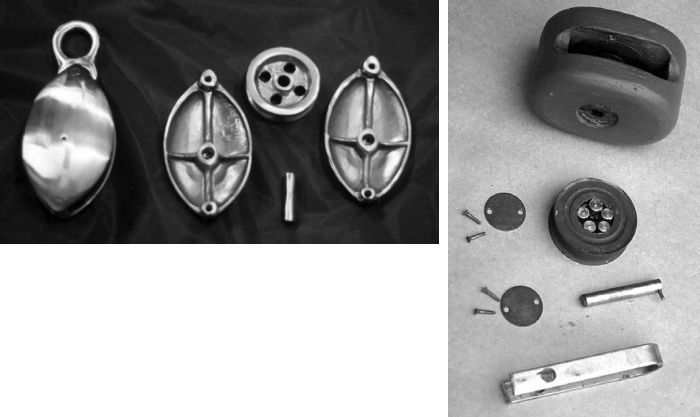
The first step in disassembling a wooden block is removing the two metal side plates that cover the ends of the axle. These side plates are usually made of bronze and are frequently embossed with the name of the manufacturer. Normally each plate is held in place with two screws. Sometimes on inexpensive or older blocks, nails are used. If the cover plate is fastened with nails, discard them at the first overhaul and replace them with screws. This will make your next maintenance job much easier. Once the screws or nails have been removed, most axle covers can be pried off, exposing the ends of the axle. Sometimes the end plates will be recessed into the wood cheek of the block. The easiest way to remove these is to pry them loose with an ice pick inserted into one of the end-plate screw holes. Infrequently, on some wooden blocks you may find axle covers that don’t want to come off. This probably means that the covers are threaded onto the end of the axle shaft and will have to be unscrewed to be removed. Usually these can be unscrewed using a nail or ice pick in one of the screw holes, but for stubborn ones a “key,” similar to a deck-plate key, might have to be fabricated (two nails driven through a small piece of wood usually does the job).
With the side plates removed, you can now push out the axle. The axle is supported by metal straps that run down close to the sheave on the inside the wooden cheeks. These metal straps take all of the load on the block. The wood cheeks simply keep the line from running off the sheave. In olden days, these support straps were made from iron, steel, or bronze, but in most of today’s wooden blocks they are of stainless steel. The axle shaft is not supposed to rotate inside these support straps, since rotation will cause wear on both the axle and the support straps. To ensure that the axle doesn’t rotate, there will sometimes be a key-pin inserted in one end of the axle shaft.
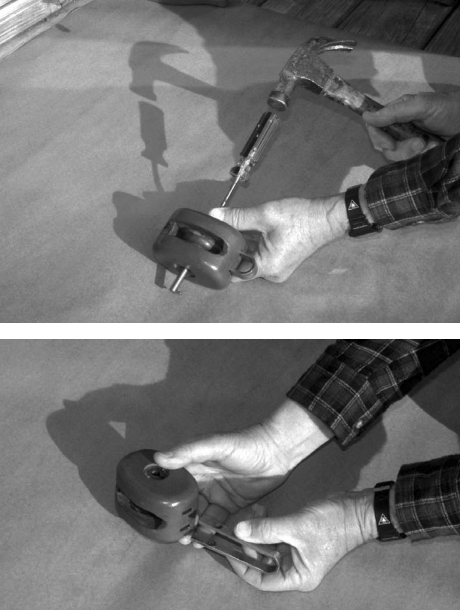
Using a hammer and a screwdriver, tap the axle out. Most axles can be removed from either side, but axles with a key-pin on one end, obviously, can only be driven out from the opposite side. With the axle removed, the sheave is free to be pushed out of the block. Sheaves can be made from various materials: wood, steel, bronze, Delrin and phenolic laminates such as Micarta. Although bronze is probably the longest-lasting and most maintenance-free, Micarta and Delrin are close seconds and offer the advantage of less weight aloft. If the sheave is bronze it will usually have stainless-steel or bronze roller bearings. Micarta sheaves generally rotate on an oil-impregnated “oilite” bushing, and Delrin sheaves frequently rotate directly on the axle or on bronze, Delrin, or Torlon bearings.
Most heavy-duty, top-of-the-line wooden blocks, have roller bearings. Usually roller bearings are locked captive into a race inside the sheave — but not always. When disassembling any block for the first time it’s a good idea to do this inside a dishpan — and not on deck. We’ve all learned that when we drop something while on deck it has the habit of taking that one bounce, then, as if in slow motion, it neatly hops over the side.
Before re-lubricating the parts, clean them of old lubricant by soaking them in gasoline for an hour or two or overnight. This will usually eliminate the old lubricant. If any of the old lubricant remains, try scrubbing them with an old toothbrush.
Once they’re clean, it’s time to re-lubricate the bearings. Most block manufacturers today recommend lubricating blocks with a dry lubricant, such as generic products like a dry Teflon spray. There are also specialty dry lubricants specifically designed for this purpose. If you insist on a petroleum lubricant, manufacturers suggest that just a single drop of 3-in-1 oil is an alternative.
With the end plates, axle, and sheave removed from the wooden shell, you can now slide out the strap that carries the block’s load, leaving only the wood shell of the block. This is the perfect time to sand, varnish, or oil the wood, without the worry of sawdust getting into the workings of the block. When you’re completely finished, the block can be reassembled, good as new.
Older wooden blocks can often be upgraded by replacing the old sheave with a modern one using Torlon roller bearings. Many block manufacturers sell these sheaves separately in a variety of diameters, widths, and axle sizes.
Regardless of the type of block you use, with just a little periodic TLC you can keep your running rigging rolling smoothly and save the expense of re-rigging. It also pays off by making it easier to hoist sail and handle sheets.
Don built his traditionally rigged schooner from a bare fiberglass hull. Its running-rigging includes 21 teak blocks with bronze sheaves, all original, all more than 22 years old, and all working perfectly.
Thank you to Sailrite Enterprises, Inc., for providing free access to back issues of Good Old Boat through intellectual property rights. Sailrite.com